
Rising Inflation and Its Implications for Fixed Income and Equities: Strategic Reallocation in a Shifting Landscape
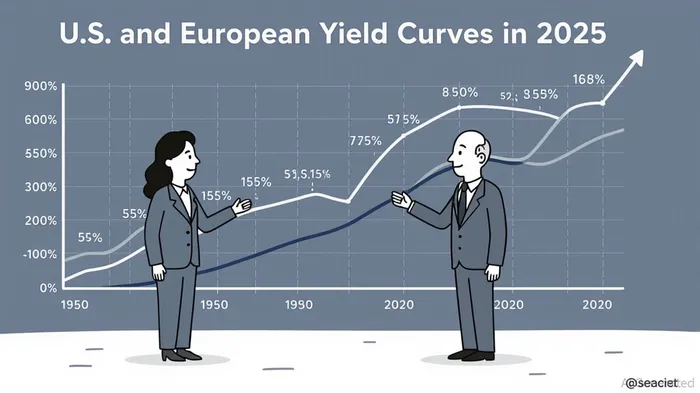
The global inflationary environment in 2025 presents a complex mosaic of opportunities and risks for investors. While U.S. inflation is projected to peak at 3.8% in Q4 2025, driven by tariff-driven supply shocks[3], other regions are experiencing disinflationary pressures, particularly in goods markets. This divergence has profound implications for asset allocation, as central banks adopt contrasting stances: the Federal Reserve remains cautious, while the European Central Bank and Asian counterparts pivot toward aggressive rate cuts[1]. Strategic reallocation must now account for these asymmetries, balancing yield preservation with risk management in a world where traditional 60/40 portfolios have lost their luster[2].
Fixed Income: Navigating Divergent Monetary Policies
For fixed income investors, the 2025 landscape favors intermediate-term bonds, which offer a sweet spot between capital preservation and yield. According to JPMorgan's Global Asset Allocation Views, European and Asian yield curves are expected to steepen as dovish central banks lower short-term rates, creating attractive spreads for longer-duration assets[1]. High-yield bonds, with all-in yields near 7.5%, also stand out, supported by robust corporate balance sheets and a flight to income in a low-growth environment[3].
Diversification within fixed income is critical. Morgan StanleyMS-- recommends a mix of U.S. Treasuries, investment-grade corporates, and alternative sectors like agency mortgage-backed securities and municipals[3]. These alternatives provide liquidity and tax advantages while mitigating duration risk. For instance, agency securities offer a buffer against mortgage rate volatility, while municipals remain insulated from federal tax policy shifts.
Equities: Sector Rotation and Active Management
Equity investors must prioritize sectors with inherent inflation protection. Historical data reveals that materials and energy sectors have historically outperformed during inflationary periods. In Q3 2024, gold surged 13.23% and silver rose 6.92%, capitalizing on dollar weakness and inflation-hedging demand[1]. Energy producers, though volatile, have also benefited from commodity price swings, as seen in the 11% rise of the S&P 500 Energy Index amid broader equity declines[1].
In contrast, the tech sector has lagged. The Nasdaq 100 E-Mini's negative correlation with Core PPI surprises underscores its vulnerability to rate hikes, as high-multiple growth stocks face valuation corrections[2]. Investors are advised to underweight tech and overweight industrials and energy, aligning with BlackRock's emphasis on active management to exploit sectoral dispersion[2].
Active strategies are particularly potent in this environment. T. Rowe Price notes that over 50% of active value managers outperformed the Russell 1000 Value Index over five years, leveraging the broader universe of value stocks to identify undervalued opportunities[3]. Similarly, industrial firms employing dynamic pricing strategies have boosted EBIT margins by 10 percentage points, offsetting inflationary cost pressures[2].
Strategic Reallocation: Balancing Yield and Risk
The 2025 outlook demands a nuanced approach. Fixed income allocations should prioritize intermediate-term bonds and high-yield credits, while equities require sectoral tilts toward materials and energy. Active management, whether through ETFs or long-volatility strategies, enhances diversification and alpha generation[3][3].
However, investors must remain vigilant. The U.S. effective tariff rate of 22.5% in 2025 has amplified trade tensions, creating headwinds for energy-dependent sectors[1]. Diversifying into non-traditional assets—such as digital assets or liquid alternatives—can further mitigate risks in a world where asset correlations have shifted[2].
Conclusion
Rising inflation in 2025 is not a monolithic force but a differentiated challenge. By leveraging regional monetary policy divergences, sectoral strengths, and active management, investors can navigate this landscape with resilience. The key lies in dynamic reallocation, where fixed income provides stability and equities offer growth, all underpinned by a disciplined focus on relative value and risk-adjusted returns.





Comentarios
Aún no hay comentarios