
Rising New Home Listings and Investor Opportunities in a Cooling Housing Market
The U.S. housing market in 2025 is undergoing a profound transformation, marked by rising new home inventory, moderating price growth, and shifting buyer behavior. For investors, this cooling environment presents both challenges and opportunities. By analyzing market dynamics and leveraging alternative strategies, real estate investors can navigate this phase with precision and foresight.
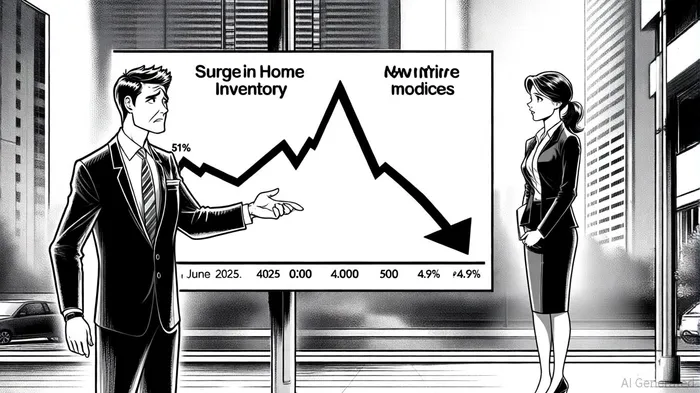
Market Dynamics: A Shift in Power
The cooling housing market is defined by a growing inventory of new homes and a decline in buyer demand, according to Fortune. As of June 2025, new home inventory reached 511,000 units, an 8.5% increase year-over-year, with a months' supply of 9.8-indicating a market where supply now outpaces demand. This shift is driven by high mortgage rates - averaging 6.7% by year-end 2025, according to J.P. Morgan - and economic uncertainty, which have dampened buyer enthusiasm.
Median new home prices have fallen 4.9% from May 2025 to $401,800, a stark contrast to the 20% annual gains seen in 2022, according to Fortune. Builders are responding aggressively, with LennarLEN-- spending 13.3% of final sales prices on incentives like mortgage rate buydowns-a 750% increase from 2022, according to Fortune. These dynamics signal a buyer's market, where negotiation power is shifting and price realism is becoming the norm.
Investment Strategies: Capitalizing on the Cooling Trend
1. Targeting Undervalued Markets
The cooling market has created pockets of opportunity in regions experiencing price corrections. For example, Florida's median home price dipped to $412,000 in June 2025, with inventory stabilizing at a 5.6-month supply, according to PriceGroup Realtors. Investors can capitalize on these areas by acquiring properties at discounted rates, particularly in Sun Belt markets where affordability challenges are driving demand.
2. Leveraging Builder Incentives
With builders offering unprecedented incentives, investors can secure assets at reduced costs. For instance, price cuts and rate buydowns effectively lower entry barriers, enabling investors to acquire high-quality properties at favorable terms. This strategy is particularly effective in markets with high inventory, where competition among sellers is intense, according to Money.
3. Alternative Asset Allocation
The cooling housing market also highlights the appeal of alternative real estate investments. As affordability challenges push more individuals toward renting, multifamily assets in suburban areas-where developers are prioritizing energy-efficient, smaller designs-are gaining traction, per Troop Messenger. Additionally, real estate investment trusts (REITs) focused on commercial or industrial properties may offer diversification and resilience amid housing market volatility.
Regional Opportunities: Divergent Trends and Strategic Entry Points
Regional disparities underscore the importance of localized analysis. In New England, states like Maine and Massachusetts have seen year-over-year price gains of up to 7%, according to Money, driven by strong job markets and limited inventory. Conversely, Sun Belt markets like California and Florida face flat or declining prices, presenting opportunities for value-driven investors. Texas remains a standout, with a median home price of $356,215 and robust transaction volumes fueled by affordability and job growth, according to Money.
The Path Forward: Navigating Uncertainty
While mortgage rates are projected to ease slightly to 6.7% by year-end 2025, per J.P. Morgan, the lock-in effect-where 80% of homeowners are "out-of-the-money" and reluctant to sell-will keep inventory constrained, per J.P. Morgan. Investors should prioritize flexibility, focusing on markets with strong fundamentals and adapting to shifting buyer preferences.
For those with a longer-term horizon, the Federal Reserve's anticipated rate cuts in late 2025 and 2026 could reignite demand, particularly in price-corrected markets, according to Fortune. By aligning strategies with these macroeconomic shifts, investors can position themselves to capitalize on the next phase of the housing cycle.
Conclusion
The cooling U.S. housing market is not a signal to retreat but an invitation to recalibrate. Rising new home listings, competitive pricing, and regional divergences create a landscape ripe for strategic investment. By embracing alternative strategies, targeting undervalued assets, and staying attuned to regional trends, investors can turn today's market challenges into tomorrow's opportunities.





Comentarios
Aún no hay comentarios