
Rising Grocery Retail Sales: A Catalyst for Consumer Discretionary Gains?
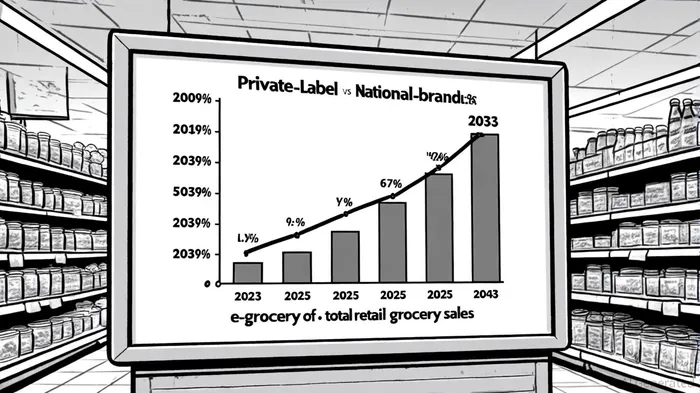
The grocery retail sector in 2025 is undergoing a seismic shift, driven by evolving consumer behavior and technological innovation. With U.S. e-grocery sales surging to $8.7 billion in May 2025—a 27% year-over-year increase—retailers are redefining convenience, affordability, and personalization to meet shifting demands[1]. This transformation raises a critical question for investors: Can rising grocery retail sales catalyze gains in the broader consumer discretionary sector?
Consumer Behavior: Value, Convenience, and the Rise of Private Labels
Persistent inflationary pressures have reshaped how consumers allocate their budgets. According to a report by Clarkston Consulting, 41% of shoppers now stock up during sales, while 35% have switched to private-label products, which now account for 28% of total grocery sales[1]. These products, once stigmatized as inferior, now dominate 80% of Aldi's and 69% of Trader Joe's offerings, with 72% of consumers citing “good value” as a key driver[1]. Analysts project private-label market share could reach 30% by 2033, outpacing national brands that are struggling to retain market share[1].
Simultaneously, e-commerce is accelerating. Delivery order volumes jumped 70% year-over-year in Q3 2025, reflecting a growing preference for speed and convenience[1]. Retailers like BJ's Wholesale ClubBJ-- are leveraging AI-powered robots for inventory tracking, while Schnuck Markets uses generative AI to craft marketing copy[1]. However, challenges persist: 73% of retailers cite budget constraints as a barrier to AI adoption, and 56% of consumers remain wary of sharing personal data with AI systems[1].
Sector Rotation Opportunities: Where to Invest?
The grocery sector's resilience and innovation present compelling opportunities for sector rotation. Three areas stand out:
Private-Label Expansion
Retailers investing in private-label portfolios are outperforming peers. KrogerKR-- and AlbertsonsACI--, for instance, are poised to offer over 35,000 SKUs of private-label products post-merger, capitalizing on consumer demand for affordability[2]. Institutional investors are also taking notice: Grocery-anchored retail centers saw 31% of Q1 2025 retail acquisitions, with vacancy rates at 3.5%—far lower than malls[1].AI and Tech Integration
The grocery industry's $136 billion AI value potential by 2030[1] underscores the importance of investing in firms adopting AI for inventory management, personalized marketing, and in-store operations. However, success hinges on balancing innovation with consumer trust. Retailers must address privacy concerns while optimizing AI-driven efficiencies to avoid alienating value-conscious shoppers.Omnichannel Retail Models
Online grocery sales are growing five times faster than in-store sales[2], with grocers like Instacart and AmazonAMZN-- Fresh expanding fulfillment networks. Investments in AI-powered pricing algorithms, mobile checkout systems, and delivery infrastructure are critical for capturing this growth.
Challenges and Considerations
While the sector's momentum is undeniable, risks remain. Beef prices, for example, have surged as a proxy for inflation, with consumers prioritizing trusted proteins despite cost increases[1]. Additionally, the $21 billion gap between dining-out and grocery spending by year-end 2024 highlights competition from the restaurant sector[2]. Grocers must innovate in value meals and in-store dining to retain customers.
Conclusion: A Strategic Inflection Point
Rising grocery retail sales are not merely a reflection of economic resilience—they are a catalyst for redefining consumer discretionary gains. Investors who align with private-label expansion, AI adoption, and omnichannel innovation are well-positioned to capitalize on this shift. However, success requires navigating challenges like consumer trust and inflationary pressures. As the sector evolves, the ability to balance affordability, convenience, and quality will determine which players—and investors—thrive.





Comentarios
Aún no hay comentarios