
Rising French 10-Year Bond Yields: A Double-Edged Sword for European Markets
The French government bond market is on fire-and investors need to pay attention. As of September 10, 2025, France's 10-year bond yield hit 3.4740%, up 0.12% month-to-date and 0.28% year-to-date, according to Trading Economics. This surge, driven by political chaos and fiscal uncertainty, has pushed yields above Italy's for the first time in decades, according to The Tradable-a historic inversion that signals a seismic shift in European risk perceptions. But what does this mean for equities and bond portfolios? Let's break it down.
Political Turmoil: The Catalyst Behind the Yield Surge
France's political instability has become a self-fulfilling crisis. The resignation of Prime Minister Sébastien Lecornu in June 2025 sent shockwaves through markets, pushing 10-year yields to 3.58%-a nine-month high, as reported by Euronews. Fitch's recent downgrade of France's credit rating underscored the government's inability to implement fiscal consolidation amid a fragmented parliament, Euronews reports. With Prime Minister François Bayrou's controversial budget plan still hanging in the balance, investors are pricing in a higher risk premium for French debt.
The result? A widening spread between French and German 10-year bonds. As of September 2025, the spread hit 0.83 percentage points (3.4740% vs. 2.6424%), data from Trading Economics shows, a level not seen since the 2023 European debt crisis. This gap reflects not just fiscal concerns but a loss of confidence in France's ability to stabilize its debt-to-GDP ratio, which now stands at 110%-up from 95% in 2015, Euronews notes.
Equity Market Reactions: Sectors on the Defensive
The CAC 40 has been a barometer of this turmoil. In June 2025, the index plummeted 2% following Lecornu's resignation, with financials like Société Générale and BNP Paribas shedding over 5% of their value, Euronews reported. Banks, in particular, are vulnerable to rising bond yields, as higher borrowing costs erode net interest margins and amplify credit risk in a fragile economy.
Meanwhile, defensive sectors like utilities and consumer staples have gained traction as investors flee cyclicals. This rotation mirrors the broader European trend of capital shifting toward "safe haven" assets amid macroeconomic uncertainty. However, the long-term outlook for French equities remains clouded. Political instability could stifle business investment and consumer spending, dragging down GDP growth and further pressuring corporate earnings.
Bond Portfolios: Duration Risk and Curve Adjustments
The steepening yield curve in France-30-year bonds now yield 4.35%, a 2.22 percentage point spread over two-year bonds, Euronews reports-has forced bond managers to rethink their strategies. Short- and medium-term bonds are now favored over long-duration instruments, as the risk of further rate hikes looms. Generali Asset Management's Massimo Spagnol, for instance, has shifted allocations to the middle of the yield curve (up to 12 years) while underweighting both ends, Euronews adds.
This shift is part of a broader trend across Europe. Fund managers are increasingly avoiding long-term government bonds in favor of peripheral Eurozone debt (e.g., Spain, Portugal) and corporate bonds with higher yields. The Dutch pension fund reforms, which aim to reduce reliance on long-term government bonds, are also expected to amplify this trend, Euronews reports. For investors, the key takeaway is clear: duration risk is no longer a passive concern-it's a strategic liability in a high-yield, high-volatility environment.
The Bigger Picture: Eurozone Fragmentation?
France's struggles contrast sharply with countries like Greece, which have stabilized bond yields through structural reforms and growth. This divergence raises the specter of Eurozone fragmentation, with weaker economies facing higher borrowing costs and stronger ones (like Germany) acting as a fiscal anchor. If France's political and fiscal challenges persist, the ECB may face a dilemma: tighten monetary policy to curb inflation or ease it to prevent a sovereign debt crisis.
For now, the market is pricing in a 3.38% yield for French 10-year bonds in 12 months, according to Trading Economics, a level that would still reflect elevated risk. Investors should brace for further volatility, especially with snap elections and a no-confidence vote looming.
Conclusion: Navigating the Storm
Rising French bond yields are a warning sign, not just for France but for the entire Eurozone. Equities are rotating into defensive plays, while bond portfolios are shortening duration and hedging against rate hikes. The key for investors is to stay nimble-positioning for both the risks and opportunities in a market where political uncertainty is now the new normal.
As always, the devil is in the details. Keep your eyes on the ECB's next moves and France's fiscal path. In this environment, complacency is the enemy of returns.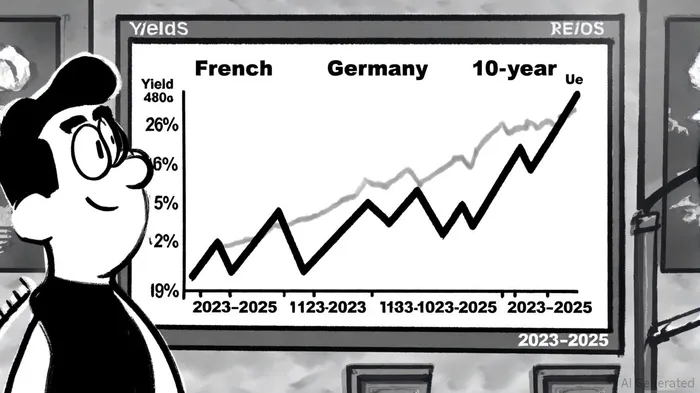







Comentarios
Aún no hay comentarios