
The Rising U.S. Dollar: Navigating Global Equity and Commodity Shifts in 2025
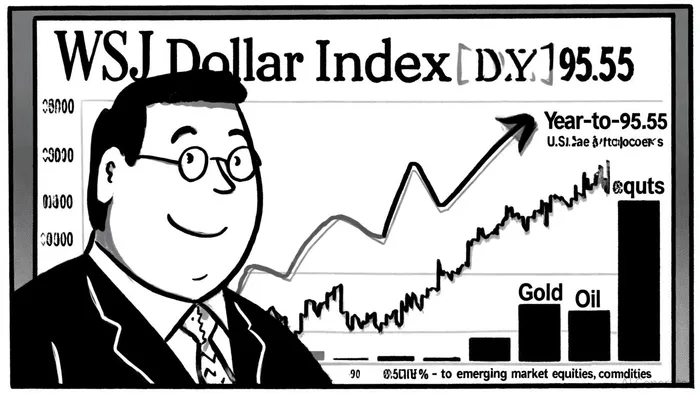
The U.S. dollar's recent resurgence has reshaped global investment dynamics, with the WSJ Dollar Index surging 0.60% this week to 95.55—the largest one-week gain since August 2025 [1]. This shift, driven by a confluence of monetary policy divergence, economic resilience, and geopolitical uncertainty, underscores the dollar's enduring influence on global asset allocation. For investors, understanding the interplay between dollar strength, equity performance, and commodity trends is critical to navigating the evolving landscape.
Drivers of Dollar Strength: Policy, Resilience, and Uncertainty
The dollar's rebound reflects a slower pace of Federal Reserve rate cuts compared to central banks in the Eurozone and Japan. The Fed's September 2025 Summary of Economic Projections (SEP) maintained a median funds rate forecast of 3.6% for Q4 2025, signaling caution amid persistent inflation risks [3]. Meanwhile, the European Central Bank (ECB) and Bank of Japan (BoJ) have signaled more aggressive easing, creating a yield differential that supports the dollar.
Economic fundamentals also bolster the greenback. Robust U.S. labor market data and resilient consumer spending—despite rising interest rates—have reinforced confidence in the dollar's stability [4]. However, policy uncertainties, including legal challenges to the Fed's independence and debates over Trump-era tariffs, have introduced volatility. J.P. Morgan analysts note that fiscal concerns, such as rising costs under the OBBBA (Older Beneficiaries Budget Balancing Act) and mixed revenue outlooks, further complicate the dollar's trajectory [5].
Dollar Strength and Global Equities: A Tug-of-War
A stronger dollar typically dampens returns for international equities, as U.S. investors see foreign earnings shrink when converted into dollars. This dynamic has reversed recent trends: in 2025, a weaker dollar had amplified returns for emerging market equities by up to 16% year-to-date, with currency appreciation accounting for nearly half of those gains [6]. However, the recent 0.60% weekly rise in the DXY index suggests a potential shift.
Developed and emerging market equities may face headwinds as capital reallocates toward U.S. assets. European investors, for instance, have increasingly favored U.S. equities and dollar-denominated bonds, reversing earlier outflows into local assets [4]. This reallocation is further fueled by concerns over U.S. fiscal sustainability, including Moody's May 2025 downgrade of U.S. sovereign debt [5].
Commodities in the Crosshairs: Dollar Dynamics and Diverging Trends
The dollar's strength exerts a dual effect on commodities. A stronger dollar typically raises the cost of dollar-denominated commodities like oil and gold for non-U.S. buyers, potentially suppressing demand. However, supply-side factors often override this relationship. For example, oil prices have been pressured by forecasts of global oversupply, with prices expected to dip to $55 per barrel by mid-2026 [6]. Gold, meanwhile, has seen mixed signals: while it benefits from safe-haven demand during geopolitical tensions, its correlation with dollar weakness has weakened as investors diversify into other assets [1].
Sector Rotation Strategies: Adapting to Dollar-Driven Shifts
Investors are recalibrating sector allocations to hedge against dollar volatility. Defensive sectors like utilities and healthcare have outperformed during periods of dollar weakness, offering stability amid uncertainty [2]. Conversely, a stronger dollar often favors sectors tied to U.S. domestic demand, such as financials and consumer staples.
Momentum-based strategies are also gaining traction. AI-driven platforms now analyze real-time data to identify sectors with strong price trends, such as industrials and technology during early recoveries [5]. For example, the recent dollar surge has prompted a reevaluation of exposure to emerging market equities, with some investors shifting to U.S.-listed multinational corporations that benefit from a stronger currency [4].
The Road Ahead: Balancing Dollar Dominance and Diversification
While the dollar's structural advantages—its role as the world's primary reserve currency (58% of global reserves) and its liquidity—remain intact [1], central banks are diversifying into gold and other currencies. This trend, accelerated by geopolitical tensions and fiscal concerns, suggests a long-term shift in asset allocation.
For now, the dollar's trajectory hinges on inflation data and Fed policy. A surprise uptick in core PCE inflation or a signal of slower rate cuts could trigger a late Q3 or early Q4 rebound [3]. Investors should remain agile, leveraging hedging instruments and sector rotation to balance exposure to U.S. and international assets.
Conclusion
The U.S. dollar's 0.60% weekly gain to 95.55 highlights its enduring influence on global markets. As policy divergences and economic fundamentals shape its path, investors must navigate the interplay between dollar strength, equity performance, and commodity trends. By adopting dynamic sector rotation strategies and monitoring capital reallocation patterns, market participants can position themselves to capitalize on emerging opportunities in this evolving landscape.







Comentarios
Aún no hay comentarios