
The Rising Cybersecurity Risk in Digital Assets and Its Impact on Institutional Investment Strategies
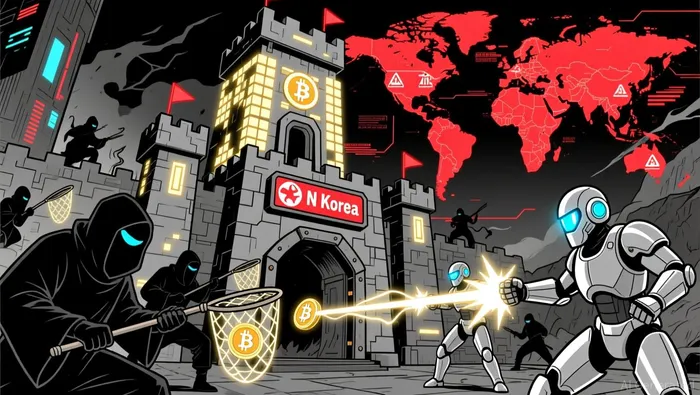
The digital asset landscape is no longer just a playground for speculative investors or tech enthusiasts. It has become a battleground for geopolitical actors, with North Korea emerging as a particularly formidable adversary. Over the past three years, North Korean cyber operations targeting cryptocurrencies have escalated dramatically, with stolen assets now surpassing $6 billion cumulatively and exceeding $2 billion in 2025 alone. For institutional investors, this represents a dual threat: not only are digital assets vulnerable to theft, but the stolen funds are often funneled into North Korea's nuclear and missile programs, creating a cascading risk for global security and financial stability.
The Financial and Operational Threats
North Korean hackers, primarily through the Lazarus Group, have refined their tactics to exploit both technical and human vulnerabilities. In 2025, the regime's cyber actors stole $1.46 billion from Bybit in a single incident, marking one of the largest breaches in crypto history. These attacks are no longer limited to exploiting software vulnerabilities; they increasingly rely on social engineering, phishing, and impersonation to manipulate high-net-worth individuals and institutional actors. The stolen funds are then laundered through cryptocurrency mixers, cross-chain transactions, and obscure blockchains, making tracking and recovery extremely challenging.
The financial impact is staggering. According to Chainalysis, North Korean-linked cybercrime has surged by 102.88% year-over-year in 2024, with $1.34 billion stolen across 47 incidents. This trend is not just a technical problem-it's a strategic one. The United Nations and U.S. Treasury have both raised alarms, noting that these funds are used to circumvent sanctions and fund North Korea's military ambitions. For institutions, the risk is twofold: direct financial loss and indirect exposure to geopolitical instability.
Institutional Adaptation: Technology and Strategy
In response, institutional investors and financial firms are recalibrating their strategies. One of the most notable shifts is the adoption of Distributed Ledger Technology (DLT) to enhance transparency and traceability. Blockchain analytics firms like Elliptic and Chainalysis have become critical partners, using advanced tools to map the flow of stolen funds and identify patterns. For example, after the Bybit heist, Elliptic's analysis revealed that over $300 million in stolen Ethereum was laundered through Tornado CashTORN-- and other mixers within days.
Beyond technology, institutions are prioritizing human-centric security measures. This includes mandatory training on social engineering tactics, multi-factor authentication (MFA) for all crypto-related accounts, and stricter identity verification processes for high-value transactions. South Korean exchanges like Upbit, frequent targets of North Korean attacks, have also implemented ISMS certifications to bolster defenses. However, as North Korean tactics evolve-such as AI-generated phishing emails that outperform human-crafted ones by 14 percentage points-these measures must keep pace.
Portfolio Adjustments and Regulatory Compliance
Institutional investors are also reshaping their portfolios to mitigate exposure. Diversification into less-volatile assets and hedging strategies are becoming standard practice, particularly for firms with significant crypto holdings. Additionally, regulatory compliance has taken center stage. The U.S. Treasury's Office of Foreign Assets Control (OFAC) has expanded sanctions to include digital currency addresses linked to North Korean laundering networks, such as the Korea Mangyongdae Computer Technology Corporation. Institutions are now required to integrate real-time sanctions screening into their operations, a costly but necessary adjustment.
A case in point is the aftermath of the Bybit breach. In the wake of the attack, Bybit announced a $100 million insurance fund to compensate affected users, while also partnering with cybersecurity firms to audit its infrastructure. This mirrors broader industry trends: exchanges are now allocating 15-20% of their budgets to cybersecurity, up from 5-10% in 2022.
The Geopolitical Dimension
The threat extends beyond financial loss. North Korea's cyber operations are deeply intertwined with its geopolitical strategy. The regime's 2024 alliance with Russia, formalized through a Comprehensive Strategic Partnership Treaty, has amplified its capabilities. Russia's infrastructure and IP addresses are now used to obscure the origins of attacks, while North Korean hackers provide ransomware-as-a-service (RaaS) to Russian-aligned actors, creating a "cyber arms race" where institutions must contend with state-sponsored actors backed by global partners.
Conclusion: A Call for Vigilance and Innovation
North Korea's cyber-enabled theft of digital assets is no longer a niche risk-it's a systemic one. For institutions, the path forward requires a combination of technological innovation, regulatory agility, and cultural shifts in security awareness. While DLT and blockchain analytics offer promising tools, they are not silver bullets. The decentralized nature of crypto will always pose challenges for regulators and law enforcement.
As one industry insider put it, "The North Koreans aren't just stealing money; they're stealing time. Every dollar they siphon off is a dollar that could have been invested in innovation or growth." According to the report for institutional investors, the stakes are clear: adapt or be left behind in a rapidly evolving threat landscape.






Comentarios
Aún no hay comentarios