
Rising Crypto Physical Security Risks and Their Implications for Institutional Investors
The cryptocurrency ecosystem has long been associated with digital vulnerabilities-hacks, exploits, and smart contract failures. Yet, as the asset class matures and institutional adoption accelerates, a new and equally perilous threat has emerged: physical security risks. In 2025, the crypto landscape witnessed a 40% year-over-year increase in physical attacks targeting high-net-worth individuals (HNWIs) and institutional investors, with losses exceeding $2.17 billion in the first half of the year alone. These attacks, ranging from "wrench attacks" to kidnappings and home invasions, underscore a critical gap in traditional risk assessments. For institutional investors, the lesson is clear: physical security must now be treated as a core component of crypto asset management.
The Escalating Threat Landscape
The rise in physical attacks is not coincidental. As BitcoinBTC-- and other cryptocurrencies reach record valuations, attackers are exploiting the visibility of crypto wealth. According to Chainalysis, 23.35% of all stolen funds in 2025 originated from personal wallet compromises, a sharp increase from 2024. This trend is exacerbated by the correlation between Bitcoin price peaks and "wrench attacks"-a term describing physical coercion or violence to extract private keys or passwords. For instance, in May 2025, a prominent crypto entrepreneur in Paris had his father kidnapped, with attackers severing his finger to pressure him for wallet access. Such incidents are no longer isolated; they reflect a systemic shift in how digital wealth is targeted.
The United States, Germany, and Russia have emerged as hotspots for these attacks, with threat actors leveraging social media, blockchain analytics, and public events to identify targets. The average ransom premium for laundering stolen funds has also risen significantly, with attackers increasingly leaving larger balances on-chain to avoid detection. This strategy highlights the sophistication of modern adversaries, who now blend physical intimidation with digital exploitation. 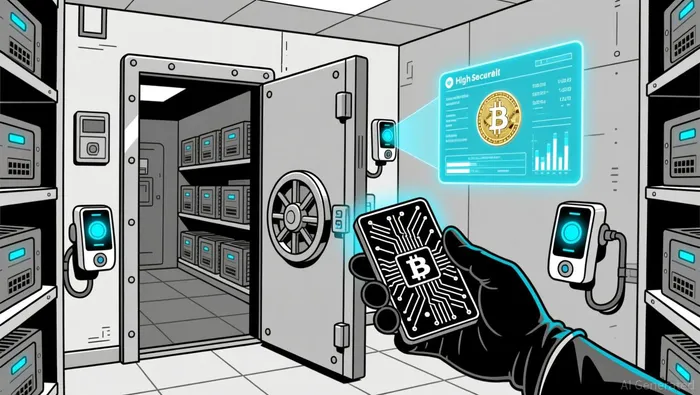
High-Net-Worth Targets and Physical Vulnerabilities
High-net-worth crypto holders are particularly vulnerable due to the visibility of their assets. A case in point is the New York Bitcoin kidnapping and torture incident, where attackers used physical violence to coerce a victim into revealing his wallet password. This case exposed the inadequacy of conventional security measures in scenarios involving extreme coercion. Unlike digital breaches, which can be mitigated through encryption and multi-layered protocols, physical attacks exploit human psychology and physical access-a domain where technology alone cannot provide a solution.
The risks extend beyond individuals. Families of crypto investors are increasingly targeted, as seen in a thwarted abduction attempt involving the daughter and grandson of a crypto CEO in the U.S. in May 2025. These attacks are often preceded by extensive surveillance, with threat actors using public data to map out routines and vulnerabilities. For institutional investors, the implications are stark: physical security must now be integrated into asset management strategies to protect both digital assets and human capital.
Institutional Custody Solutions as a Mitigation Strategy
The growing threat landscape has accelerated the adoption of institutional-grade custody solutions. As of 2025, 60% of institutional investors-including hedge funds, pension funds, and asset managers-now hold digital assets according to industry reports. To safeguard these holdings, institutions are turning to multi-signature (multi-sig) wallets, cold storage, and Hardware Security Modules (HSMs). These technologies add multiple layers of security, reducing the risk of single points of failure. For example, multi-sig wallets have been shown to reduce unauthorized access by over 60% compared to single-signature wallets.
Cold storage, which keeps private keys offline, has also gained traction. Providers like Gemini Custody and XBTO use geographically distributed HSMs to protect assets, while decentralized seed phrase storage-splitting recovery phrases across multiple locations-adds another layer of resilience. However, even these measures are not foolproof. A 2025 case involving a $40 million Bitcoin theft demonstrated how attackers bypassed hardware wallets through social engineering, such as phishing emails impersonating legitimate services. This underscores the need for complementary strategies, including insurance and personal security protocols.
The Case for Integrated Risk Management
Institutional investors must adopt a holistic approach to risk mitigation. This includes:
1. Institutional Custody: Partnering with third-party custodians that offer SOC 1/2 compliance, insurance, and advanced cryptographic protocols like Multi-Party Computation (MPC) according to industry analysis.
2. Physical Security: Engaging private security firms, deploying bodyguards, and using secure storage facilities such as bank vaults or geographically isolated cold storage according to best practices.
3. Regulatory Alignment: Leveraging evolving frameworks like the U.S. SEC's post-SPBD guidance and the EU's MiCAR to ensure compliance and investor protection according to industry experts.
The market for institutional custody solutions is projected to exceed $3.28 billion in 2025, driven by regulatory clarity and technological innovation. For example, the OCC's 2025 guidance on crypto custody clarified banks' permissions to hold digital assets, fostering trust in institutional-grade solutions. Similarly, AI-driven transaction analysis and interoperable custody platforms are reducing counterparty risk while improving operational efficiency according to industry analysis.
Conclusion: A New Era of Risk Assessment
The rise of physical security threats in 2025 has redefined the risk calculus for institutional investors. While digital security remains paramount, the human and physical dimensions of asset protection cannot be ignored. As attackers grow more sophisticated, institutions must prioritize integrated risk assessments that account for both digital and physical vulnerabilities. This includes not only adopting advanced custody solutions but also investing in personal security measures and regulatory compliance.
For investors entering or expanding in the crypto space in 2026, the message is clear: physical security is no longer optional. The cost of inaction-measured in lost assets, reputational damage, and human safety-far outweighs the investment in robust risk-mitigation strategies. In an era where digital wealth attracts both innovation and danger, institutional investors must lead the charge in redefining what it means to "hold" crypto securely.







Comentarios
Aún no hay comentarios