
Rising U.S. Crude Oil Inventories and OPEC+ Output Hikes: A Bearish Outlook for Energy Commodities?
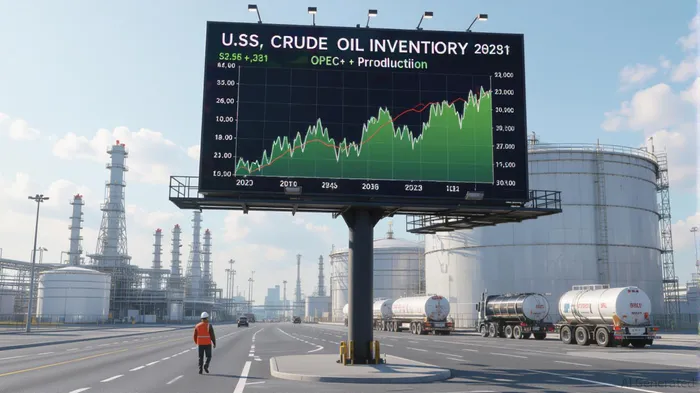
The global energy market is navigating a complex interplay of supply-side adjustments and demand-side uncertainties. Recent developments in U.S. crude oil inventories and OPEC+ production decisions have sparked renewed debate about the short-term trajectory of energy commodities. While the U.S. has seen a modest rise in crude stockpiles, OPEC+ is accelerating its output expansion to reclaim market share. Together, these dynamics are amplifying bearish risks for oil prices in the near term.
U.S. Inventory Trends: A Mixed Signal
According to a report by the U.S. Energy Information Administration (EIA), crude oil inventories increased by 1.25 million barrels in the week ending September 5, 2025, following a 0.62 million-barrel rise the prior week [6]. This upward trend contrasts with a 0.974 million-barrel decline recorded in early August [6]. While the data reflects seasonal volatility, it also underscores the fragility of demand-side resilience. As of August, U.S. commercial crude inventories were -5.2% below the five-year seasonal average [1], suggesting a tighter domestic supply environment. However, this tightness is localized; global markets face a different reality.
OPEC+'s Strategic Shift: From Price Stability to Market Share
OPEC+ has embarked on a deliberate strategy to unwind its production cuts, prioritizing market share over price stability. In Q3 2025, the group approved a 137,000 barrels per day (bpd) output increase starting in October 2025, marking the first step in unwinding the final 1.66 million bpd of voluntary cuts [1]. This move, as stated by OPEC Secretary General Haitham Al Ghais, aims to address a "tight supply-demand balance" anticipated in the coming quarters [3]. By October 2025, the group plans to raise output by an additional 411,000 bpd, contributing to a projected 2.2 million bpd increase through 2026 [5].
The implications are clear: OPEC+ is flooding the market with incremental supply, a strategy that risks oversupplying a demand landscape already constrained by macroeconomic headwinds. Commerzbank analysts have revised their Brent crude price forecast to $65/barrel, citing heightened downside risks from these production hikes [1].
The Interplay of U.S. and OPEC+ Dynamics
The divergence between U.S. inventory trends and OPEC+ actions creates a paradox. While the U.S. faces a tighter supply environment, global markets are grappling with a projected oversupply of over 2 million bpd in Q4 2025 and early 2026 [1]. This imbalance is exacerbated by OPEC+'s coordinated output expansion, which introduces downward pressure on prices. For instance, WTIWTI-- crude has declined steadily over the past five trading sessions, with technical indicators confirming bearish momentum [2].
Geopolitical tensions—such as U.S. sanctions on Russian and Iranian oil—have temporarily mitigated price declines [1]. However, these factors are transient and unlikely to offset the structural oversupply driven by OPEC+'s strategy.
Short-Term Bearish Risks: A Prudent Investor's Perspective
For investors, the short-term outlook for energy commodities is clouded by three key risks:
1. Supply-Demand Imbalance: OPEC+'s output hikes are adding to a global supply glut, even as demand growth remains subpar.
2. Technical Weakness: WTI's sustained decline and bearish indicators suggest further downward momentum in the near term [2].
3. Policy Flexibility: While OPEC+ retains the ability to pause or reverse production increases, the current trajectory signals a prioritization of market share over price support [3].
Conclusion: Navigating the Bearish Outlook
The combination of rising U.S. inventories and OPEC+'s aggressive output expansion paints a bearish picture for energy commodities in the short term. While localized demand in the U.S. remains resilient, global markets are vulnerable to oversupply pressures. Investors should remain cautious, hedging against price volatility and monitoring OPEC+'s next moves. The path forward will depend on whether demand can absorb the incremental supply or if further adjustments are needed to restore equilibrium.







Comentarios
Aún no hay comentarios