
Rising U.S. Crude Oil Inventories and Their Implications for Energy Market Volatility
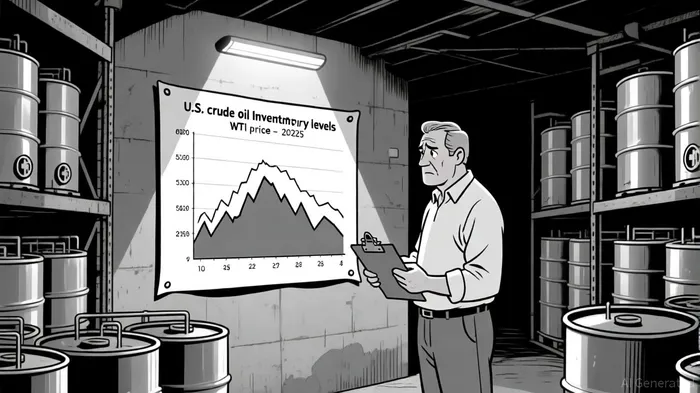
The U.S. energy market is grappling with a surge in crude oil inventories, a development that has intensified volatility and reshaped short-term trading strategies. According to the U.S. Energy Information Administration (EIA), crude oil stockpiles rose by 3.524 million barrels in the week ending October 10, 2025, far exceeding expectations of a 0.12-million-barrel increase, as reported in the OilPrice article. This trend, which follows a 3.715-million-barrel build the prior week, has pushed total inventories to 423.8 million barrels, or 4% below the five-year average for this time of year, according to the OilPrice article. The market's reaction was swift: West Texas Intermediate (WTI) prices fell by $0.97 per barrel (1.66%) to $57.30 as traders recalibrated to the oversupply risk, per the same OilPrice coverage.
Inventory Surprises and Market Reactions
Historical trading strategies around EIA reports emphasize the importance of actual versus expected inventory deviations. For instance, a 2025 analysis by Energy Trading Week notes that traders often use the American Petroleum Institute (API) report—released on Tuesdays—to front-run EIA expectations. If the API signals a significant draw, long positions in crude futures or energy ETFs are typically initiated before the EIA's official data. However, the recent inventory builds have defied these patterns. The unexpected surge in October 2025, for example, triggered a bearish sentiment, with the Oil Volatility Index (OVX) spiking by 18% as uncertainty over demand and supply imbalances grew, as reported by a Nasdaq article.
The interplay between crude inventories and volatility metrics is further complicated by geopolitical factors. A Macquarie report warns that a U.S. inventory build could exacerbate downward pressure on prices, particularly amid ongoing sanctions on Russian oil and shifting dynamics in India's energy strategy. These uncertainties have amplified the role of implied volatility in energy markets, with traders increasingly relying on tools like the OVX and VIX to hedge against directional risks, according to a peer-reviewed study.
Short-Term Trading Strategies in a Volatile Environment
To navigate this landscape, traders are adopting a mix of futures, options, and ETFs. For example, the United States Oil Fund (USO), which tracks WTIWTI-- crude oil futures, has seen increased inflows as investors seek direct exposure to price swings, according to an Investing.com guide. Similarly, the ProShares K-1 Free Crude Oil Strategy ETF (OILK) offers an alternative through swap agreements, while the Invesco DB Oil Fund (DBO) provides access to a diversified index of crude oil futures, as noted in the Investing.com guide. These instruments allow traders to hedge against inventory-driven price swings without the complexities of futures contracts.
Options strategies are also gaining traction. A protective put—buying a put option to limit downside risk—has become a popular choice as volatility remains elevated. For instance, during the October 2025 inventory surge, traders who purchased WTI puts at $57.30 could have mitigated losses as prices dipped. Conversely, straddles and calendar spreads are being used to capitalize on expected price swings around EIA reports, particularly when inventory data is likely to deviate sharply, as discussed in a CME Group article.
Portfolio Positioning and Diversification
Beyond individual instruments, portfolio managers are rethinking their energy allocations. Morgan Stanley's 2025 outlook highlights a shift toward natural gas and energy infrastructure as hedges against crude volatility. Natural gas, for example, has benefited from constrained global supply and surging U.S. exports, with the EU's reduced reliance on Russian energy creating a favorable demand backdrop, according to the Morgan Stanley outlook. Energy infrastructure MLPs, such as those operating midstream pipelines, have also outperformed, offering steady distributions that align with inflationary pressures, per the Morgan Stanley outlook.
Clean energy investments are another focal point. Nuclear energy, in particular, has gained momentum due to policy support and its role in powering AI data centers, as noted in the Fidelity outlook. The One Big Beautiful Bill Act has further softened regulatory headwinds for renewables, making wind and solar projects more attractive, according to the Fidelity outlook. However, investors are cautioned to balance these long-term plays with short-term hedges, such as delta-neutral options strategies, to manage exposure to oil price swings.
Geopolitical Risks and Strategic Adjustments
The 2025 energy landscape is further complicated by geopolitical tensions, particularly in the Middle East. AI-driven market intelligence systems are now critical for decoding regional conflicts, such as Iran-Israel tensions, and their potential impacts on LNG and crude markets, according to the World Energy Report. Traders are also prioritizing cybersecurity protocols for energy infrastructure, given the rising threat of cyberattacks on critical assets, as reported by the World Energy Report.
International collaboration is another key theme. Initiatives like the U.S.-Japan-Australia Green Hydrogen Initiative aim to diversify supply chains and reduce reliance on single regions, the World Energy Report notes. For traders, this means opportunities in cross-border energy partnerships and investments in decentralized energy systems, which are less vulnerable to geopolitical shocks, according to the World Energy Report.
Conclusion
The surge in U.S. crude oil inventories has underscored the need for agile trading strategies and diversified portfolios in the energy sector. While inventory builds and geopolitical risks have heightened volatility, tools like ETFs, options, and AI-driven analytics offer pathways to manage risk and capitalize on market dislocations. As the EIA's October 2025 report demonstrates, the ability to anticipate and adapt to inventory surprises will remain a cornerstone of successful energy trading in 2025 and beyond.





Comentarios
Aún no hay comentarios