
Rising Credit Fraud Risks and Regional Bank Vulnerabilities: Navigating Hedging Strategies and Strategic Asset Reallocation in 2025
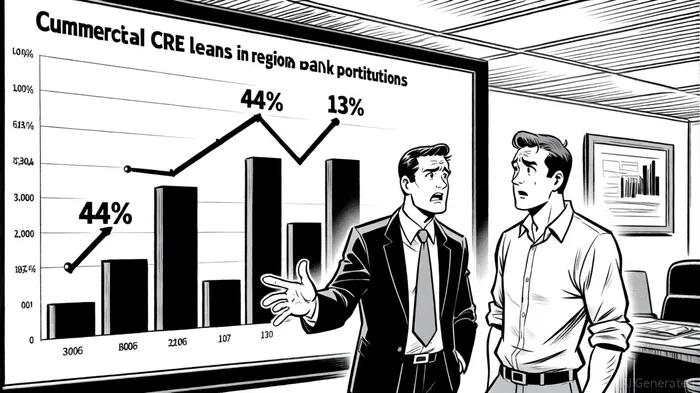
The regional banking sector is facing a perfect storm of challenges in 2025. Credit fraud—both cyber-enabled and traditional—has surged, while vulnerabilities in commercial real estate (CRE) portfolios loom large. According to the FDIC Consumer Compliance Highlights, consumer complaints related to credit card errors and third-party vendor missteps have spiked, with 38% of complaints tied to credit reporting inaccuracies. Meanwhile, regional banks, which hold 44% of their loan portfolios in CRE compared to just 13% for larger institutions, are bracing for a potential delinquency crisis reminiscent of 2008, as detailed in a Markets article. For investors, the question is no longer whether these risks exist but how to hedge against them and reallocate assets strategically.
The Dual Threat: Fraud and CRE Exposure
The FDIC's 2025 Consumer Compliance Supervisory Highlights underscore a troubling trend: third-party vendors, now integral to banking operations, have become a vector for fraud. Kristina Schaefer, chief risk officer at First Bank and Trust, warns that "fraud is no longer a peripheral risk—it's a core operational challenge." This is compounded by the CRE sector's fragility. As real estate values in office and retail sectors stagnate, regional banks with concentrated CRE exposure face a ticking time bomb. Recent legal issues at Zions BancorporationZION-- and Western Alliance Bancorp—linked to loan fraud and misvaluation—have only amplified concerns, according to the Markets piece cited above.
Hedging Strategies: From Currency Swaps to Inverse ETFs
To mitigate these risks, banks and investors are turning to sector-specific hedging tools. The Risk Management Association (RMA) highlights in the 2025 CRO Outlook Survey that institutions are increasingly using currency, commodity, and interest rate hedging to stabilize net interest margins amid volatility. For individual investors, the Tuttle Capital Daily 2X Inverse Regional Banks ETF (SKRE) offers a direct hedge, according to SumGrowth's ETF roundup. Similarly, options strategies—such as protective puts on regional bank indices—can limit downside risk during sector selloffs.
For broader macroeconomic hedging, inverse ETFs like ProShares UltraShort MSCI EAFE (EFU) and UltraPro Short S&P 500 (SPXU) provide exposure to global and broad-market downturns. However, these tools require careful timing, as prolonged high interest rates and inflationary pressures from potential Trump-era tariffs could compress yield curves and erode profitability for regional banks, a point highlighted in the Oliver Wyman survey noted earlier.
Strategic Asset Reallocation: Balancing Risk and Reward
Asset reallocation in 2025 demands a nuanced approach. Regional banks like KeyCorpKEY-- (KEY), Regions FinancialRF-- (RF), and Huntington BancsharesHBAN-- (HBAN) remain attractive due to their high dividend yields and potential for earnings growth, particularly if regulatory pressures ease, as outlined in a MarketBeat piece. Yet, their CRE-heavy portfolios necessitate caution. Investors are advised to diversify across regional banks with varying geographic and sectoral exposures—such as Citizens Financial Group (CFG) and East West Bancorp (EWBC)—to reduce concentration risk (see the SumGrowth ETF roundup referenced earlier).
The normalization of the yield curve has also created opportunities. As short-term rates stabilize and long-term rates rise, regional banks can expand net interest margins (NIM), provided they avoid overexposure to CRE. For example, M&T Bank (MTB) and Wells Fargo (WFC) have demonstrated resilience in 2025 stress tests, with robust capital ratios enabling aggressive share buybacks and dividend growth, according to the Markets article cited above.
The Path Forward: Flexibility and Vigilance
For investors, the key lies in balancing hedging and reallocation. A diversified portfolio with a lower allocation to regional banks—say, 10–15%—can capture growth while limiting downside risk. AI-driven asset allocation tools, as used by a European pension fund in 2025, offer dynamic rebalancing based on real-time macroeconomic signals, as discussed in the Oliver Wyman survey. Meanwhile, regulatory developments and CRE market trends must be monitored closely.
In this high-stakes environment, the mantra is clear: hedge where necessary, but don't abandon the sector entirely. Regional banks, for all their vulnerabilities, remain a cornerstone of the U.S. financial system—and with the right strategies, they can be a source of both resilience and reward.







Comentarios
Aún no hay comentarios