
The Rising Cost of Compliance in Crypto: How OKX's Risk Controls Impact Investor Liquidity and Platform Trust
The crypto industry in 2025 stands at a crossroads. Regulatory frameworks like the EU's Markets in Crypto-Assets (MiCA) and the U.S. GENIUS Act have forced exchanges to adopt stringent compliance measures, reshaping the landscape for both institutional and retail investors. At the center of this transformation is OKX, a global exchange that has invested heavily in risk controls while grappling with the trade-offs between regulatory resilience and user experience. This analysis examines how OKX's compliance framework impacts investor liquidity and platform trust, drawing on 2025 data to assess the broader implications for the crypto ecosystem.
The Cost of Compliance: A Multi-Layered Defense
OKX's compliance strategy is anchored in a three-tiered system: customer identification, risk-based due diligence, and continuous monitoring. The platform enforces strict KYC (Know Your Customer) and KYB (Know Your Business) protocols, aligning with FATF standards and screening users against sanctions lists like U.S. OFAC and the UN Security Council Sanctions List. For U.S. operations, OKX holds a federal money service business license, ensuring adherence to local regulations.
These measures are not merely procedural. OKX has integrated AI-driven monitoring systems and global certifications (e.g., SOC 2 Type II, ISO/IEC 27001) to detect suspicious activity in real time. The exchange also publishes monthly Proof of Reserves reports, independently audited by firms like Hacken, to verify that customer assets are fully backed. Such transparency is critical in a sector where trust has historically been scarce.
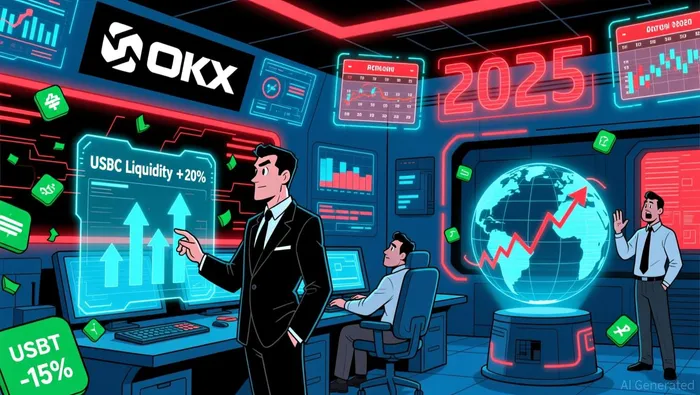
However, the cost of compliance is steep. A 2025 industry report notes that regulatory changes increased compliance costs for centralized exchanges (CEXs) by 22-35%, with MiCA's implementation alone leading to the delisting of non-compliant stablecoins like TetherUSDT-- (USDT). For OKX, this meant shifting liquidity toward compliant stablecoins like USDCUSDC--, a move that aligned with global trends but required significant operational adjustments.
Liquidity Shifts: Gains and Gaps
OKX's compliance-driven strategy has yielded notable liquidity gains. In 2025, trading volumes in regulated markets surged 53-fold, driven by MiCA and U.S. regulatory clarity. Centralized exchange (CEX) trading volume rose 16% globally, while decentralized exchange (DEX) volume spiked 262%-a testament to OKX's dual focus on institutional-grade infrastructure and retail accessibility.
Yet, liquidity is not without its vulnerabilities. The same year saw a record $158 billion in illicit crypto flows, with a significant portion tied to sanctioned entities and Russia-linked stablecoin ecosystems. OKX's proactive measures, including immediate account freezes and law enforcement collaboration, mitigated some risks but also introduced friction. For instance, users reported delays in withdrawals during high-volatility periods, a common side effect of real-time transaction monitoring.
The tension between compliance and liquidity is further highlighted by OKX's 2025 enforcement action. The U.S. Department of Justice fined the exchange $504 million for AML failures, including allowing users to bypass KYC checks and facilitating $5 billion in suspicious transactions. While the penalty underscores the risks of inadequate controls, it also reveals the human element: employees advised users on falsifying documents, a lapse that no AI system could fully prevent.
Trust Metrics: A Double-Edged Sword
Regulatory compliance has become a cornerstone of platform trust. OKX's 2025 compliance blueprint emphasizes a "zero-tolerance" approach to illicit activity, with 24/7 law enforcement support and a culture of compliance training. These efforts paid off: the exchange reported 120 million global users by year-end, with daily active wallets doubling and DEX trading volume rising 262%.
However, trust is not solely a function of compliance. User experience remains a critical factor. The 2025 DOJ case against OKX highlights how lax KYC procedures can erode trust, even as robust controls exist elsewhere. For example, mandatory identity verification-a standard practice-can deter privacy-conscious users, while overly aggressive account freezes may alienate legitimate traders.
Third-party audits and Proof of Reserves reports have bolstered OKX's credibility, but they cannot fully address the friction inherent in compliance. A 2025 study notes that while MiCA and similar frameworks fostered institutional adoption, they also introduced stricter transaction reporting (e.g., the $3,000 Travel Rule threshold), which increased operational complexity for users.
The Balance: Compliance as a Strategic Investment
OKX's 2025 journey illustrates a broader industry truth: compliance is both a cost and an investment. The exchange's $504 million fine was a wake-up call, but its subsequent focus on AI-driven monitoring and global certifications demonstrates a commitment to long-term resilience. Similarly, the 53-fold surge in regulated market volumes shows that compliance can drive liquidity when executed effectively.
For investors, the key question is whether the benefits of compliance outweigh the costs. In 2025, the answer leans toward yes. Regulatory clarity has attracted institutional capital, stabilized markets, and spurred innovation in tokenized assets. Yet, the industry must also acknowledge the human and operational costs of compliance. As OKX's case shows, even the most advanced systems are vulnerable to internal lapses and user frustration.
Conclusion: Navigating the Compliance-User Experience Tightrope
The crypto industry's 2025 regulatory evolution has redefined the role of compliance. For OKX, the path forward requires balancing three priorities: enhancing AI-driven monitoring to reduce false positives, streamlining KYC/AML processes to minimize user friction, and maintaining transparency through third-party audits.
Investors should view compliance not as a burden but as a strategic enabler. While the costs are undeniable, the rewards-greater institutional participation, improved market stability, and a shift toward crypto as a legitimate financial tool-justify the investment. The challenge lies in ensuring that compliance does not become a barrier to adoption. As the industry matures, the exchanges that succeed will be those that treat compliance as a dynamic, user-centric process rather than a static checkbox.






Comentarios
Aún no hay comentarios