
Rising Consumer Spending and Retail Resilience in the Post-Holiday Season
The 2025 Holiday Season: A New Retail Paradigm
Consumer spending during the 2025 Thanksgiving and Black Friday periods revealed a nuanced picture. While 71% of shoppers opted for online purchases, 72% of Gen Z consumers defied broader trends by prioritizing in-store experiences, drawn by early-bird deals and experiential retail. Meanwhile, 69% of shoppers cited rising living costs as the primary factor for reduced holiday spending, yet 24% still planned to spend $1,000 or more. Retailers leveraging omnichannel strategies, such as WalmartWMT-- and AmazonAMZN--, dominated the landscape, with 71% and 94% of shoppers respectively visiting their stores or platforms.
Key Trends Shaping Retail Resilience
- Omnichannel Dominance: Retailers integrating seamless online and in-store experiences outperformed peers. Walmart's $8-per-person Game Day Basket, offering one-click pickup or delivery, exemplifies this strategy. Similarly, TJX Companies' focus on value-driven omnichannel offerings attracted budget-conscious shoppers, driving a 25% year-to-date stock gain.
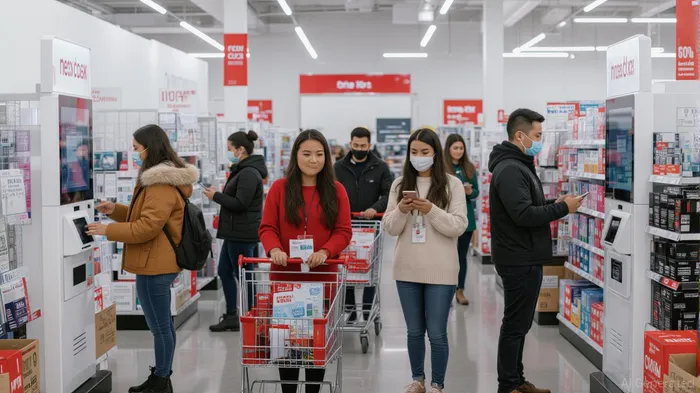 2. Gen Z's Influence: Gen Z's preference for experiential gifts (e.g., travel, concert tickets) and mobile-first shopping (54.5% of e-commerce sales via mobile in 2024) has reshaped inventory and marketing strategies. Dollar General's $1-priced items and Hollister's TikTok-driven campaigns highlight this alignment.
3. AI and Personalization: AI tools, such as Amazon's Rufus and Walmart's inventory systems, enhanced price tracking and customer engagement, with 81% of shoppers using AI for holiday decisions.
Undervalued Retail Stocks: Strategic Positioning and Financial Metrics
1. Walmart (WMT)
Walmart's broad appeal across income tiers and its 4.5% comparable sales growth in Q3 2025 solidify its position as a holiday stalwart. With a P/E ratio of 17.0 and a 17% year-to-date gain, the stock reflects its resilience in a cautious spending environment. Its grocery division and early-morning delivery services further differentiate it.
2. TJX Companies (TJX)
TJX's value-focused model resonated with a 23% decline in Gen Z holiday spending, as consumers prioritized discounted goods. The company raised FY 2025 guidance after Q3 results and trades at a P/E of 14.2 with a 25% YTD gain. Analysts rate it as a "Buy" in 24 out of 25 cases, underscoring its undervaluation.
3. Kohl's (KSS)
Kohl's, with a P/E of 14.2 and a TC Quantamental Rating of 64, offers a 37% estimated upside. Despite mid-tier challenges, its improved merchandising and 71% YTD stock gain reflect a turnaround. Its focus on promotions and trade-down strategies aligns with cost-conscious shoppers.
4. Abercrombie & Fitch (ANF)
Abercrombie & Fitch's rebranding under Fran Horowitz, including Hollister's Gen Z-focused campaigns, has driven a debt-free balance sheet and strong margins. While its post-Black Friday performance faces headwinds, its omnichannel strategy and social media engagement position it for long-term growth.
Post-Holiday Performance and Outlook
Post-Black Friday 2025, value retailers like Walmart and TJX outperformed, with Walmart reporting 4.5% sales growth and TJXTJX-- raising guidance. Conversely, mid-tier retailers like Kohl's and Abercrombie & Fitch face challenges as shoppers trade down. However, the National Retail Federation forecasts $1 trillion in holiday sales, albeit with 3.7-4.2% growth, indicating sustained demand for value propositions.
Conclusion
The 2025 holiday season highlights the importance of adaptability in a fragmented retail landscape. Walmart, TJX, and Kohl's exemplify how omnichannel strategies, Gen Z engagement, and cost-conscious offerings can drive resilience. While economic uncertainties persist, these undervalued stocks-backed by strong financial metrics and strategic innovation-present compelling opportunities for investors seeking to capitalize on evolving consumer trends.





Comentarios
Aún no hay comentarios