
Rising Consumer Confidence and its Implications for Retail and Consumer Discretionary Sectors
The U.S. consumer confidence landscape in October 2025 presents a nuanced picture of resilience and fragility. While the University of Michigan's preliminary consumer sentiment index dipped to 55.0 in October-a 22.0% decline year-over-year-this reading was marginally higher than the 54.1 forecast, suggesting a floor may be forming in the data [1]. Meanwhile, the LSEG/Ipsos Primary Consumer Sentiment Index showed a 0.5-point increase to 52.9, with the Expectations sub-index rising 1.9 points to 59.4, its strongest showing since mid-2024 [2]. These divergent signals underscore a market grappling with inflationary pressures and labor market uncertainties, yet holding onto cautious optimism.
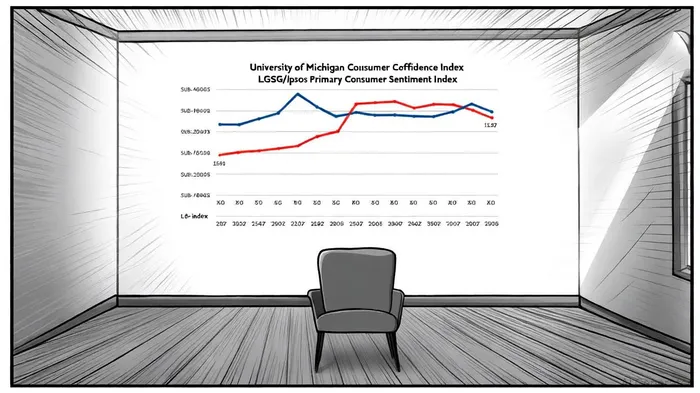
For investors, the implications for the retail and consumer discretionary sectors are twofold: persistent headwinds from high prices and job insecurity, and emerging opportunities as late-day market momentum hints at a potential rotation into growth-oriented assets.
Consumer Confidence: A Tale of Two Metrics
The University of Michigan data reveals a stark reality: 60% of consumers anticipate higher unemployment in the next year, while year-ahead inflation expectations remain stubbornly elevated at 4.6% [1]. This pessimism is mirrored in the retail sector, where companies like Abercrombie & Fitch and TargetTGT-- have revised 2025 forecasts downward due to economic pressures and rising tariffs [3]. However, the LSEG/Ipsos index paints a slightly rosier picture. Its Jobs sub-index improved by 1.7 points to 63.6, and the Expectations sub-index climbed nearly two points, indicating that consumers are not entirely abandoning hope [2].
This duality creates a unique investment environment. While the Current sub-index (43.9) and Investment sub-index (46.5) in the LSEG/Ipsos data remain depressed, the upward trend in expectations suggests a potential inflection point [2]. For the consumer discretionary sector, which is highly sensitive to macroeconomic shifts, this could signal a gradual normalization of spending patterns-particularly in non-essential categories like travel, dining, and apparel.
Market Momentum and Sector Valuation: A Near-Term Opportunity
The SPDR Select Sector Fund - Consumer Discretionary (XLY) exemplifies this tension. On October 9, 2025, the sector faced a 0.24% decline amid concerns over AI valuations, a U.S. government shutdown, and Federal Reserve policy uncertainty [4]. Yet, by October 13, late-day momentum saw the sector lead a hypothetical rebound, with the XLY trading at a 15% discount to fair value and a P/E ratio of 33.5x-below its 3-year average of 37.4x [5]. This valuation gap, coupled with the sector's 25% annual earnings growth over the past three years, suggests undervaluation amid macroeconomic noise [5].
The sector's beta of 1.24 and elevated implied volatility (20.06%) highlight its sensitivity to market sentiment, but also its potential for outsized returns if consumer confidence stabilizes [4]. For instance, Amazon and Tesla-two bellwethers of the sector-have historically driven performance. While Tesla's earlier 22% drop in 2025 reflects sector-specific challenges, Amazon's resilience in essential goods and services positions it as a defensive play within discretionary spending [4].
Strategic Entry Points and Risk Mitigation
Investors seeking near-term opportunities should focus on two areas:
1. Undervalued Growth Plays: Companies with strong balance sheets and exposure to essential discretionary categories (e.g., home goods, digital services) could benefit from a stabilization in consumer confidence. The sector's P/E ratio of 28.51 as of October 9-aligned with its 5-year average-suggests limited downside risk [5].
2. Capital Reallocation Trends: The October 13 rally indicates a shift in investor behavior toward growth-oriented strategies. This aligns with historical patterns where capital rotates into consumer discretionary during economic recoveries, particularly when inflation expectations moderate [1].
However, risks remain. The ongoing government shutdown has created a "market data blind spot," complicating assessments of economic health [4]. Additionally, 48% of households still expect rising unemployment, which could dampen spending in Q4 2025 [1]. A prudent approach would involve hedging against inflationary pressures by allocating to sub-sectors with pricing power (e.g., premium retail, e-commerce logistics).
Conclusion
The October 2025 data underscores a market at a crossroads. While consumer confidence remains fragile, the divergence between sentiment indices and the sector's valuation metrics point to a potential inflection point. For investors, the key lies in balancing caution with opportunism-leveraging late-day momentum in the consumer discretionary sector while monitoring macroeconomic catalysts like Fed policy and inflation trends. As the sector trades at a discount to fair value and shows early signs of capital reallocation, it may offer compelling entry points for those positioned to capitalize on a gradual normalization of consumer behavior.





Comentarios
Aún no hay comentarios