
Rising Canadian Home Resales and Rate Sensitivity: Implications for Real Estate and Mortgage-Backed Securities Markets
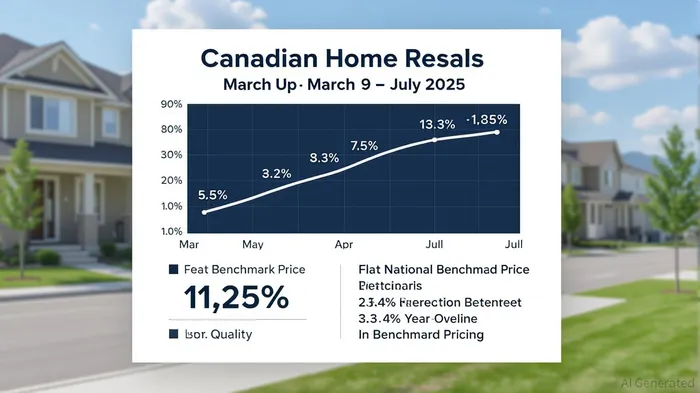
The Canadian housing market has shown signs of a tentative rebound in 2025, with home resales surging in key regions despite a high-interest-rate environment. According to CREA's August 15, 2025, analysis, national home sales rose 3.8% month-over-month in July, marking an 11.2% cumulative increase since March 2025[1]. This growth, however, is unevenly distributed, with the Greater Toronto Area (GTA) accounting for a 35.5% rebound in transactions during the same period[1]. While these figures suggest a post-inflation correction in buyer behavior, the sustainability of this upturn remains contingent on the interplay between rate sensitivity and market fundamentals.
Rate Sensitivity and Market Dynamics
The Bank of Canada's prolonged high-rate policy, designed to curb inflation, has historically dampened housing demand by increasing borrowing costs. Yet, the recent surge in resales—particularly in the GTA—indicates that localized factors, such as pent-up demand and inventory constraints, may temporarily outweigh rate-related headwinds. CREA's data reveals that the national benchmark price remained flat month-over-month in July 2025, while the year-over-year decline of 3.4% contrasts with a 0.6% rise in the national average sale price[1]. This divergence suggests a market recalibration, where lower-priced properties are gaining traction as affordability challenges persist for higher-end buyers.
The sales-to-new listings ratio, now at 52%, further underscores shifting dynamics. A ratio above 50% typically signals a buyer's market, implying that rising resales could exert downward pressure on prices if inventory fails to keep pace[1]. However, this metric must be interpreted cautiously: in a high-rate environment, buyers may prioritize price negotiations over volume, limiting the immediate impact on benchmarks.
Sustainability in a High-Rate Environment
The current upturn's longevity hinges on two critical factors: the Bank of Canada's rate trajectory and regional market resilience. While CREA's report highlights regional strength in the GTA, national price stability masks underlying fragility. For instance, the 3.4% year-over-year decline in the benchmark price suggests that affordability constraints—driven by elevated rates—are still curbing broader market participation[1].
Mortgage-backed securities (MBS) markets, though not directly analyzed in recent Canadian reports, are likely to reflect similar pressures. High rates typically reduce prepayment speeds, extending the duration of MBS and increasing interest rate risk for investors. However, without granular data on Canadian MBS performance in 2025, it is challenging to assess how these instruments are adapting to the current environment.
Conclusion
The Canadian housing market's 2025 upturn, while geographically concentrated, reflects a complex balance between rate sensitivity and localized demand. For investors, the key risk lies in the Bank of Canada's potential to extend high rates into 2026, which could erode the recent gains in resales. Policymakers and market participants must monitor inventory levels and regional price trends closely, as these will determine whether the current upturn evolves into a sustainable recovery or a temporary anomaly.







Comentarios
Aún no hay comentarios