
Rising from the Ashes: Strategic Investment in Drone Defense and Urban Resilience in Ukraine's Post-War Landscape
The Russian invasion of Ukraine has created a paradoxical opportunity: the destruction of infrastructure has catalyzed a surge in demand for advanced defense technologies and urban reconstruction solutions. As drone swarms and missile strikes continue to target energy grids, hospitals, and residential areas, investors are now positioned to capitalize on two converging trends—strategic investments in air defense systems and urban infrastructure resilience. This article outlines how firms specializing in counter-drone technologies and fire-resistant building materials are poised for long-term growth, driven by both Ukraine's reconstruction needs and global security dynamics.
The Rising Demand for Air Defense Systems
Russian drone attacks have evolved into a systematic campaign against civilian infrastructure, with over 4,000 drones launched monthly by late 2025. These attacks, often paired with AI-driven “double-tap” strikes targeting emergency responders, have exposed critical vulnerabilities in Ukraine's defenses. Traditional methods like anti-aircraft artillery are overwhelmed by the scale and sophistication of these assaults.
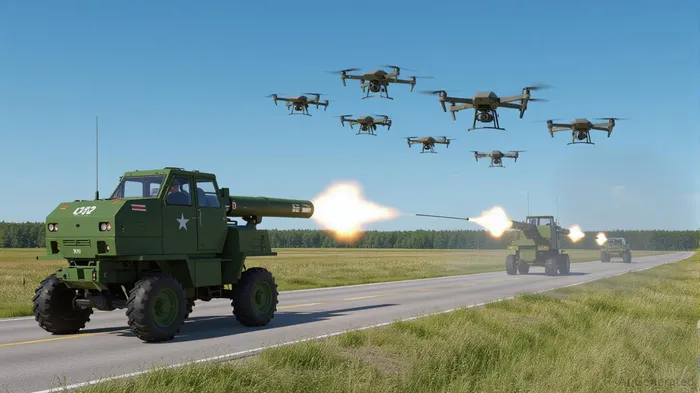
The solution lies in layered defense systems combining radar, AI, and directed energy. Companies like QinetiQ (QQQ) and L3Harris are leading this shift:
- QinetiQ's DragonFire laser neutralizes drones at under £10 per shot, offering cost efficiency against swarms.
- L3Harris's VAMPIRE Counter-UAS Pallet provides portable radar and jamming capabilities for frontline forces.
Investors should note QQQ's 30% revenue growth in 2024, driven by defense contracts. This trajectory is likely to accelerate as global militaries adopt similar technologies.
Meanwhile, AI-driven solutions from firms like DroneShield and ZenaTech are critical for real-time threat detection. Their modular systems, compatible with existing infrastructure, ensure scalability for post-war recovery.
Urban Infrastructure Resilience: The $260 Billion Opportunity
Beyond defense, Ukraine's reconstruction requires materials that can withstand future attacks. Over 1,000 energy facilities and 650 healthcare centers were damaged by late 2024, creating demand for fire-resistant steel, blast-proof glass, and smart grid technologies.
Key sectors to watch:
1. Fire-Resistant Building Components:
- USG Corporation (USG) manufactures fire-resistant drywall used in critical infrastructure.
- Cemex (CX) produces ultra-high-performance concrete for blast-resistant buildings.
- Smart Energy Grids:
- NextEra Energy (NEE) and Schneider Electric are pioneering microgrids that decentralize energy distribution, reducing reliance on centralized targets.
Why Invest Now?
The Ukraine conflict has become a global proving ground for defense and resilience technologies. While the immediate focus is on Ukraine's recovery, these solutions are already shaping military spending worldwide:
- Geopolitical Spillover: Over 40 countries are modernizing air defenses amid fears of drone warfare, per the 2025 Global Counter-UAV Report.
- Climate Resilience Synergies: Fire-resistant materials and smart grids are also critical for climate adaptation, creating dual-use demand.
Risks and Mitigation
- Geopolitical Uncertainty: Conflict escalation could disrupt supply chains. Diversify portfolios with firms with global production bases (e.g., ZenaTech, partnered with NATO).
- Regulatory Barriers: U.S. export controls on advanced tech may delay profits. Focus on firms with existing defense contracts (e.g., L3Harris).
Investment Thesis: Allocate Capital to the “Defense-Resilience Stack”
- Short-Term Plays:
- Directed Energy Weapons: QinetiQ (QQQ), with its DragonFire system, offers immediate exposure to counter-drone demand.
AI Threat Detection: DroneShield (DSHLD) is a low-cost entry point into AI-driven solutions.
Long-Term Growth:
- Urban Reconstruction: USG (USG) and CemexCX-- (CX) will benefit from multiyear rebuilding efforts.
- Global Security Trends: L3HarrisLHX-- (LHX) and ZenaTechZENA-- (ZNT) are positioned to capture post-Ukraine defense spending.
Conclusion: A Market Built on Necessity, Not Speculation
The Ukraine conflict has turned defense and resilience technologies from niche sectors into strategic imperatives. With reconstruction costs exceeding $1 trillion and global defense spending on counter-UAV systems projected to hit $260 billion by 2030, investors ignoring this space risk missing a generational opportunity.
Allocate 5–10% of your portfolio to this “defense-resilience stack,” prioritizing firms with proven tech and geopolitical relevance. The stakes are high, but so are the rewards—for Ukraine's recovery and the world's security.





Comentarios
Aún no hay comentarios