
The Rise of XRP-Like Rivals Amid Dogecoin ETF Disappointment
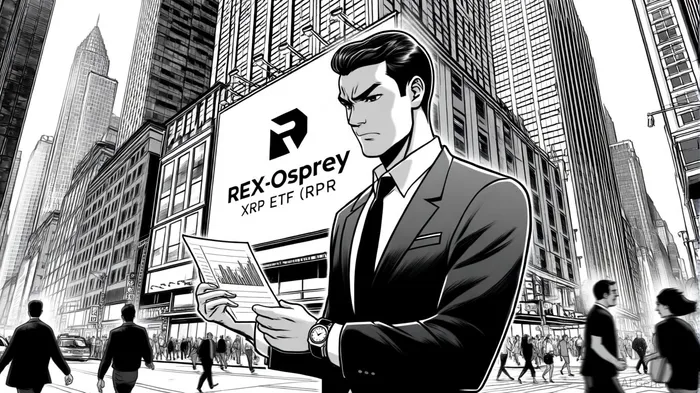
The launch of the REX-Osprey XRPXRP-- and DogecoinDOGE-- ETFs on September 18, 2025, marked a seismic shift in the cryptocurrency market, with combined first-day trading volumes of $54.7 million—setting a record for the year[1]. The XRP ETF (XRPR) alone accounted for $37.7 million, outpacing even the most optimistic projections for the Dogecoin ETF (DOJE), which secured $17 million[2]. This regulatory breakthrough, achieved under the Investment Company Act of 1940, bypassed traditional Securities Act hurdles, enabling faster approvals and stricter fund oversight[3]. While these ETFs signaled growing institutional acceptance of altcoins, they also exposed diverging trajectories between XRP's utility-driven appeal and Dogecoin's meme-driven volatility.
XRP's Regulatory Legitimacy and Competitor Dynamics
XRP's ETF success underscores its position as a regulated utility coin, contrasting with Dogecoin's grassroots origins. The REX-Osprey XRP ETF's record-breaking debut reflects investor confidence in XRP's role in cross-border payments and its alignment with regulatory frameworks[4]. This legitimacy has intensified competition with SolanaSOL-- (SOL), which boasts high-speed transactions and developer adoption. As of late September 2025, Solana trades at $214.64, with analysts forecasting a potential climb to $300 if key resistance levels are breached[5]. XRP, meanwhile, hovers around $2.90, with bullish scenarios contingent on further ETF approvals and institutional inflows[6].
The regulatory clarity afforded by the 1940 Act framework has also spurred interest in other utility coins. Shiba InuSHIB-- (SHIB), for instance, trades at $0.00001248 but faces mixed signals, with a 67% breakout potential if it clears $0.000013[7]. This fragmentation highlights a broader trend: investors are diversifying beyond BitcoinBTC-- and EthereumETH--, seeking exposure to projects with tangible use cases or regulatory alignment.
Dogecoin ETF Disappointment: A Cautionary Tale
Despite its historic launch, the Dogecoin ETF has shown signs of investor disappointment. While DOGEDOGE-- surged 30% in the week leading up to the ETF debut, hitting $0.2813, it has since faced resistance at $0.30, with some analysts warning of a potential pullback to $0.25[8]. The ETF's $17 million volume, though impressive, fell short of the $37.7 million generated by its XRP counterpart, raising questions about Dogecoin's institutional appeal.
Technical indicators further complicate the outlook. The MACD and RSI suggest overbought conditions, while whale accumulation and corporate purchases (e.g., CleanCore Solutions' 500 million DOGE hoard) hint at mixed sentiment[9]. Institutional investors, drawn to XRP's regulated infrastructure, may view Dogecoin's price volatility as a risk, particularly in a market increasingly prioritizing utility over meme-driven speculation.
Regulatory Shifts and the Future of Altcoin ETFs
The success of XRPRXRPR-- and DOJE has accelerated regulatory momentum for altcoin ETFs. The SEC's revised approval standards, reducing timelines to 75 days, could unlock over 90 pending applications, including funds tied to Solana and Shiba Inu[10]. This shift signals a maturation of the crypto market, where projects with clear regulatory compliance and real-world applications—like XRP's cross-border payment solutions—will outperform speculative assets.
However, challenges remain. The 1940 Act's restrictions, which prevent direct crypto holdings in favor of offshore subsidiaries, may limit liquidity for some ETFs. Additionally, macroeconomic factors, such as interest rate expectations, could influence inflows. For instance, lower rates in late 2025 are projected to boost risk-on assets, potentially benefiting both XRP and Dogecoin[11].
Conclusion: Navigating the New Altcoin Landscape
The post-ETF landscape reveals a bifurcation in the crypto market: utility coins like XRP and Solana are gaining institutional traction through regulatory alignment and scalable infrastructure, while memeBOME-- coins like Dogecoin face an uphill battle to sustain momentum. Investors must weigh these dynamics carefully. For XRP-like rivals, the path forward hinges on continued ETF approvals and ecosystem development. For Dogecoin, overcoming price resistance and proving long-term utility will be critical to avoiding the “ETF disappointment” narrative.
As the market evolves, one thing is clear: the integration of altcoins into traditional finance is no longer a question of if, but how projects will adapt to meet regulatory and institutional demands.






Comentarios
Aún no hay comentarios