
The Rise of Undersea Drones: A New Frontier in Defense Tech and Strategic Naval Power
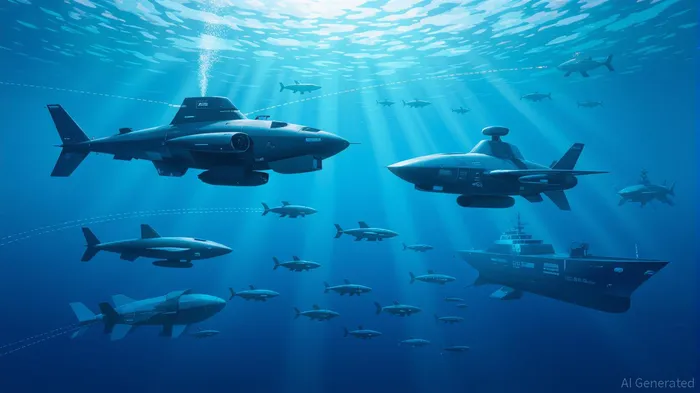
The Indo-Pacific is witnessing a quiet revolution beneath the waves. Autonomous undersea vehicles (AUVs) are redefining naval power, offering unprecedented capabilities in intelligence, surveillance, and strike operations. As China's undersea dominance grows and regional alliances like AUKUS accelerate their technological edge, defense contractors and tech partners are positioning themselves at the forefront of this new frontier. For investors, the AUV ecosystem represents a confluence of strategic necessity and exponential growth potential.
Strategic Shifts and Military Applications
AUVs are no longer niche tools; they are central to modern naval strategy. China's HSU-001, a large-displacement AUV introduced in 2019, exemplifies Beijing's push to modernize its navy and assert influence across the Indian Ocean[4]. Meanwhile, the U.S. Navy's Orca XLUUV and Australia's Ghost Shark program underscore the Indo-Pacific's role as a battleground for undersea technological supremacy. These systems operate in GPS-denied environments, leveraging advanced sonar, inertial navigation, and real-time imaging to conduct covert reconnaissance, mine detection, and even strike missions[2].
The strategic value of AUVs lies in their stealth and endurance. Unlike traditional submarines, AUVs can remain undetected for extended periods, gathering intelligence or disrupting adversary operations. For instance, AUVs equipped with acoustic positioning systems and simultaneous localization and mapping (SLAM) technologies can map undersea terrain, monitor critical infrastructure like communication cables, and even deploy loitering munitions[1]. This capability is particularly critical as undersea cables—vital for global data and financial networks—face growing risks from sabotage[4].
Australia's Ghost Shark: A Case Study in Scalable Innovation
At the heart of this transformation is Australia's Ghost Shark, an extra-large autonomous undersea vehicle (XL-AUV) developed by Anduril for the Royal Australian Navy. With a modular design and scalable manufacturing techniques, the Ghost Shark can be rapidly reconfigured for missions ranging from ISR to strike operations. Its “very, very long-range” endurance and lack of large masts enhance stealth, making it a potential “mothership” for smaller uncrewed systems[1].
The project's economic and strategic implications are profound. A joint investment of over $180 million between the Australian government and Anduril has created a domestic supply chain involving 42 local companies, ensuring resilience against global disruptions[1]. The first production unit is slated for late 2025, aligning with Australia's AUKUS commitments and its goal to counter China's growing undersea influence. For investors, this underscores a broader trend: AUV programs are no longer experimental—they are industrial-scale ventures with clear ROI metrics.
Leidos and the Commercialization of Undersea Autonomy
While Anduril focuses on high-end platforms like the Ghost Shark, LeidosLDOS-- is capitalizing on the scalability of lower-cost AUVs. Its Sea Dart UUV, priced at around $150,000 per unit, is designed for mass deployment in counter-mine operations, infrastructure monitoring, and environmental sensing[2]. A classified customer has already ordered 12 units, with plans to acquire 70 more—a testament to the demand for attritable systems in the Indo-Pacific[3].
Leidos' recent $248 million Navy contract to support autonomous systems further cements its role in this ecosystem[4]. The company's Leidos Autonomous Vessel Architecture (LAVA), which has logged over 120,000 nautical miles, demonstrates the operational viability of AI-driven undersea platforms[3]. By targeting both military and commercial applications—such as offshore energy and scientific research—Leidos is diversifying its revenue streams while addressing a market projected to grow from $610 million in 2024 to $854 million by 2030[5].
Market Dynamics and Long-Term Growth
The Asia-Pacific AUV market is expanding at a compound annual growth rate (CAGR) of over 8%, driven by defense budgets and hybrid commercial applications[5]. Governments are prioritizing AUVs for Maritime Domain Awareness (MDA), while private firms see opportunities in subsea infrastructure inspection and resource exploration. For example, Saab and ExailXOM-- are developing AUVs to monitor and repair undersea cables, a niche with high margins and geopolitical relevance[4].
Investors should also note the role of swarm capabilities and hybrid systems. AUVs operating in coordinated swarms can overwhelm adversary defenses or conduct complex missions like deep-sea mining. This technological leap is attracting capital from both traditional defense firms and tech startups, creating a fertile ground for innovation.
Conclusion: A Submerged Gold Rush
The rise of undersea drones is not just a military imperative—it's an investment opportunity. Companies like Anduril and Leidos are building platforms that combine strategic value with commercial scalability, while regional dynamics ensure sustained demand. As AUVs evolve from experimental tools to operational essentials, the Indo-Pacific's undersea landscape will become a key battleground for both power and profit. For investors, the message is clear: the future of naval warfare—and the fortunes tied to it—is beneath the waves.







Comentarios
Aún no hay comentarios