
The Rise of Toy-Driven Franchises: Assessing Sony's Labubu Movie Venture as a Strategic Bet in Global Pop Culture and Consumer Demand
The Labubu Phenomenon: From Keychain to Cultural Currency
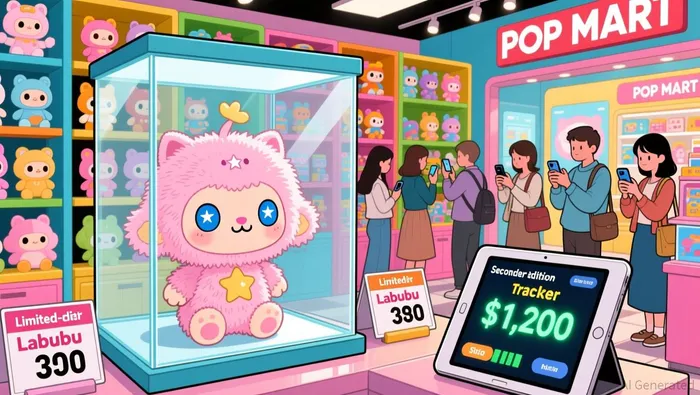
Labubu, a pastel-hued plush toy with a melancholic expression, was designed by Hong Kong artist Kasing Lung and marketed by Pop Mart as part of its "Monsters" series. Its success hinges on a unique value proposition: blending the tactile appeal of plush toys with the collectibility of vinyl figurines. According to a report by , the dolls have become "viral fashion accessories," with new releases selling out within minutes on Pop Mart's platforms. This demand is further amplified by deliberate scarcity-Pop Mart releases only 10–15% of its products in limited runs-and a thriving resale market where items trade at 10–20 times their retail price.
The franchise's scalability is evident in Pop Mart's financials. In Q3 2025, the company reported a 245–250% year-over-year revenue increase, driven by a 365–370% surge in international sales, particularly in the Americas. CEO Wang Ning projects 2025 annual revenue of $4.2 billion, with Labubu accounting for over 35% of Pop Mart's total revenue-up from 14% in mid-2024 according to . By comparison, Mattel's Barbie and Hot Wheels segments generated $374 million and $626 million, respectively, during the same period according to . These figures suggest Labubu's IP is not only outpacing traditional toy franchises but also demonstrating the kind of cross-platform appeal that Hollywood covets.
Sony's Strategic Gambit: Anchoring a Franchise in a Post-Barbie Era
Sony's decision to develop a Labubu feature film aligns with a broader industry pivot toward toy-driven storytelling. The 2023 Barbie film, which grossed $1.2 billion globally, proved that nostalgia-fueled IP could resonate with modern audiences. Sony, still riding the success of its animated KPop Demon Hunters (which earned $350 million in 2024), aims to replicate this formula with a franchise that already has a built-in global fanbase.
However, the studio faces challenges. Unlike Barbie, which has decades of brand equity, Labubu's narrative potential remains untested in live-action or animated formats. No director or producer has yet been attached to the project, and the lack of a clear creative vision raises questions about how to translate the toy's aesthetic into a compelling story. Yet, notes, Sony's early involvement signals confidence in Labubu's commercial viability, even if the creative roadmap is still under development.
Scalability and Risks: Can Labubu Avoid the "Toy Movie" Trap?
The scalability of Labubu's IP depends on three factors: production capacity, international expansion, and resistance to market saturation. Pop Mart has already diversified, its product line, releasing over 20 new plush variants in 2025 to sustain demand. However, as the Layne's Chicken Fingers case study illustrates, even rapid growth can lead to domestic market saturation. Layne's, a Texas-based fast-food chain, achieved near-total saturation in its home state but struggled to replicate success elsewhere according to PR Newswire. For Labubu, the solution lies in expanding into untapped international markets-a strategy Pop Mart has executed with vigor, achieving 1,265% revenue growth in the Americas and 730% in Europe.
The secondary market also presents a double-edged sword. While high resale prices validate Labubu's exclusivity, they risk alienating core consumers who cannot afford inflated prices. This dynamic mirrors the early days of Beanie Babies, where speculation drove demand but eventually led to a crash. Sony's film could mitigate this risk by creating new touchpoints-merchandising, theme park attractions, or spinoff characters-that sustain interest beyond the toy itself.
Conclusion: A Strategic Bet with High Rewards
Sony's Labubu venture is a calculated risk in an era where consumer IP is increasingly valued for its cross-industry potential. With Pop Mart's revenue projections and the franchise's dominance in both primary and secondary markets, Labubu appears undervalued relative to its scalability. The key for Sony will be to balance creative ambition with commercial pragmatism, ensuring the film doesn't merely capitalize on the toy's popularity but elevates it into a multimedia empire. For investors, the stakes are high-but so are the rewards.







Comentarios
Aún no hay comentarios