
The Rise of Token2049: Crypto's New Epicenter and Its Implications for Decentralized Finance
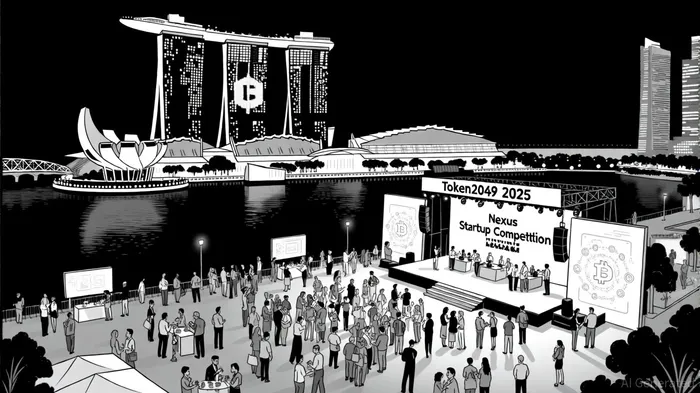
The global crypto landscape has long been defined by volatility and speculative fervor. Yet, in 2025, a new paradigm is emerging: one where geopolitical stability and institutional adoption converge to legitimize digital assets as a cornerstone of modern finance. At the heart of this transformation lies Token2049, a conference that has evolved from a niche gathering to the "Davos of digital assets." Held in Singapore, Token2049 2025 attracted over 25,000 attendees from 160+ countries, 300+ speakers, and 7,000+ companies, cementing its role as a catalyst for decentralized finance (DeFi) and real-world asset (RWA) innovation, according to the ChainUp guide. This article examines how Singapore's regulatory framework and geopolitical strategies have positioned Token2049 as a linchpin for institutional adoption, reshaping the future of crypto.
Singapore's Regulatory Framework: A Model of Balance
Singapore's approach to crypto regulation exemplifies a delicate balance between fostering innovation and ensuring market integrity. Under the Financial Services and Markets Act 2022 (FSMA), all digital token service providers (DTSPs) must obtain licenses from the Monetary Authority of Singapore (MAS), with non-compliance risking fines up to SGD 250,000 or imprisonment, as described in the Coinpedia overview. This stringent yet transparent framework has attracted institutional players like Franklin Templeton and BlackRockBLK--, which are increasingly allocating capital to crypto assets, as noted in the CryptoCalendar listing.
The regulatory environment also aligns with Singapore's geopolitical ambitions. By hosting Token2049, the city-state reinforces its position as a neutral hub bridging East and West. Unlike jurisdictions with restrictive sanctions, Singapore's policies allow participation from diverse actors, including entities from politically sensitive regions, a point highlighted in the Boxmining overview. This inclusivity, coupled with its reputation for regulatory clarity, has made Singapore a preferred destination for global capital. For instance, the 2025 edition of Token2049 coincided with Bitcoin's rally to $125,000 and record institutional inflows of $5.95 billion into crypto ETFs, signaling a shift from retail speculation to institutional underwriting, according to the Ricosworks report.
Institutional Adoption: From Skepticism to Strategic Integration
Token2049 2025 underscored the maturation of institutional adoption. The conference spotlighted themes such as tokenized RWAs, AI-blockchain integration, and post-quantum cryptography, reflecting the industry's pivot toward scalable, real-world applications, as noted in a Forbes analysis. For example, discussions on tokenizing luxury assets like real estate and watches highlighted how blockchain can unlock liquidity in traditionally illiquid markets, an observation also covered by ChainUp's guide.
Institutional confidence was further bolstered by Singapore's proactive engagement with global regulatory developments. The Stablecoin Summit 2025, held alongside Token2049, brought together leaders from SAP, Mastercard, and central banks to address cross-border payment solutions and enterprise finance, as reported in the TMCNet report. Executives emphasized that regulatory clarity-such as the U.S. GENIUS Act and the EU's MiCA-has been pivotal in enabling institutional participation. As David Katz of Circle noted, "Clear rules promote good behavior and unlock liquidity," a sentiment echoed by regulators and investors alike in the TMCNet report.
The conference also showcased Singapore's commitment to nurturing innovation. Initiatives like the TOKEN2049 Origins Hackathon and the NEXUS Startup Competition provided platforms for early-stage projects to secure funding and mentorship from industry giants like Binance and a16z, an effort covered by Boxmining. These programs, supported by Singapore's infrastructure and regulatory environment, reinforce the city-state's role as a launchpad for Web3 solutions.
Implications for DeFi and the Broader Ecosystem
Token2049's focus on institutional-grade DeFi and layer-2 scalability signals a broader industry shift. DeFi protocols are no longer just experimental; they are being integrated into traditional financial systems. For instance, liquid staking derivatives and decentralized exchanges (DEXs) are now being evaluated by hedge funds and asset managers as tools for yield generation and risk diversification, per the BitPinas wrap-up.
Moreover, the conference highlighted the intersection of AI and blockchain, with projects exploring AI-driven governance models and automated risk management systems. These innovations, discussed by speakers like Balaji Srinivasan and Vlad Tenev, suggest that DeFi's next phase will be defined by AI-enhanced efficiency and security, an evolution highlighted in ChainUp's guide.
Geopolitically, Token2049's success underscores Singapore's strategic role in mitigating risks associated with crypto's global fragmentation. By fostering dialogue between regulators, developers, and investors, the event has helped align disparate interests toward a common goal: mainstream adoption. As Richard Teng of Binance stated, "Our aim is to serve both centralized and decentralized markets," a vision that resonates with Singapore's broader economic strategy, as noted in the Ricosworks report.
Conclusion
Token2049 2025 is more than a conference-it is a microcosm of crypto's evolution. By leveraging Singapore's regulatory clarity and geopolitical neutrality, the event has become a nexus for institutional adoption, technological innovation, and global collaboration. For investors, the implications are clear: DeFi and tokenized assets are no longer speculative bets but strategic assets in a rapidly digitizing financial ecosystem. As Singapore continues to refine its regulatory framework and host events like Token2049, it will likely remain at the forefront of this transformation, offering a blueprint for other jurisdictions seeking to balance innovation with stability.





Comentarios
Aún no hay comentarios