
The Rise of Stablecoins: Institutional Adoption and the Next Wave of DeFi Growth
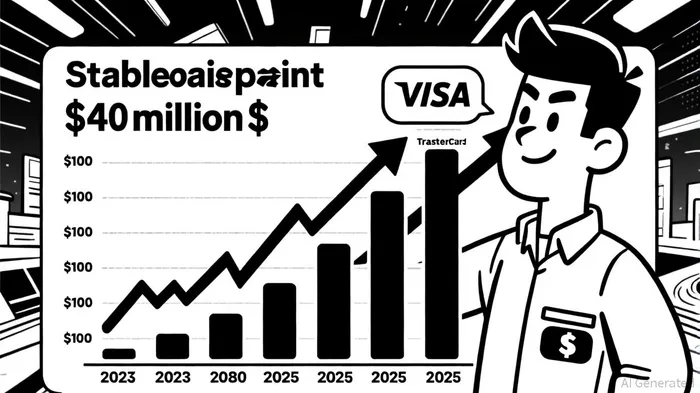
The digital asset sector is undergoing a seismic shift, with stablecoins emerging as the linchpin of institutional portfolios and decentralized finance (DeFi) ecosystems. By October 2025, the global stablecoin market has surged past $250–280 billion in market capitalization, with annual transaction volumes projected to eclipse $40 trillion-surpassing Visa and Mastercard combined, according to a stablecoin market analysis. This meteoric rise is not a speculative bubble but a calculated response to macro tailwinds: regulatory clarity, real-world utility, and institutional-grade yield opportunities.
Macro Tailwinds: Regulatory Clarity and Market Validation
The U.S. GENIUS Act, enacted in July 2025, has been a game-changer. By mandating 1:1 reserves in safe assets and aligning with the EU's MiCA framework, it has transformed stablecoins from a regulatory gray zone into a legitimate asset class, that analysis found. This clarity has spurred 90% of businesses to testTST-- or adopt stablecoins, primarily for cross-border payments, according to global adoption trends. Meanwhile, Circle's IPO-a 168% surge on day one-has validated the financial viability of stablecoin models, with USDCUSDC-- now backed 1:1 by cash and short-term U.S. Treasuries, according to a Mitosis report.
Emerging markets are leading the charge. In Latin America and Asia, stablecoins are revolutionizing remittances and financial inclusion, bypassing legacy banking infrastructure, the same analysis notes. For institutions, the appeal is twofold: stablecoins offer programmable cash with yield-generation capabilities, while DeFi protocols provide access to real-time settlements and global liquidity, according to the Q3 2025 report.
Strategic Asset Allocation: Yield, Liquidity, and Diversification
Institutions are no longer treating stablecoins as a side bet. By Q3 2025, $47.3 billion had been deployed into stablecoin-based yield strategies across blockchain ecosystems, the report found. Lending protocols dominate this space, with AaveAAVE-- capturing 41.2% of the market share via its multi-chain infrastructure. Borrowing rates for USDC and USDTUSDT-- now hover at 5.7% and 5.3%, respectively-outperforming traditional fixed-income instruments, the report adds.
Real-yield products are the next frontier. Retrieval-augmented finance (RAF) protocols are tokenizing short-term Treasuries and commercial paper, offering institutions a bridge between stablecoins and real-world assets, the report explains. Ethena's USDeUSDe-- staking program, with its 11% yield, has attracted 9.3% of institutional deployments, though its delta-neutral model remains untested at scale, the report cautions. Liquid staking derivatives, meanwhile, enable dual yield capture-combining stablecoin lending with staking rewards-accounting for 14.7% of institutional allocations, the report notes.
USDC's dominance (56.7% market share) is no accident. Its regulatory compliance and integration with BlackRock's infrastructure make it the gold standard, according to that report. Yet USDT (27.9%) and USDe (9.3%) persist due to liquidity and yield advantages. Emerging compliant stablecoins like PayPal's PYUSD are also gaining traction, with 140% quarter-over-quarter growth in institutional adoption, the report indicates.
Institutional Adoption in DeFi and Cross-Border Payments
Stablecoins are no longer confined to crypto-native use cases. JPMorgan, Visa, and PayPal have integrated them into their platforms, treating stablecoins as cash equivalents with programmable yield, that analysis observes. Deutsche Bank and Santander are leveraging stablecoins for real-time B2B settlements, reducing costs and settlement times, the Mitosis report noted.
In DeFi, stablecoins are the lifeblood of liquidity pools and automated market makers. Yearn Finance and PendlePENDLE-- are automating yield strategies, while Aave and CompoundCOMP-- offer institutional-grade lending. The rise of Layer 2 solutions like Base and ArbitrumARB-- has further lowered barriers, with EthereumETH-- retaining 42.3% of institutional deployments despite high gas costs, the Q3 2025 report states.
Risks and the Road Ahead
No asset class is without risks. Regulatory shifts, like the potential for stricter reserve requirements, could disrupt the current trajectory. Additionally, the novelty of some yield protocols (e.g., USDe) introduces counterparty risks. However, the macro tailwinds-regulatory alignment, institutional infrastructure, and real-world adoption-suggest these challenges will be navigated rather than insurmountable.
By 2028, the stablecoin supply is projected to reach $2 trillion, the market analysis projects. For investors, this represents a unique opportunity: a liquid, yield-generating asset class that bridges traditional finance and DeFi. As 86% of institutional investors now have exposure to digital assets, the Mitosis report concludes, the question is no longer if stablecoins will matter-but how much they will reshape global finance.





Comentarios
Aún no hay comentarios