
The Rise of Specialized AI Models and Agentic AI in 2026: A Definitive Shift in Enterprise Value Creation
The year 2026 marks a pivotal inflection point in enterprise AI adoption, as organizations transition from fragmented automation to agentic AI systems and specialized models that redefine workflows, governance, and ROI. This shift is not merely about deploying tools but reengineering entire operating models to harness AI's potential for autonomous decision-making, contextual intelligence, and scalable efficiency. For investors, the opportunities lie in targeted infrastructure upgrades, data-centric innovation, and edge AI enablers-sectors poised to capture the next wave of enterprise value creation.
Infrastructure Reimagined: From Monolithic to Agent-Ready Architectures
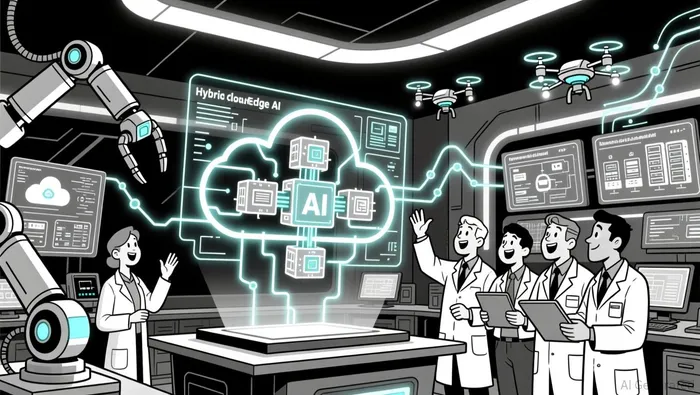
Enterprises are no longer retrofitting legacy systems for AI; they are building agent-compatible architectures from the ground up. According to a report by Deloitte, 70% of organizations are prioritizing hybrid cloud-edge infrastructures to balance performance, latency, and cost. This includes modular systems that integrate domain-specific language models (DSLMs) for regulated industries like healthcare and finance, where accuracy and compliance are non-negotiable according to industry analysis.
A critical enabler is the rise of Model Context Protocols (MCP), which standardize AI integration with tools and data sources, reducing fragmentation and improving context retention as research shows. For example, NVIDIA's acquisition of Groq assets and Broadcom's ASIC expertise are accelerating the deployment of agent-ready hardware, while startups like Nscale and Modular are democratizing access to scalable AI infrastructure as startups report.
However, challenges persist. Only 14% of enterprises have agentic AI solutions ready for deployment, with 35% lacking formal strategies according to Deloitte analysis. Legacy system integration, data architecture constraints, and governance frameworks remain significant barriers as industry data shows. Investors must prioritize companies addressing these pain points, such as SurrealDB (unified data management for agentic workflows) and Nektar (AI-driven revenue operations analytics) according to market insights.
Workforce Reengineering: From Task Automation to Human-AI Collaboration
The workforce is being reshaped, not replaced. By 2028, 38% of organizations will have AI agents embedded in human teams, redefining roles in sales, healthcare, and finance according to industry forecasts. For instance, AI agents in healthcare are reducing administrative burdens by automating documentation through ambient note generation, saving 66 minutes per provider daily as case studies show. In finance, banks report 40% faster loan approvals and 35% lower fraud rates via agentic AI according to financial reports.
This shift demands reskilling and cultural overhauls. Deloitte emphasizes that AI adoption requires redefining workflows to align with AI's strengths, such as real-time data processing and predictive analytics as industry analysis indicates. Startups like Abridge (AI-powered medical scribing) and EvenUp (legal AI) are already demonstrating how specialized models can augment human expertise while reducing burnout as startup reports show.
ROI Case Studies: Measuring the Impact of Agentic AI
The ROI of agentic AI is no longer theoretical. IDC projects that AI investments will grow to $1.3 trillion by 2029, driven by task-specific agents embedded in 40% of enterprise applications by 2026 according to industry projections. For example:
- Healthcare: AI agents reduce documentation time by 66 minutes per provider daily as data shows.
- Customer Service: 80% of common issues are resolved autonomously by 2029, with contact centers seeing 20–40% cost reductions according to market analysis.
- Finance: Banks report 40% faster loan approvals and 35% lower fraud as financial data shows.
These outcomes are underpinned by bounded autonomy and multi-agent systems, which allow agents to act independently within defined limits while maintaining human oversight as industry trends show. Enterprises leveraging these systems see 1.7x ROI beyond basic automation savings according to ROI analysis.
Investment Recommendations: Capturing the 2026 Inflection Point
To capitalize on this shift, investors should focus on three pillars:
1. AI-Native Platforms
- OpenAI and Anthropic remain foundational, with OpenAI's GPT-5.1 and Anthropic's safety-first models dominating enterprise adoption according to market analysis.
- Mistral AI and Perplexity AI are emerging as leaders in open-source and retrieval-augmented generation, offering cost-effective alternatives to proprietary models as startup reports indicate.
- Nektar and Nektar (revenue operations analytics) exemplify how AI-native platforms are redefining vertical-specific workflows according to industry analysis.
2. Data-Centric Startups
- SurrealDB (unified data management) and Nektar (customer data unification) are critical for enterprises scaling agentic AI according to market insights.
- Lucidworks and Creole Studios are advancing data governance and ethical AI deployment in regulated sectors as industry analysis shows.
3. Edge AI Enablers
- NVIDIA (GPU leadership), Broadcom (ASICs), and Vertiv (data center infrastructure) are foundational to AI's physical layer according to financial reports.
- Arm Holdings and Ceva are dominating edge AI with low-power architectures, while NXP and Ambarella are leading in automotive and industrial applications according to industry analysis.
Conclusion: The New AI Operating System
The 2026 AI landscape is defined by a shift from automation to autonomy, where specialized models and agentic systems become the backbone of enterprise operations. For investors, the key is to target companies enabling this transition-those building the infrastructure, data frameworks, and edge hardware that make agentic AI scalable, governable, and profitable. As enterprises demand measurable ROI, the winners will be those who reimagine workflows, not just replace tasks.







Comentarios
Aún no hay comentarios