
The Rise of Southeast Asia as the New Manufacturing Hub: A Strategic Investment Opportunity Amid U.S.-China Decoupling
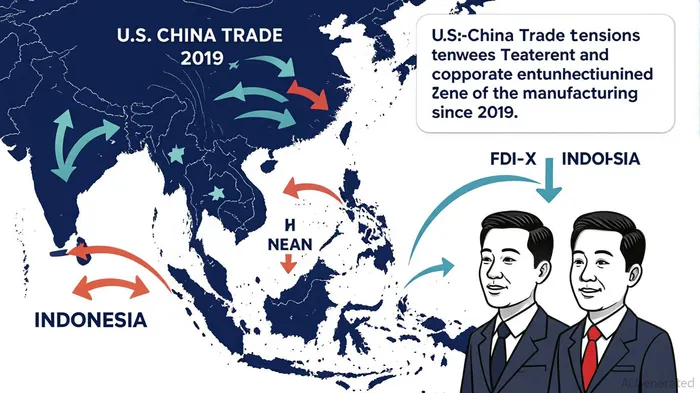
The global manufacturing landscape is undergoing a seismic shift as companies recalibrate supply chains in response to U.S.-China decoupling, rising labor costs in China, and the pursuit of geopolitical resilience. At the epicenter of this reallocation lies Southeast Asia, where Vietnam and Indonesia are rapidly emerging as manufacturing powerhouses. Driven by surging foreign direct investment (FDI), strategic infrastructure development, and tech-enabled industrialization, these nations are not only capturing Chinese manufacturing shifts but also redefining the region's role in global trade.
FDI Inflows and Export Growth: A Quantifiable Surge
Vietnam and Indonesia have become magnets for capital seeking to diversify away from China. In 2023, Vietnam attracted $39 billion in FDI, with manufacturing accounting for 64.2% of total inflows [1]. By 2024, this figure rose to $25.58 billion in manufacturing-specific investments, representing 66.9% of total FDI and a 1.1% year-on-year increase [2]. Indonesia, meanwhile, saw FDI jump to $55.33 billion in 2024, with greenfield manufacturing projects dominating inflows [3]. These investments are translating into export growth: Vietnam's exports hit $440 billion in 2023, while Indonesia's reached $290 billion, driven by electronics, metals, and chemicals [4].
The U.S.-China trade war has accelerated this trend. Between 2019 and 2023, Vietnam's exports to the U.S. grew at an 8.2% compound annual growth rate (CAGR), fueled by FDI in electronics and automotive sectors [5]. Similarly, Indonesia's manufacturing FDI surged as firms like ToyotaTM--, HondaHMC--, and FordF-- established EV production facilities, leveraging the country's natural resources and competitive labor costs [6].
Corporate Relocations and Sectoral Shifts
Multinational corporations are reshoring or nearshoring operations to Vietnam and Indonesia. Samsung, for instance, has invested $17.5 billion in Vietnam's electronics sector, making it a global hub for high-end mobile phone production [7]. In Indonesia, the government's “Making Indonesia 4.0” initiative has drawn automakers to its EV ecosystem, with Toyota and Ford setting up battery and component manufacturing plants [8]. These relocations are not merely reactive but strategic: companies are capitalizing on Southeast Asia's young, skilled workforce and integration into global value chains.
The shift is also tech-driven. Vietnam's digital transformation plan aims for the digital economy to contribute 25% of GDP by 2025, supported by 5G expansion and AI R&D hubs [9]. Indonesia's focus on Industry 4.0 technologies—AI, IoT, and robotics—is evident in its cement and pharmaceutical sectors, where digital twins and automation are optimizing production [10].
Infrastructure and Logistics: Enabling the Manufacturing Boom
To sustain this growth, both nations are prioritizing infrastructure. Vietnam's North-South Expressway, set to cut travel times by 50%, and Long Thanh International Airport, designed to handle 50 million passengers annually, are critical to reducing logistics costs [11]. Indonesia's Danantara sovereign wealth fund has allocated $4 billion for transportation and energy projects, including the Batam-Bintan Bridge and Semarang Harbour Toll Road [12].
However, challenges persist. Vietnam's Cat Lai Port faces congestion due to a 30% surge in cargo volumes, while Indonesia's archipelagic geography complicates logistics. Despite these hurdles, the region's logistics market is projected to grow at a 6.29% CAGR from 2025–2030, driven by e-commerce and urbanization [13].
Tech-Enabled Manufacturing: The Next Frontier
Vietnam's ambition to become a semiconductor hub is gaining traction. Hana MicronMU-- and Amkor TechnologyAMKR-- have committed $2.5 billion to establish plants by 2030, while domestic firms like Viettel Group are advancing AI capabilities [14]. Indonesia's focus on automation is equally bold: AI robotics revenue is projected to grow from $57.95 million in 2024 to $228.70 million by 2030, driven by smart manufacturing adoption [15].
Challenges and the Path Forward
While Southeast Asia's manufacturing ascent is undeniable, risks remain. Vietnam's logistics costs still exceed the global average (16.5% of GDP), and Indonesia's regulatory complexity—such as local content requirements—can deter investment [16]. Yet, with continued infrastructure spending, digital innovation, and policy reforms, these nations are well-positioned to solidify their roles as manufacturing hubs.
For investors, the opportunities are clear: infrastructure projects, tech-enabled manufacturing, and logistics upgrades offer high-growth potential amid a reconfigured global supply chain. As the U.S.-China rivalry reshapes trade, Southeast Asia's strategic adaptability ensures it will remain a focal point for capital seeking resilience and returns.







Comentarios
Aún no hay comentarios