
The Rise of RWA Perpetuals and Their Role in Bridging Crypto and Traditional Finance
Structural Advantages: Liquidity, Accessibility, and Efficiency
RWA Perpetuals offer a unique blend of features that address long-standing inefficiencies in both DeFi and TradFi. By tokenizing assets such as Tesla shares, U.S. treasuries, and commercial real estate, these contracts enable 24/7 trading and up to 10x leverage, while mitigating liquidation risks through dynamic index management. This contrasts sharply with traditional markets, where settlement delays, intermediaries, and high transaction costs often hinder participation.
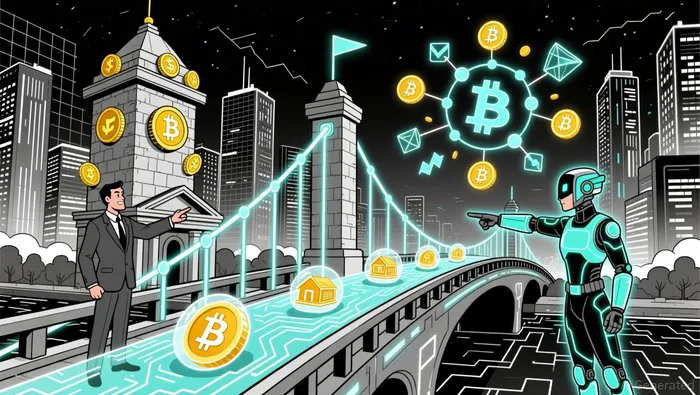
A key innovation lies in fractional ownership. For instance, tokenized real estate or private credit allows investors to own a slice of high-value assets previously reserved for institutional players. This democratization is amplified by blockchain's inherent transparency: ownership records and transaction histories are immutableIMX--, reducing fraud risks and enhancing trust.
Moreover, RWA Perpetuals integrate seamlessly with DeFi protocols. Tokenized assets can serve as collateral for loans on platforms like Aave's Horizon market or generate yield via staking on Maple FinanceSYRUP--, offering returns of 4–12% APY. This hybrid model combines the stability of traditional assets with the programmability of DeFi, enabling automated dividend distributions and real-time settlements.
Growth Potential: Market Projections and Institutional Adoption
The RWA market is on a trajectory to triple in value by 2026, driven by institutional adoption and regulatory clarity. Platforms like BlackRock's USD Institutional Digital Liquidity Fund (BUIDL) have already attracted over $500 million, signaling strong demand for tokenized financial products. Meanwhile, the U.S. financial system is undergoing a blockchain-driven transformation, with treasuries, real estate, and private credit transitioning into onchain assets. Analysts estimate the tokenized RWA market could reach $1 trillion by 2030, with the U.S. alone representing a $100 trillion opportunity.
Regulatory frameworks are also evolving to support this growth. The EU's MiCA framework, for example, provides a compliant pathway for RWA tokenization, fostering innovation while ensuring investor protection. In the U.S., legislative efforts to govern stablecoins and tokenized assets are accelerating adoption, particularly in cross-border transactions.
Comparative Edge Over Traditional Assets
Compared to traditional assets, RWA Perpetuals offer superior liquidity and operational efficiency. Traditional real estate or private credit markets are often illiquid, with transactions taking weeks or months to settle. In contrast, tokenized RWAs enable instant transfers and fractional trading, reducing entry barriers for retail investors. Smart contracts further automate compliance processes like KYC and AML, cutting operational costs by up to 70%.
For high-yield seekers, RWA Perpetuals outperform traditional fixed-income instruments. Platforms like Ondo Finance and Plume are leveraging tokenized treasuries to create onchain high-yield opportunities, capitalizing on regulatory shifts and market demand. This is particularly appealing in a low-interest-rate environment, where traditional bonds struggle to compete.
Future Outlook: Strategic Opportunities for 2026 Investors
For investors in 2026, RWA Perpetuals represent a dual opportunity: exposure to traditional asset classes and participation in DeFi's innovation. The integration of AI and machine learning into risk management systems is further enhancing their appeal, enabling real-time adjustments to index weights and volatility thresholds.
However, risks remain. Regulatory uncertainty in some jurisdictions and the nascent nature of onchain infrastructure could pose challenges. Yet, the rapid adoption by institutions and the structural advantages of RWA Perpetuals suggest these hurdles will be overcome as the market matures.
Conclusion
RWA Perpetuals are not merely a niche innovation but a foundational shift in how assets are owned, traded, and leveraged. By bridging the gap between DeFi and TradFi, they offer a scalable, efficient, and inclusive financial ecosystem. For 2026 investors, the combination of institutional backing, regulatory progress, and technological advancements makes RWA Perpetuals a compelling long-term bet. As the $100 trillion U.S. market moves toward tokenization, early adopters stand to reap significant rewards.






Comentarios
Aún no hay comentarios