
The Rise of Regulated Stablecoins in Cross-Border Payments: Strategic Infrastructure Investment in the Digital Settlement Revolution
The Infrastructure Revolution: From Concept to Reality
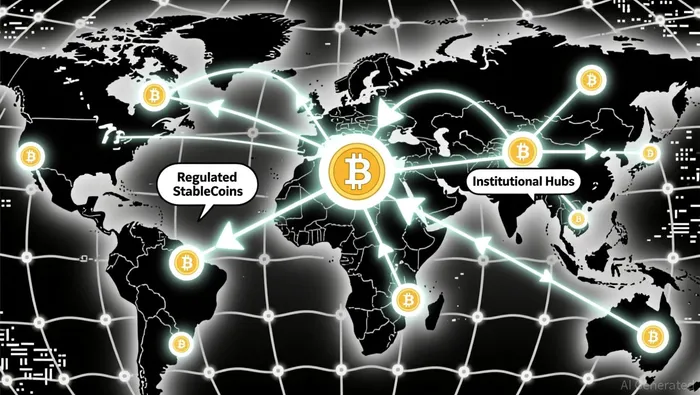
Regulated stablecoins are no longer speculative experiments. They are becoming foundational infrastructure for digital settlements, driven by three pillars: regulatory clarity, technological maturation, and institutional adoption.
Regulatory Frameworks as Catalysts
The European Union's Markets in Crypto-Assets (MiCA) regulation and the U.S. GENIUS Act of 2025 have provided the legal scaffolding needed for stablecoins to scale. These frameworks mandate reserve transparency, anti-money laundering (AML) compliance, and consumer protections, addressing earlier concerns about stability and misuse. For example, the GENIUS Act requires stablecoin issuers to maintain 100% fiat reserves, ensuring redemption guarantees and reducing de-pegging risks. Such clarity has attracted institutional players, with JPMorgan's JPM Coin now processing over $1 billion in daily transactions for institutional clients.Blockchain Scalability and Security
Public blockchains like EthereumETH-- and SolanaSOL-- have evolved to support high-throughput, low-cost transactions. Layer 2 solutions such as ArbitrumARB-- and OptimismOP-- have slashed fees, enabling real-time settlements for cross-border remittances and securities trading. Meanwhile, institutional-grade wallets now employ multiparty computation and hardware-based key management to mitigate hacking risks. These advancements are critical for stablecoins to handle the volume and complexity of global commerce.Institutional Adoption and Use Cases
Beyond remittances, stablecoins are penetrating capital markets. Projects like Singapore's Project Guardian and the China-Hong Kong-Thailand-UAE mBridge initiative demonstrate how tokenized cash can settle securities and Treasury bills in seconds, bypassing the days-long delays of traditional systems. For small businesses and migrant workers, stablecoins offer a lifeline: a migrant worker in the U.S. can now send $500 to Mexico in under a minute for less than $1 in fees, compared to the $25–$30 typically charged by legacy providers.
Strategic Investment Opportunities
The rise of regulated stablecoins is creating fertile ground for infrastructure investments. Key areas include:
- On- and Off-Ramp Providers: Firms enabling seamless conversion between fiat and stablecoins, such as crypto-native banks and fintechs, are critical for liquidity.
- Custody Solutions: Secure storage for institutional-grade stablecoin holdings is in high demand, with hardware wallets and MPC-based systems leading the charge.
- On-Chain Analytics: Tools like Chainalysis and Elliptic are essential for AML compliance and transaction surveillance, ensuring regulatory adherence.
Challenges and Risks
Despite the momentumMMT--, hurdles remain. Legal rights for stablecoin holders are still ambiguous, and liquidity models for banks are shifting as deposits are replaced by tokenized assets. Cybersecurity threats and reserve mismanagement could destabilize the ecosystem if not addressed. However, these risks are being mitigated by evolving regulations and technological safeguards.
Conclusion: Preparing for the Digital Settlement Era
The next decade will likely see stablecoins surpassing traditional payment methods in transaction volume. For investors, the priority is to align with infrastructure that supports this transition-blockchain scalability, custody solutions, and regulatory compliance tools. Financial institutions that fail to adapt risk obsolescence, while early adopters stand to capture a significant share of the $2 trillion stablecoin market projected by 2028.
As the digital settlement revolution accelerates, the question is no longer if stablecoins will reshape global finance, but how quickly institutions will build the infrastructure to harness their potential.





Comentarios
Aún no hay comentarios