
The Rise of Prediction Markets as Mainstream Financial Instruments: Polymarket vs. Kalshi
Market Dominance: Volume, Users, and Partnerships
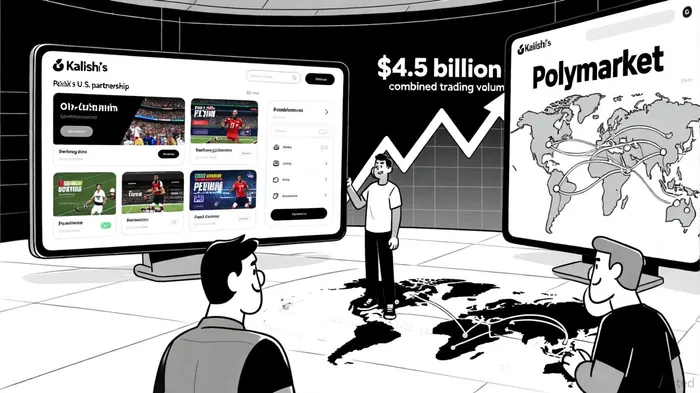
Kalshi and Polymarket have carved distinct paths to dominance. In October 2025, Polymarket led in nominal trading volume with $1.062 billion, while Kalshi trailed closely at $950 million, according to a Lookonchain analysis. The Lookonchain analysis also notes that Kalshi outpaced Polymarket in transaction count (3.575 million vs. 2.586 million), signaling stronger retail engagement. Kalshi's federal license in the U.S. has also given it a strategic edge, enabling partnerships like its collaboration with Robinhood, which drove 66.59% market share in September 2025, according to a Forklog report.
Meanwhile, Polymarket's offshore model has attracted international users through on-chain data and a $2 billion investment from Intercontinental ExchangeICE-- (ICE), pushing its valuation to $9 billion, as reported by Forklog. The platform is also preparing to launch a native token, POLY, and now allows BitcoinBTC-- funding, broadening its appeal in crypto-centric markets.
A pivotal development in 2025 was the NHL's licensing deals with both platforms-the first major U.S. sports league to partner with prediction markets, according to a Tribuna report. This move not only legitimizes the sector but also opens doors for similar agreements with leagues like the NBA and MLB. Kalshi's CEO has already hinted at such possibilities, framing prediction markets as "here to stay," in CasinoBeats coverage.
Regulatory Challenges and Strategic Advantages
Kalshi's federal license under the Commodity Futures Trading Commission (CFTC) has been a double-edged sword. While it grants access to all 50 U.S. states, including those where traditional sports betting is banned, it has also drawn criticism from the American Gaming Association (AGA), which argues that prediction markets bypass traditional consumer protections, according to GamingToday coverage. Kalshi's ability to innovate-such as introducing parlays (multi-event bets)-has helped it maintain a 66.59% market share in key periods, a point Forklog highlights.
Polymarket, by contrast, operates in a regulatory gray area. Despite its offshore status, the platform has expanded access through on-chain data and international user participation. However, its lack of U.S. regulatory clarity poses long-term risks, particularly as states like New York and California tighten crypto regulations, according to a Coinotag report.
Sustaining Growth: The Post-Election Slump
Both platforms face a critical challenge: user retention. While Q3 2025 saw record notional volumes exceeding $3 billion, user activity plummeted by mid-2025. Daily app downloads for Kalshi dropped to 13,000, and Polymarket's fell below 10,000-over 90% lower than the 2024 U.S. presidential election peak, according to Fortune. Fortune also reports daily active users declined sharply, with Kalshi at 27,000–32,000 and Polymarket at 5,000–10,000. This highlights the sector's reliance on high-profile events and the need for sustained product innovation.
Investment Potential: Valuation and Long-Term Outlook
Kalshi's valuation has surged to $12 billion following a $300 million Series D round led by Andreessen Horowitz and Sequoia Capital, according to a Bitget report. Its annualized trading volume now exceeds $50 billion, driven by sports betting and regulatory legitimacy. Polymarket, backed by ICE's $2 billion investment, is valued at $9 billion, per Forklog's reporting. Both platforms are positioning themselves to disrupt traditional sportsbooks like DraftKings and FanDuel, particularly in markets where online betting is restricted, as noted in a CoinDesk report.
However, risks remain. Kalshi faces state-level gaming disputes, while Polymarket's offshore model could face increased scrutiny. Investors must also weigh the sector's dependence on macroeconomic factors-such as crypto adoption and regulatory shifts-that could sway valuations.
Conclusion
Prediction markets are no longer speculative curiosities. Kalshi and Polymarket have demonstrated that trading on real-world events can rival traditional financial instruments in scale and sophistication. Kalshi's regulatory head start and U.S. partnerships give it a near-term edge, but Polymarket's international reach and ICEICE-- backing offer long-term resilience. For investors, the key is balancing optimism with caution: the sector's growth is undeniable, but its future hinges on navigating regulatory crosscurrents and sustaining user engagement beyond the next big event.







Comentarios
Aún no hay comentarios