
The Rise of Prediction Markets as a Disruptive Financial Innovation
Prediction markets, once niche curiosities, are emerging as a disruptive force in global finance. At the forefront of this transformation is Kalshi, a platform that has recently hit a $5 billion valuation following a $300 million Series D funding round led by Andreessen Horowitz, Sequoia Capital, and Paradigm. This valuation, coupled with its aggressive global expansion and regulatory-first strategy, positions Kalshi as a compelling case study for investors seeking exposure to a nascent asset class.
Valuation and Funding: A Catalyst for Growth
Kalshi's $5 billion valuation reflects investor confidence in its ability to scale prediction markets into a mainstream financial tool. The platform now accounts for over 60% of global prediction-market activity, a dramatic leap from 3.3% in 2024. This growth is underpinned by a $300 million Series D round, which has enabled Kalshi to expand its liquidity pool to 140 countries, creating a unified market for events ranging from central bank decisions to sports outcomes. The platform's monthly trading volume now exceeds $1.3 billion, a figure CEO Tarek Mansour has discussed amid concerns about regulatory uncertainty, with projections of $50 billion in annualized volume by 2025.
The funding has also allowed Kalshi to integrate with major brokerage platforms like WebullBULL-- and RobinhoodHOOD--, democratizing access for retail investors. This aligns with the company's vision of prediction markets as a "Trojan Horse for mainstream adoption," leveraging their inherent appeal to crypto-native users while bridging traditional and decentralized finance.
Global Expansion: Liquidity as a Strategic Asset
Kalshi's expansion strategy hinges on liquidity aggregation. By creating a single global pool, the platform mitigates fragmentation that has historically hindered prediction markets. This approach mirrors the evolution of foreign exchange markets, where liquidity depth drives efficiency. According to a CoinDesk report, Kalshi's international rollout has already positioned it as the dominant player, outpacing rivals like Polymarket.
However, expansion is not without friction. Regulatory challenges persist, particularly in U.S. states like Maryland and Nevada. While Kalshi secured a temporary injunction in Nevada under the Commodity Exchange Act, Maryland regulators have blocked its sports-related contracts, arguing they resemble gambling. These legal battles highlight the tension between federal and state frameworks, a hurdle that CEO Tarek Mansour has called "a drag on innovation."
Regulatory Uncertainty: A Double-Edged Sword
Kalshi's regulatory-first approach-operating as a federally licensed Designated Contract Market under the CFTC-has been a key differentiator. This clarity has shielded it from some state-level challenges, such as the CFTC's dismissal of its political event contract appeal, as seen in a New Jersey federal court ruling. Yet, the lack of a unified federal policy creates ambiguity, particularly for markets tied to sports and elections.
Mansour advocates for harmonization between the SEC and CFTC to reduce compliance costs and prevent "offshore innovation." For investors, this means balancing Kalshi's regulatory edge with the risk of prolonged litigation. The company's appeal in Maryland's Fourth Circuit and its preliminary injunction in New Jersey suggest a strategic, if cautious, path forward.
Crypto Integration: A Bridge to Mainstream Adoption
Kalshi's integration with the crypto ecosystem is another strategic lever. At Token2049, Head of Crypto John Wang announced plans for major crypto integration, including on-chain tools and real-time data feeds, positioning prediction markets as a hybrid asset class. By aligning with blockchains like SolanaSOL-- and Base, Kalshi is tapping into a user base that values transparency and programmability-traits critical for scaling trust in event-driven markets.
Competitive Landscape and Investment Considerations
Kalshi's dominance is not unchallenged. Rivals like Polymarket are acquiring Designated Contract Market licenses and preparing U.S. relaunches. However, Kalshi's first-mover advantage, regulatory clarity, and liquidity depth give it a structural edge. For investors, the key question is whether the platform can sustain its market share while navigating regulatory headwinds.
The valuation itself warrants scrutiny. At $5 billion, Kalshi trades at a premium to traditional exchanges but reflects its disruptive potential. If prediction markets achieve even a fraction of the volume of forex or derivatives markets, the upside could be substantial. However, regulatory outcomes in Maryland and other states could introduce volatility.
Conclusion
Kalshi's $5 billion valuation and global expansion represent a strategic inflection point for prediction markets. While regulatory uncertainty persists, the company's liquidity aggregation, crypto integration, and regulatory-first model position it as a leader in a space poised for mainstream adoption. For investors, the challenge lies in balancing the risks of litigation with the potential rewards of a market that could redefine how information is priced. As Mansour notes, the future of prediction markets may hinge on whether regulators can keep pace with innovation. For now, Kalshi's trajectory suggests they are betting on a future where markets, not just events, are predictable.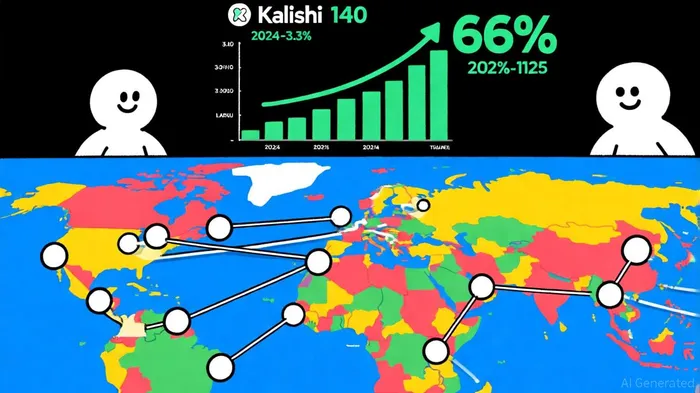





Comentarios
Aún no hay comentarios