
The Rise of Perpetual Futures in Traditional Markets: A Strategic Edge for 2025 Investors
The Adoption of Perpetual Futures in Traditional Markets
The integration of perpetual futures into traditional assets has been catalyzed by regulatory progress and technological innovation. A pivotal example is Architect Financial Technologies, launched by former FTX US president Brett Harrison, which secured regulatory approval in Bermuda to offer perps on stocks, indices, commodities, currencies, and interest rates, signaling a shift toward mainstream adoption, as reported by Coinotag. This move leverages the crypto-style features of perps-such as 24/7 trading and leverage-to attract both institutional and retail investors.
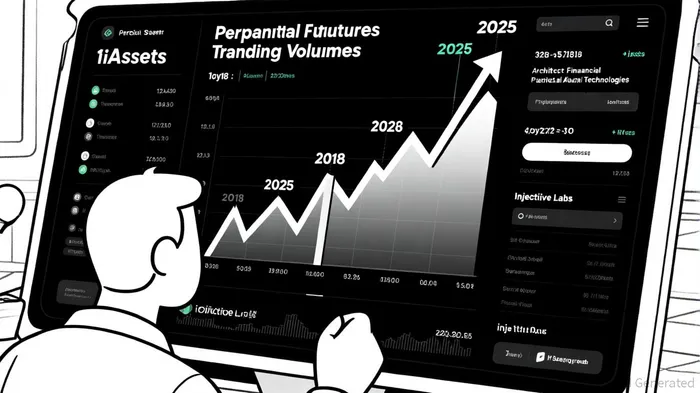
The crypto perps market itself has demonstrated explosive growth, with monthly trading volumes surging to $6.4 trillion in 2025, up from $35 billion in 2018, according to Coinotag. This trajectory underscores the demand for perpetual contracts, which is now spilling into traditional markets. Platforms like Injective Labs and Kraken are pioneering this shift by enabling trading on tokenized real-world assets (RWAs). For instance, Injective's iAssets have generated over $1.7 billion in volume by offering leveraged perpetuals on assets like the "Magnificent 7" and niche equities, as reported by Forbes. The appeal lies in their simplicity: traders need only a fraction of the position value to control large positions, bypassing the complexities of traditional derivatives like options, as Forbes noted.
Strategic Advantages and Market Impact
Perpetual futures are not merely expanding access-they are redefining market dynamics. Their funding rate mechanism, which aligns perpetual prices with spot markets, has become a barometer for investor sentiment. In 2025, BitcoinBTC-- perpetual futures accounted for 68% of all Bitcoin trading volume, with platforms like Binance recording daily volumes exceeding $80 billion, as Kaiko reports. During periods of high volatility, such as Bitcoin's surge above $112,000, stable funding rates reflected disciplined institutional participation, mitigating risks from excessive leverage, Kaiko noted.
The impact extends beyond crypto. In traditional markets, perps are enabling 24/7 leveraged trading, enhancing liquidity and informed trading. For example, tokenized U.S. treasuries-now valued at $33 billion-have become foundational assets for perps, offering real-time settlement and global accessibility, according to XBTO. Similarly, real estate tokenization is democratizing access to illiquid assets. A luxury hotel in New York, tokenized for fractional ownership, attracted investors with minimum stakes as low as $1,000, projecting a 21% CAGR for the global real estate tokenization market by 2033, according to TokenMetrics.
Tokenized Real-World Assets and Perpetual Futures
The synergy between tokenized RWAs and perps is particularly transformative. Platforms like xStocks-tokenized representations of equities and ETFs-have attracted $558 million in volume since their June 2025 launch, as Forbes reported. Meanwhile, Hyperliquid and Aster are decentralizing perpetual futures, challenging centralized exchanges and fostering competition. Academic studies further validate this trend: a ScienceDirect study (2020–2024 analysis of Bitcoin and EthereumETH-- perps) revealed that volatility is influenced by trade size and frequency, aligning with the Mixture of Distributions Hypothesis (MDH). This underscores the need for investors to understand high-frequency dynamics when deploying perps in traditional markets.
A Strategic Edge for 2025 Investors
For investors, perpetual futures offer a toolkit for hedging, speculation, and diversification. Carry trades, for instance, exploit price discrepancies between spot and derivative markets, as the ScienceDirect study illustrates. Additionally, perps on tokenized gold or real estate allow exposure to traditional assets without ownership, reducing entry barriers. BlackRock's USD Institutional Digital Liquidity Fund (BUIDL), which attracted $500 million in 2024, exemplifies institutional confidence in tokenized products, XBTO reported.
However, success hinges on navigating regulatory frameworks. Jurisdictions like the EU, UAE, and Hong Kong have provided clarity, fostering institutional adoption, according to Alphapoint. Conversely, the absence of perps-such as during China's 2021 crypto ban-led to reduced trading volumes and higher participation costs, as noted by Cornell Business. As perps expand, investors must balance innovation with risk management, particularly in volatile markets.
Conclusion
The rise of perpetual futures in traditional markets is not a passing trend but a structural shift. By blending crypto's agility with traditional assets' depth, perps are unlocking liquidity, flexibility, and efficiency. For 2025 investors, the strategic edge lies in leveraging these instruments to capitalize on 24/7 trading, leverage, and tokenized RWAs. As Architect Financial Technologies and InjectiveINJ-- Labs demonstrate, the future belongs to those who bridge the gap between decentralized innovation and conventional finance.







Comentarios
Aún no hay comentarios