
The Rise of Meme Coin ETFs and Institutional Adoption in Crypto: Evaluating Shiba Inu and Dogecoin's Investment Potential
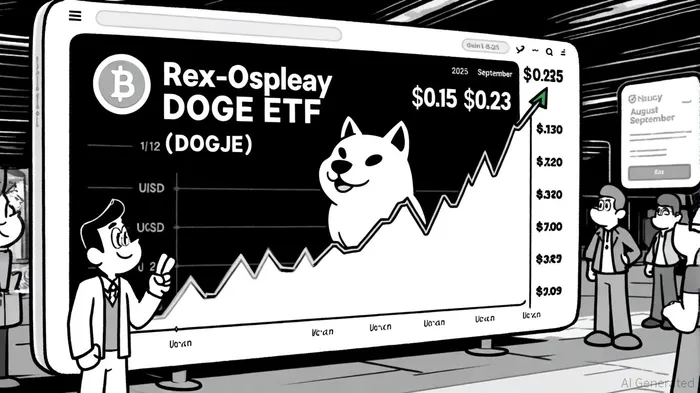
The crypto market is witnessing a seismic shift as institutional investors and traditional finance players begin to embrace meme coins. The launch of the first U.S. DogecoinDOGE-- (DOGE) ETF, the Rex-Osprey DOGEDOGE-- ETF (DOJE), marks a pivotal moment in this evolution[5]. This development has reignited debates about the investment potential of meme coins like DOGE and Shiba InuSHIB-- (SHIB), particularly as institutional adoption accelerates. However, the divergent trajectories of these two tokens—driven by factors such as regulatory clarity, ecosystem utility, and celebrity endorsements—highlight stark differences in their long-term viability.
Dogecoin: The Institutional Meme Coin
Dogecoin's impending ETF approval under the 1940 Act represents a historic milestone. Unlike traditional ETFs, DOJE is the first fund to intentionally hold an asset with no inherent utility, challenging conventional notions of value in finance[5]. This move has already driven DOGE's price above $0.23, a 9% surge in the week leading up to the ETF's launch[4].
The institutional pipeline for DOGE is robust, with applications from Bitwise and 21Shares pending SEC review[1]. These filings signal growing confidence in DOGE's market stability and liquidity, despite its origins as a joke cryptocurrency. Analysts attribute this interest to DOGE's unique position as a “social token” with a massive, loyal community and high-profile endorsements from figures like Elon Musk and Mark Cuban[2].
However, skeptics caution that ETFs alone cannot guarantee sustained price growth. Whale activity and market sentiment remain dominant forces. For instance, a single large sell order could negate the positive momentum generated by ETF inflows[1].
Shiba Inu: Ecosystem Ambitions vs. Institutional Hesitation
Shiba Inu, despite a $9 billion market cap, lacks any ETF filings as of September 2025[2]. This absence is puzzling given SHIB's ecosystem advancements, including the expansion of Shibarium and the introduction of privacy-focused tools like Fully Homomorphic Encryption (FHE)[6]. Yet, institutional investors appear hesitant to engage with SHIBSHIB-- due to several factors:
- Anonymity of Key Figures: The identity of Shytoshi Kusama, SHIB's pseudonymous founder, remains unknown, raising red flags for institutions prioritizing transparency[2].
- Complex Ecosystem: SHIB's multi-token model (SHIB, LEASH, BONE) and decentralized governance structures may deter investors seeking simplicity[2].
- Lack of Celebrity Endorsements: Unlike DOGE, SHIB has not benefited from high-profile advocacy, limiting its visibility in mainstream media[2].
Price predictions for SHIB remain cautiously optimistic, with some analysts projecting a rise to $0.00003452 by 2025, contingent on ecosystem adoption[3]. However, reaching $1 is deemed improbable due to SHIB's 1 quadrillion circulating supply and the logistical challenges of token burns[4].
The ETF Paradox: Exposure vs. Performance
While ETFs provide retail and institutional investors with easier access to meme coins, they do not inherently drive long-term value. For DOGE, the Rex-Osprey ETF's launch could catalyze further institutional interest, but its success will depend on maintaining liquidity and avoiding regulatory pushback[5]. Conversely, SHIB's absence from the ETF landscape underscores the importance of utility and governance in attracting traditional investors[6].
A newer contender, Layer Brett, is already outpacing both DOGE and SHIB in institutional discussions. Its Layer 2 infrastructure and utility-focused approach have positioned it as a potential outperformer, even if both meme coins secure ETF approvals[6]. This highlights a critical lesson: while ETFs democratize access, they cannot compensate for a lack of technological innovation or real-world use cases.
Conclusion: Navigating the Meme Coin ETF Landscape
The rise of meme coin ETFs signals a broader acceptance of crypto's cultural and speculative appeal. Dogecoin's institutional momentum, driven by regulatory progress and community loyalty, makes it a compelling short-to-medium-term play. Shiba Inu, meanwhile, faces an uphill battle to convince institutions of its legitimacy, despite its ambitious ecosystem roadmap.
For investors, the key takeaway is to balance enthusiasm for ETF-driven hype with a critical evaluation of fundamentals. As Layer Brett's ascent demonstrates, utility and scalability will ultimately determine which projects thrive in the next crypto cycle.






Comentarios
Aún no hay comentarios