
The Rise of Lighter: Is It the Next Big Thing in Perpetual DEXs?
Strategic Partnerships and Technological Edge
Lighter's ascent is not merely a function of volume but a result of strategic alliances and technological differentiation. A pivotal partnership with Chainlink has enabled the platform to integrate real-time oracle data, enhancing the accuracy of real-world asset (RWA) derivatives trading, according to a Coinotag report. This innovation has allowed Lighter to process over $8.85 billion in daily perpetual trading volume, a figure that underscores its growing influence. Meanwhile, Hyperliquid, despite maintaining a higher open interest ($74.7 billion vs. Lighter's $16.2 billion), faces a shift in market dynamics driven by Lighter's ZK-rollup scalability and user-centric design, as noted in the Coinotag report.
Capital Efficiency: A Tale of Two Metrics
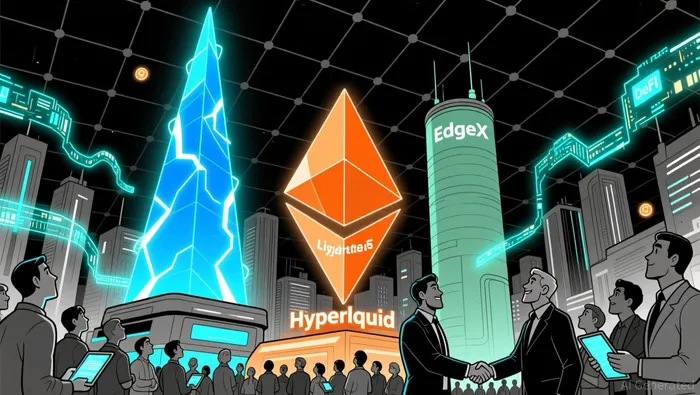
Capital efficiency remains a cornerstone of DeFi derivatives, and Lighter's approach diverges from its peers. While Hyperliquid boasts a TVL of $47.31 billion-far exceeding Lighter's $11.72 billion-Lighter's trading volume-to-TVL ratio (though not explicitly quantified) suggests a more aggressive capital utilization strategy, as detailed in the Lookonchain overview. In contrast, Hyperliquid's capital efficiency ratio in Q3 2025 stood at 6.32% (based on $302 million in volume and $4.78 billion TVL), a figure that pales in comparison to Lighter's implied efficiency, according to a Bitget analysis. EdgeX, with a TVL of $4.95 billion and a higher open interest-to-volume ratio (0.27), appears to prioritize sustained trading activity over sheer volume, as noted in the Lookonchain overview.
Fee Models and Liquidity Provider Returns
The sustainability of a Perp DEX hinges on liquidity provider (LP) incentives. Hyperliquid's tiered fee model, which adjusts daily based on 14-day trading volume, rewards frequent traders with rebates and maker-taker discounts, as described in a Coincodecap comparison. EdgeX, meanwhile, employs a 30-day rolling system to incentivize long-term liquidity. Lighter, however, disrupts the norm with a zero-fee model for standard accounts, reducing costs for LPs while relying on gas and funding fees as primary revenue streams, according to the Coincodecap comparison. This approach could attract a broader user base, though it risks diluting profit margins if gas costs rise.
The Road Ahead
Lighter's $68 million funding round in 2025, as reported in the Lookonchain overview, has undoubtedly accelerated its growth, but long-term success will depend on maintaining its technological edge and expanding TVL. Hyperliquid's higher open interest and TVL suggest a more mature ecosystem, yet Lighter's volume leadership and ChainlinkLINK-- integration position it as a formidable challenger. For investors, the key question is whether Lighter can sustain its capital efficiency while scaling-a feat that could redefine the DeFi derivatives landscape.






Comentarios
Aún no hay comentarios