
The Rise of Institutional-Grade Tokenized U.S. Treasuries: A Catalyst for RWA Market Expansion
The real-world asset (RWA) tokenization market has surged past $23 billion in total value by mid-2025, with tokenized U.S. Treasuries emerging as a cornerstone of this expansion, according to a TokenizedLiving report. This growth is not merely speculative but driven by institutional-grade innovations that address long-standing inefficiencies in traditional markets. As major asset managers and fintech platforms deploy blockchain-based solutions, tokenized Treasuries are redefining liquidity, settlement, and yield generation for institutional investors.
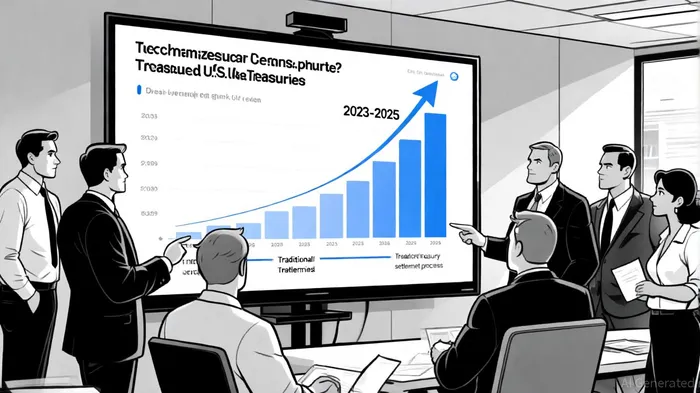
Institutional Adoption: A New Era of Blockchain-Backed Infrastructure
Institutional players have led the charge in tokenizing U.S. Treasuries, leveraging blockchain to unlock efficiency and scalability. BlackRock's USD Institutional Digital Liquidity Fund (BUIDL) exemplifies this shift, with tokenized assets BUIDL had surpassed $2.3B. The report notes the fund operates on EthereumETH-- and other blockchains like AptosAPT-- and ArbitrumARB--, offers daily yield accrual and monthly distributions, currently yielding 4.5% annually. By distributing assets across multiple chains, BUIDL reduces fees and enhances accessibility, positioning itself as a multichain liquidity hub.
Franklin Templeton's Franklin OnChain U.S. Government Money Fund (FOBXX) further underscores institutional confidence. With $380 million in assets under management, FOBXX provides exposure to U.S. government securities and repos in a tokenized format, according to an Investax article. Similarly, platforms like InvestaX Earn and Matrixdock's Short-Term Treasury Bill Token (STBT) are democratizing access to Treasury yields, enabling accredited investors to trade with as little as 100 USDC; the Investax coverage highlights these product innovations. These products reflect a broader trend: institutional-grade tokenization is no longer a niche experiment but a scalable infrastructure layer (Investax analysis).
Efficiency Gains: Settlement, Cost, and Risk Mitigation
Tokenized U.S. Treasuries address critical pain points in traditional markets. Legacy systems, such as T+1 or T+2 settlement cycles, are being replaced by near-instant finality enabled by smart contracts, as outlined in The Great Tokenization Shift. For instance, Centrifuge's Janus Henderson Anemoy Treasury Fund demonstrated a 97% reduction in securitization costs and instant redemptions of up to $125 million, a result noted in industry coverage. Such advancements eliminate intermediation delays and counterparty risk, while dynamic compliance platforms like Zoniqx automate operational processes, ensuring institutional-grade standards as described in a Zoniqx resource.
Cost savings are equally transformative. Traditional Treasury markets suffer from fragmented liquidity and high intermediation fees, but tokenization streamlines these processes. BlackRock's multichain strategy, for example, reduces transfer costs and enhances on-chain liquidity (as reported in the decripto coverage). Meanwhile, tokenized funds like BUIDL offer yield-bearing opportunities to stablecoin holders, bridging the gap between DeFi and traditional finance (Keyrock analysis).
Systemic Growth: Projections and Market Implications
The institutional shift to tokenization is poised to accelerate. Projections suggest tokenized funds could manage over $600 billion in assets by 2030, according to a McKinsey report, with the broader RWA market potentially reaching $2 trillion globally. This growth is underpinned by systemic advantages: tokenized Treasuries enable 24/7 trading, programmable liquidity, and interoperability across chains, capabilities demonstrated in BlackRock's multichain deployments. For capital markets, this means a reimagined infrastructure where settlement delays and intermediation costs become relics of the past (Zoniqx resource).
However, challenges remain. Regulatory clarity and interoperability standards are critical to sustaining this momentum. Yet, as institutions like BlackRockBLK--, Franklin Templeton, and UBS continue to innovate, the path toward mainstream adoption appears inevitable (Investax analysis).
Conclusion
Tokenized U.S. Treasuries are not just a financial innovation-they are a catalyst for systemic change. By addressing inefficiencies in settlement, cost, and liquidity, they are reshaping capital markets and bridging traditional and decentralized finance. As institutional adoption accelerates, the RWA market is set to become a cornerstone of global finance, with tokenized Treasuries leading the charge.







Comentarios
Aún no hay comentarios