
The Rise of Institutional Blockchain Debt Markets: JPMorgan's $50M Solana Commercial Paper as a Catalyst
The institutional capital markets are undergoing a seismic shift. JPMorgan's recent $50 million commercial paper issuance for Galaxy DigitalGLXY-- on the SolanaSOL-- blockchain-settled entirely in USDC-marks a pivotal moment in the tokenization of real-world assets (RWA). This transaction, the first of its kind on a public chain, underscores how blockchain technology is redefining the architecture of institutional finance. By leveraging on-chain infrastructure, JPMorganJPM-- has not only demonstrated the feasibility of tokenized debt but also signaled a broader paradigm shift toward programmable, transparent, and efficient capital markets.
A New Blueprint for Debt Issuance
JPMorgan's issuance of the Galaxy Digital commercial paper (USCP) on Solana represents a fusion of traditional finance (TradFi) and decentralized infrastructure. The $50 million, short-term, unsecured debt instrument was structured as a tokenized asset, with proceeds settled in USDCUSDC--, a stablecoin pegged to the U.S. dollar according to data. CoinbaseCOIN-- and Franklin Templeton, two institutional-grade participants, purchased the paper, while Coinbase also provided custody and wallet services for the USCP token according reports. This dual role of blockchain as both settlement infrastructure and custodial layer highlights its potential to streamline workflows traditionally plagued by intermediaries and delays.
The transaction's efficiency is staggering. By using Solana's high-throughput network, JPMorgan achieved near-instant settlement, a stark contrast to the multi-day processes of legacy systems. 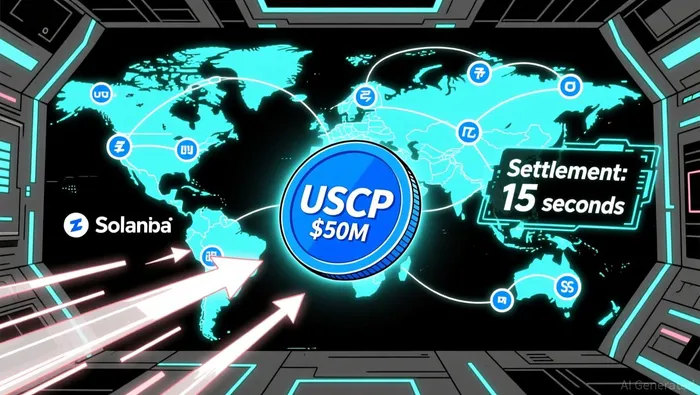 Scott Lucas, JPMorgan's Head of Markets Digital Assets, emphasized that this model will expand in 2026, incorporating new investor groups. For Galaxy Digital, the on-chain structure unlocking access to a broader pool of institutional investors, many of whom are integrating blockchain-based tools into their portfolios.
Tokenized RWAs: A $34.63 Billion Opportunity
JPMorgan's move is not an isolated experiment but part of a rapidly scaling trend. As of November 2025, tokenized RWAs have surged to $34.63 billion, driven by innovations in U.S. Treasuries, real estate, and private credit. Tokenized U.S. Treasuries alone now exceed $8 billion, offering real-time settlement and reduced counterparty risk. BlackRock's USD Institutional Digital Liquidity Fund (BUIDL), which tokenizes U.S. Treasuries, attracted over $500 million in 2024, illustrating robust institutional demand.
Real estate tokenization is another frontier. Fractional ownership models are democratizing access to high-value properties, enabling global liquidity and reducing entry barriers for investors according to analysis. Meanwhile, private credit and debt instruments-like Santander's $20 million blockchain-issued bond in 2025-are streamlining issuance timelines from weeks to days. These innovations are not merely incremental; they are redefining capital allocation, liquidity, and risk management in institutional portfolios.
Strategic Opportunities in the Blockchain-Enabled Future
The JPMorgan-Galaxy transaction exemplifies three strategic opportunities for institutional capital markets:
- Efficiency and Cost Reduction: On-chain settlement eliminates intermediaries, slashing costs and accelerating transaction speeds. For example, the USCP issuance bypassed traditional clearinghouses, reducing operational overhead.
- Liquidity and Access: Tokenized assets enable 24/7 trading and fractional ownership, unlocking liquidity in traditionally illiquid markets. This is particularly transformative for real estate and private debt, where liquidity constraints have long limited participation.
- Diversification and Innovation: Blockchain-based instruments allow institutions to diversify beyond traditional asset classes. JPMorgan's plan to expand tokenized issuance to new security types-such as corporate bonds or securitized loans-could create entirely new markets according to industry analysis.
The Road Ahead: From Catalyst to Revolution
JPMorgan's Solana commercial paper is a catalyst, but the broader revolution is already underway. As institutions increasingly adopt blockchain-based tools, the lines between TradFi and decentralized finance (DeFi) will blur. The Solana Foundation's support for the transaction-highlighting the network's "predictable execution environment"-signals confidence in public chains for institutional-grade use cases.
Looking ahead, the integration of tokenized RWAs into mainstream portfolios will depend on regulatory clarity, interoperability, and scalability. However, the momentum is undeniable. With tokenized debt markets projected to grow exponentially, institutions that embrace this shift will gain a first-mover advantage in a $trillion-dollar opportunity.
Conclusion
JPMorgan's $50 million Solana commercial paper is more than a technical milestone-it is a harbinger of a new era in institutional finance. By proving that blockchain can support complex, high-value transactions, the bank has laid the groundwork for a future where capital markets are programmable, transparent, and globally accessible. As tokenized RWAs continue to scale, the strategic imperative for institutions is clear: adapt or be left behind.





Comentarios
Aún no hay comentarios