
The Rise of High-Activity Blockchains: Why Solana, BNB Chain, and Tron Are Capturing Market Share
In the rapidly evolving blockchain landscape, network growth and transaction dominance have emerged as critical indicators of long-term value creation. As institutional and retail investors increasingly scrutinize on-chain metrics, three networks-Solana, BNBBNB-- Chain, and Tron-have distinguished themselves through explosive transaction volumes, expanding user bases, and strategic positioning in key verticals like decentralized finance (DeFi), stablecoins, and decentralized exchanges (DEX). This analysis explores how these blockchains are reshaping the market and what their trajectories suggest for future investment potential.
Solana: The High-Performance DEX Powerhouse
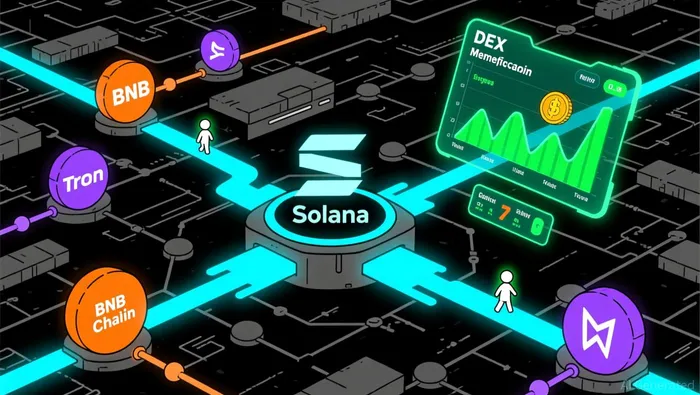
Solana's 2025 performance underscores its role as a high-throughput blockchain optimized for real-world applications. According to a report by , SolanaSOL-- processed a staggering 23.01 billion transactions in 2025, dwarfing BNB Chain's 3.89 billion and Tron's 3.22 billion. This dominance was driven by its DEX ecosystem, which captured 40% of the industry's market share in early 2025, fueled by retail-driven memecoinMEME-- frenzies and low-latency trading capabilities.
However, Solana's growth story is not without turbulence. While its token price reached record highs in early 2025, volatility persisted amid speculation around the potential approval of a SOL ETP (Exchange-Traded Product) and evolving digital asset treasury strategies as reported by VanEck. Despite these fluctuations, Solana's 3.23 million daily active addresses and 38.3 million monthly active users highlight its ability to sustain high-performance utility, supported by its proof-of-history consensus mechanism according to MEXC data.
BNB Chain: The Retail-Focused Ecosystem Leader
BNB Chain has solidified its position as the most active blockchain in terms of user engagement. reveals that BNB Chain averaged 4.32 million daily active wallets in 2025, outpacing Solana and NEAR ProtocolNEAR--. By September 2025, its monthly active addresses surged to 58 million, overtaking Solana's 38.3 million and signaling a shift in retail adoption.
This growth is underpinned by BNB Chain's cost-efficiency and accessibility, which have attracted a broad user base despite regulatory headwinds for its parent exchange, Binance according to MEXC analysis. In DeFi, BNB Chain's total value locked (TVL) grew 30.7% quarter-on-quarter to $7.8 billion in Q3 2025, driven by platforms like PancakeSwapCAKE-- and ListaDAO as detailed in Messari's report. Yet, as noted in Binance Research, Ethereum's DeFi recovery in late 2025 saw BNB Chain and Solana ceding slight market share, reflecting the competitive intensity of the sector.
Tron: The Stablecoin Infrastructure Giant
Tron's 2025 narrative is defined by its dominance in the stablecoin economy. The network processed 3.2 billion transactions in Q4 2025, including 1.9 billion free transactions, with an average of 2.5 million daily active addresses according to Business Insider data. Its role as the primary infrastructure for USDTUSDT-- (Tether) remains unparalleled: TronTRX-- facilitated $7.9 trillion in USDT transfers over 365 days in 2025, with $23.86 billion in daily transfers in the last 30 days of the year as reported by Market Insider.
Despite these strengths, Tron faced challenges in 2025. A VanEck report highlights a 37% monthly decline in blockchain revenues, attributed to reduced market volatility and onchain governance changes as detailed in their monthly recap. However, its entrenched position in stablecoin infrastructure-accounting for 81% of circulating stablecoins alongside Ethereum-suggests resilience in a market where cross-chain stablecoin adoption remains critical according to DL News research.
Market Share Dynamics and Long-Term Value Creation
The competitive positioning of these blockchains reflects divergent value propositions:
- Solana excels in high-speed, high-volume use cases, particularly DEX trading, but faces risks tied to token price volatility and regulatory scrutiny.
- BNB Chain leverages its massive user base and cost advantages to dominate retail-driven activity, though DeFi competition from EthereumETH-- and ArbitrumARB-- remains a wildcard.
- Tron maintains a near-monopoly in stablecoin transfers, a sector critical to global remittances and decentralized finance, but must navigate revenue declines and governance challenges.
For investors, the key takeaway is that transaction volume and active address metrics are not just vanity stats-they are proxies for real-world utility and network effects. Solana's DEX dominance, BNB Chain's user growth, and Tron's stablecoin infrastructure each represent defensible moats in a fragmented blockchain ecosystem.
Conclusion
As the crypto market matures, the ability to scale, attract users, and sustain transactional throughput will determine which blockchains capture lasting value. Solana, BNB Chain, and Tron have each demonstrated unique strengths in 2025, but their long-term success will depend on their capacity to innovate beyond transactional metrics-whether through enterprise partnerships, regulatory compliance, or novel use cases. For now, their combined market share in DeFi, stablecoins, and retail activity underscores their roles as foundational pillars of the blockchain economy.






Comentarios
Aún no hay comentarios