
The Rise of DEX Perpetual Futures as a Strategic On-Chain Derivatives Play
The decentralized finance (DeFi) landscape has entered a new era, marked by the explosive growth of DEX perpetual futures. By 2025, these instruments have not only captured a significant share of the derivatives market but also redefined the interplay between capital efficiency, institutional adoption, and composability-driven innovation. For investors, the rise of DEX perpetual futures represents a strategic on-chain derivatives play, offering a unique convergence of decentralized infrastructure, institutional-grade utility, and modular financial ecosystems.
Capital Efficiency: Bridging the Gap Between Decentralization and Performance
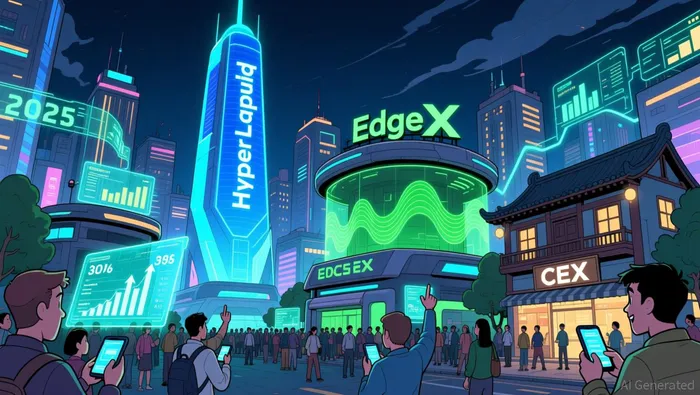
Capital efficiency in DEX perpetual futures has advanced rapidly, with platforms like EdgeX Exchange and HyperLiquid leading the charge. EdgeX, for instance, offers up to 100x leverage on BTCBTC-- pairs, supported by liquidity pools exceeding $10 million within 1 basis point spreads according to CoinGecko. HyperLiquid, operating on its native HyperEVM, has achieved $3.35 trillion in total trading volume through a CLOB-based liquidity model, catering to high-frequency traders while maintaining decentralized control as reported by CoinGecko.
While centralized exchanges (CEXs) still dominate in terms of volume and lower fees (average perpetual futures fees of 0.04% vs. DEXs' 0.06%) according to Mettalex, DEXs are closing the gap through yield-bearing collateral and self-custody models. Platforms like Aevo Perps and Ostium now enable traders to stake assets while accessing leveraged positions, blending the benefits of DeFi's permissionless innovation with CEX-like performance. For example, Aevo's unified margin system reduces slippage across derivative products, while Ostium's 200x leverage on RWAs (Real-World Assets) appeals to capital-constrained traders as reported by CoinGecko.
Institutional Adoption: From Niche to Mainstream
Institutional interest in DEX perpetual futures has surged, driven by platforms that combine regulatory compliance with decentralized infrastructure. Gate Perp DEX, launched in September 2025 on Gate's LayerLAYER-- 2 blockchain, processed over $1 billion in trading volume within months, showcasing the appeal of self-custodial perpetuals for institutional players according to CoinGecko. This aligns with broader trends: DEX perpetual futures accounted for 21.7% of total crypto derivatives volume in Q3 2025, with HyperLiquid capturing 73% of DEX derivatives volume ($653 billion quarterly turnover) as per Aminagroup research.
Institutional adoption is further fueled by the tokenization of real-world assets (RWAs). Platforms like Ondo Finance and Maple Finance now offer institutional-grade yields on tokenized U.S. treasuries and private credit, which are increasingly traded on DEXs for liquidity and transparency according to ChainUp. As regulatory clarity improves, institutions are treating DEX perpetual futures as a core asset class, leveraging them for hedging and portfolio diversification.
DeFi Composability: Building a Modular Financial Ecosystem
Composability-the ability to integrate protocols like Lego blocks-has been a game-changer for DEX perpetual futures. Platforms like Uniswap V4 and HyperLiquid are pioneering dynamic fees and cross-protocol integrations, enabling traders to hedge positions, access lending protocols, or tokenize RWAs within a single on-chain workflow according to RocknBlock. For instance, HyperLiquid's $700 million in annualized revenue stems not just from trading but from its role as a hub for DeFi composability, linking perpetuals with yield-generating strategies as reported by ChainUp.
The growth of RWA tokenization further underscores this trend. Tokenized treasuries and private credit instruments are now traded on DEXs, creating a bridge between traditional finance and DeFi. This integration allows perpetual futures to serve as both speculative tools and foundational components of diversified, on-chain portfolios according to ChainUp.
Strategic Implications for Investors
The convergence of capital efficiency, institutional adoption, and composability positions DEX perpetual futures as a compelling investment thesis. For capital-efficient traders, platforms like EdgeX and HyperLiquid offer CEX-like performance with decentralized safeguards. For institutions, DEXs provide compliance-friendly access to derivatives and RWAs. And for DeFi innovators, composability ensures perpetual futures remain at the forefront of modular finance.
As the market matures, investors should prioritize platforms that balance liquidity depth, regulatory alignment, and protocol interoperability. The next phase of growth will likely be driven by cross-chain solutions and further RWA integration, solidifying DEX perpetual futures as a cornerstone of the on-chain derivatives ecosystem.







Comentarios
Aún no hay comentarios