
The Rise of DAG-Based Blockchain: Powering the 2025 Altcoin Rebound
The 2025 crypto market is witnessing a seismic shift. After years of BitcoinBTC-- dominance and regulatory uncertainty, altcoins are reclaiming their spotlight, driven by institutional inflows and technological breakthroughs. At the heart of this rebound lies a quiet revolution in blockchain infrastructure: Directed Acyclic Graph (DAG)-based solutions. These architectures, which process transactions in parallel rather than in linear blocks, are redefining scalability, security, and real-world adoption. Projects like BlockDAG and Constellation are not just technical experiments-they're reshaping the altcoin landscape and attracting billions in capital.
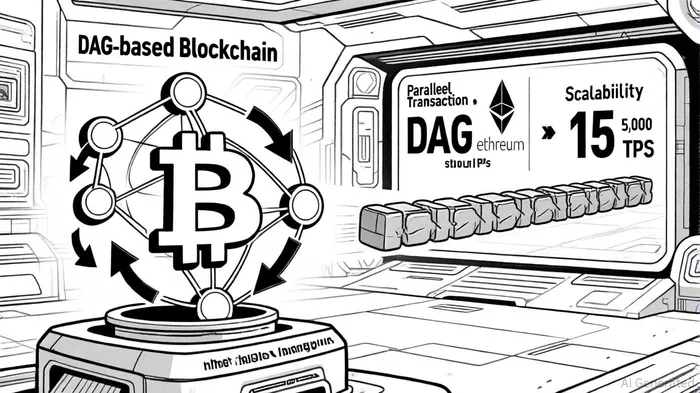
The DAG Advantage: Scalability Without Compromise
Traditional blockchains, like EthereumETH--, face inherent bottlenecks. Ethereum's 15 TPS (transactions per second) pales in comparison to the demands of global finance, DeFi, and AI-driven applications. DAG-based systems, however, eliminate these constraints by validating transactions asynchronously. BlockDAG's hybrid model-combining DAG with Proof-of-Work (PoW)-achieves 800 TPS in beta testing and aims for 15,000 TPS at scale, per the beta test results. This isn't just incremental improvement; it's a paradigm shift.
The implications are profound. For instance, BlockDAG's X1 mobile mining app has onboarded 3 million daily users, democratizing participation without requiring specialized hardware, according to X1 mobile app metrics. Meanwhile, Constellation's Network-as-a-Service (NaaS) offering targets enterprises with feeless transactions and DoD-vetted security, securing partnerships in healthcare and IoT, as detailed in Constellation updates. These projects aren't just chasing TPS-they're building ecosystems.
Altcoin Rebounds: DAG as the Catalyst
The 2025 altcoin rebound isn't a fluke. Institutional investors are reallocating capital to projects with clear use cases and technical differentiation. BlockDAG's $405 million presale-largely fueled by 325,000 holders-exemplifies this trend, according to presale funding growth. By Q3 2025, the project had shipped 19,800 ASIC miners globally and attracted $4.4 million in whale transactions, signaling confidence from sophisticated investors; the same analytics piece also highlighted these metrics.
This momentum is part of a broader altcoin surge. Ethereum's price rose 68.5% in Q3 2025, while DeFi's total value locked (TVL) grew 40.2% as tokenized assets and stablecoins gained traction, as reported in the Q3 2025 crypto report. Yet DAG-based projects like BlockDAG are outpacing even these leaders. With a projected 76,815% ROI for early presale buyers and a roadmap targeting $0.05+ exchange listings, BlockDAG's growth curve mirrors Ethereum's 2017 trajectory, a projection highlighted by CoinCentral.
Challenges and Skepticism: Can DAG Deliver?
Critics argue DAG's complexity could undermine decentralization. Projects like IOTAIOTA--, which rely on centralized nodes for validation, have faced security concerns, as discussed in challenges facing DAG currencies. However, BlockDAG's hybrid PoW model mitigates this risk by maintaining a decentralized mining network while leveraging DAG's parallel processing. Additionally, its WASM compatibility allows developers to build dApps using mainstream languages like Rust and C++, accelerating adoption.
Regulatory clarity is another hurdle. While DAG projects like Constellation have secured enterprise contracts, broader adoption depends on frameworks that balance innovation with compliance. Fortunately, 2025's institutional embrace of tokenized assets and stablecoins suggests regulators are adapting, per the 2025 Digital Assets Outlook.
The Bigger Picture: Altcoin Season 2.0
The 2025 altcoin season isn't just about hype-it's about infrastructure. As the Federal Reserve signals rate cuts and macroeconomic uncertainty looms, investors are seeking assets with deflationary mechanics and real-world utility. BlockDAG's presale success, coupled with its 4,500-strong developer community and 300 dApps in development, positions it as a prime beneficiary; the presale analysis highlighted this developer momentum.
Meanwhile, traditional blockchains like SolanaSOL-- and CardanoADA-- are also gaining traction, but DAG's scalability edge is undeniable. Solana's 50,000 TPS is impressive, but BlockDAG's hybrid model offers a more sustainable path to 15,000 TPS without compromising security, as framed in Top Altcoins to Watch. This isn't a zero-sum game-DAG's innovations are raising the bar for the entire industry.
Conclusion: The Future Is DAG
The 2025 altcoin rebound is a testament to blockchain's evolving maturity. DAG-based solutions like BlockDAG aren't just solving scalability-they're addressing the core limitations of traditional blockchains while attracting institutional capital. As the market capitalization climbs toward $4.0 trillion, the projects that thrive will be those that combine technical rigor with real-world adoption.
For investors, the message is clear: the next decade of crypto will be defined by infrastructure. And in that race, DAG is leading the charge.






Comentarios
Aún no hay comentarios