
The Rise of Crypto ETFs: Institutional Adoption and Strategic Risk Allocation in a Maturing Market
The Crypto ETF Revolution: A New Era of Institutional Participation
The cryptocurrency market has entered a transformative phase, driven by the explosive growth of exchange-traded funds (ETFs) and the rapid adoption of digital assets by institutional investors. In 2025, crypto ETFs have become a cornerstone of institutional portfolios, with BitcoinBTC-- and EthereumETH-- spot ETFs attracting over $167 billion in assets under management (AUM) by mid-year, according to a Markets report. This surge is not merely a function of speculative fervor but a calculated response to regulatory clarity, macroeconomic tailwinds, and the maturation of crypto infrastructure.
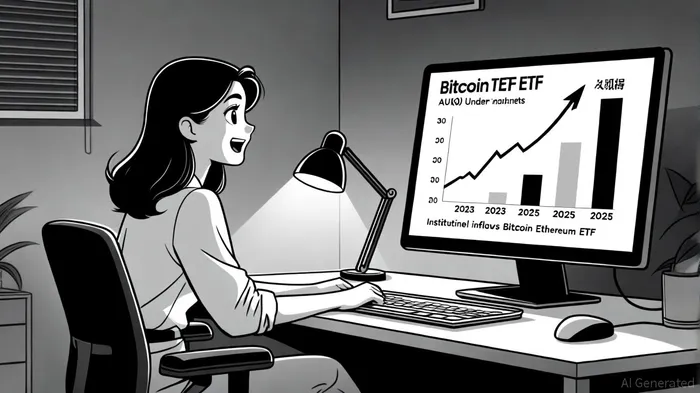
Momentum in Crypto ETFs: From Niche to Mainstream
The performance of crypto ETFs in 2023 and 2025 underscores their growing appeal. Bitcoin ETFs, led by BlackRock's iShares Bitcoin Trust (IBIT), have dominated the market, with IBITIBIT-- alone nearing $100 billion in AUM by October 2025, per a Walbi analysis. This growth is fueled by the "debasement trade," where institutions allocate capital to Bitcoin as a hedge against currency devaluation amid global monetary expansion, as noted in a Kenson analysis. Meanwhile, Ethereum ETFs have shown a late-2024 rebound, capturing 77% of institutional inflows in August 2025, according to the CryptoSlate playbook.
The SEC's streamlined approval process for crypto ETFs has further accelerated adoption. By reducing approval timelines from nearly a year to 75 days, as detailed in a Finance Monthly analysis, the regulator has enabled a flood of new products, including altcoin ETFs for SolanaSOL--, XRPXRP--, and CardanoADA--. This regulatory shift has not only lowered entry barriers but also legitimized crypto as a strategic asset class, according to The Currency Analytics.
Institutional Adoption: A Strategic Shift
Institutional investors are no longer on the sidelines. By Q2 2025, over $58 billion in institutional capital had flowed into crypto ETFs, with 60% of institutional investors planning to increase allocations, based on a DigiCash report. The adoption curve follows an S-curve trajectory: early phases focused on pension funds and 401(k) plans, while later stages expanded into corporate treasuries and global sovereign wealth funds, as outlined by Datos Insights.
A key driver of this shift is the integration of crypto into traditional risk-parity models. Institutions are allocating 1% to 3% of portfolios to Bitcoin for inflation hedging and non-correlated returns, observed in Jellyc insights. For example, Yale's endowment model allocates 5% to blockchain-based assets, demonstrating how crypto diversifies risk while enhancing returns, according to the NexusCrypto model. Additionally, regulated custody solutions from Fidelity and Coinbase have mitigated concerns around security and compliance, as reported by NFTBirdies.
Investment Timing: Navigating the Crypto Cycle
Timing remains a critical challenge in crypto markets. Institutions are leveraging quantitative models to optimize entry points. A modular simulation framework-combining volatility stress testing, stablecoin hedging, and Monte Carlo simulations-enables dynamic portfolio adjustments, described in an arXiv paper. For instance, allocating a portion of the portfolio to stablecoins during downturns reduces volatility while preserving capital, as illustrated in a Charter case study.
The S-curve adoption model also informs timing strategies. Early-stage allocations prioritize Bitcoin and Ethereum, while later-stage strategies diversify into altcoins and tokenized real assets, consistent with the CryptoBitMag guide. This approach aligns with the SEC's approval of altcoin ETFs in late 2025, which could unlock $5–8 billion in institutional inflows (the Walbi analysis cited above provides related estimates).
Risk Allocation: Balancing Volatility and Growth
Crypto's inherent volatility demands robust risk management. Institutions are adopting advanced quantitative tools to model risks:
- Value-at-Risk (VaR) and GARCH models: Adapted to account for fat-tailed distributions and clustering volatility, as discussed in Harmoniq research.
- Principal Component Analysis (PCA): Used to analyze correlations during market stress (see the Charter case study cited earlier).
- Diversified portfolios: A 2025 institutional crypto portfolio might allocate 40% to Bitcoin, 30% to Ethereum, 20% to altcoins, and 10% to tokenized assets, per the CryptoBitMag guide referenced above.
Environmental, social, and governance (ESG) considerations are also shaping strategies. Energy-efficient blockchains like Ethereum (post-Merge) and AlgorandALGO-- attract ESG-conscious investors, while tokenized green projects further diversify risk (see the CryptoBitMag guide cited earlier).
The Road Ahead: Altcoin ETFs and Market Expansion
The approval of altcoin ETFs in late 2025 could redefine the crypto market. Tokens like Solana and XRP, with their high transaction speeds and cross-border utility, are prime candidates for institutional adoption, according to The Currency Analytics (cited earlier). However, challenges persist: regulatory scrutiny of altcoin ETFs and liquidity concerns for speculative tokens remain hurdles, as noted in the Finance Monthly coverage referenced above.
State Street predicts crypto ETFs may surpass traditional precious-metal ETFs in North America, positioning crypto as the third-largest ETF category after equities and bonds, in its State Street outlook. This trajectory hinges on continued regulatory alignment and the development of sophisticated risk frameworks.
Conclusion
The maturation of the crypto market is no longer a question of if but how. ETFs have bridged the gap between digital assets and traditional finance, enabling institutions to participate with confidence. As regulatory clarity and quantitative innovation converge, the next phase of growth will be defined by strategic timing, diversified risk allocation, and the democratization of crypto access. For investors, the lesson is clear: in a maturing market, the winners will be those who adapt-not just to the technology, but to the evolving rules of the game.





Comentarios
Aún no hay comentarios