
The Rise of Crypto ETFs: How Bitcoin and Ethereum Inflows Signal Institutional Adoption and Market Sentiment Shifts
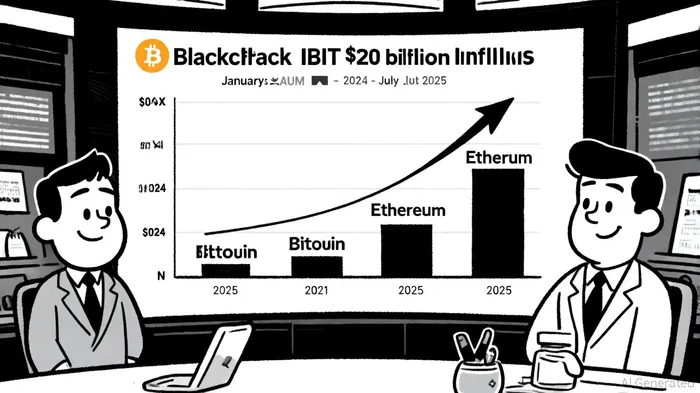
The approval of spot BitcoinBTC-- and EthereumETH-- ETFs in the United States has catalyzed a seismic shift in institutional adoption and market sentiment, reshaping the crypto landscape in 2023–2024. These products, now managed by titans like BlackRockBLK--, Fidelity, and Grayscale, have not only normalized crypto as an asset class but also provided a regulated on-ramp for institutional capital. The data is unequivocal: Bitcoin ETFs alone attracted over $37 billion in net inflows in 2024, with BlackRock's IBIT dominating the space[1]. Ethereum ETFs, meanwhile, have surged in 2025, with ETHAETHA-- and FETH collectively pulling in $12.3 billion in 2024 and $5.4 billion in July 2025 alone[2]. This momentum underscores a broader trend—crypto is no longer a speculative niche but a core component of institutional portfolios.
Institutional Adoption: A New Era of Legitimacy
The institutionalization of crypto is evident in the sheer scale of ETF inflows. BlackRock's IBIT, for instance, became the fastest ETP to reach $20 billion in assets under management (AUM), a testament to the demand for regulated crypto exposure[3]. By September 2025, BlackRock's combined crypto AUM (Bitcoin and Ethereum) had surpassed $100 billion, with institutions accounting for 25% of Bitcoin ETF holdings, per JPMorgan[4]. This shift is not merely quantitative—it reflects a qualitative reclassification of crypto as a strategic asset.
Ethereum's rise in 2025 further illustrates this dynamic. Post-merge, Ethereum's deflationary mechanics and yield-bearing capabilities (via staking) have made it an attractive diversifier for institutional portfolios. According to a report by Yellow.com, Ethereum ETFs outperformed Bitcoin ETFs in July 2025, with ETHA recording a record $300.9 million in daily inflows[5]. This surge was driven by investors seeking exposure to Ethereum's unique value proposition, including its role in decentralized finance (DeFi) and smart contracts.
Regulatory Clarity and Market Confidence
The U.S. Securities and Exchange Commission (SEC) has played a pivotal role in legitimizing crypto ETFs. The January 2024 approvals of Bitcoin ETFs and subsequent Ethereum ETFs provided the regulatory clarity needed to unlock institutional participation[6]. While the SEC remains cautious—postponing decisions on staking-related products like BlackRock's ETHA staking ETF to October 2025—it has signaled a commitment to creating a standardized framework for crypto products under “Project Crypto”[7]. This balance between oversight and innovation has bolstered market confidence, with 85% of firms surveyed by EY planning to invest in digital assets by 2025[8].
Asset Allocation Shifts: From Speculation to Strategy
The integration of crypto ETFs into traditional portfolios marks a paradigm shift in asset allocation. Historically, crypto was viewed as a high-risk, speculative bet. Today, institutions are treating it as a hedge against inflation and a diversifier in a low-yield environment. For example, Ethereum's proof-of-stake model and fee-burning mechanism have created a narrative of scarcity and utility, making it a compelling alternative to traditional assets[9].
North America, particularly the U.S., has emerged as the epicenter of this shift. Chainalysis reports that institutional activity accounts for 70% of the region's crypto transactions, with ETFs serving as the primary conduit[10]. This trend is further amplified by macroeconomic factors, including the U.S. dollar's dominance and the entry of legacy financial institutions into crypto markets.
The Road Ahead: Challenges and Opportunities
While the momentum is undeniable, challenges remain. The SEC's delayed decisions on staking ETFs highlight regulatory uncertainties, and volatility in crypto markets continues to test institutional resolve. However, the broader trajectory is clear: crypto ETFs are here to stay, and their inflows will remain a leading indicator of institutional adoption. As BlackRock's AUM in crypto assets grows, so too does the expectation that crypto will become a standard component of global portfolios.
For investors, the takeaway is straightforward: Bitcoin and Ethereum ETF inflows are not just numbers—they are signals. They reflect a maturing market, a regulatory environment moving toward clarity, and an institutional sector increasingly comfortable with crypto's risks and rewards. As we approach the end of 2025, the question is no longer if crypto will be part of the future of finance, but how quickly it will become the present.





Comentarios
Aún no hay comentarios