
The Rise of Corporate Titans: How Tech Giants Outsize Nations and Reshape Global Capital Markets
The global economic landscape is undergoing a seismic shift as technology giants like AppleAAPL--, MicrosoftMSFT--, and NvidiaNVDA-- now rival or surpass the GDPs of entire nations. With a market capitalization of $4.01 trillion as of September 2025, Apple's valuation exceeds the economic output of all but four countries: the United States ($30.62 trillion), China ($19.40 trillion), Germany ($5.01 trillion), and Japan ($4.28 trillion) according to Investopedia. This stark comparison underscores a new era in which corporate titans wield economic clout once reserved for sovereign states, reshaping capital markets and challenging traditional notions of national economic power.
The Valuation Divide: Tech Giants vs. Nations
The dominance of tech firms is not an isolated phenomenon. The combined market capitalization of the top 10 U.S. stocks reached $24.3 trillion in September 2025, surpassing the stock markets of major economies like the European Union, China, Japan, and India. Individually, companies such as Nvidia ($4.5 trillion) and Microsoft ($3.84 trillion) now outstrip the GDPs of developed economies including the UK, France, and Canada according to Yahoo Finance. This concentration of value reflects the transformative role of artificial intelligence (AI), which accounted for 92% of U.S. GDP growth in the first half of 2025.
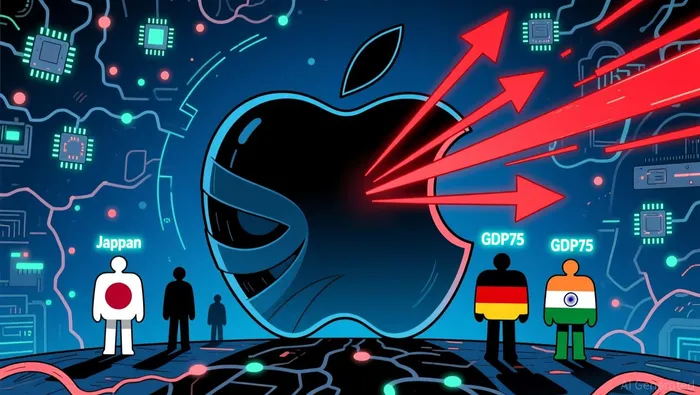 However, this corporate ascendancy raises critical questions about economic fragility. The "Magnificent Seven" tech firms-led by Apple, Nvidia, and Microsoft-now represent 37% of the S&P 500's total market capitalization. A 25% correction in this sector could erase $16 trillion in household wealth and reduce U.S. GDP growth by 1.6 percentage points, highlighting the systemic risks of overreliance on a handful of companies according to market analysis.
Geopolitical Investing: Navigating Fragmentation and AI-Driven Shifts
The rise of tech giants is inextricably linked to geopolitical dynamics. As nations grapple with the implications of AI and digital sovereignty, investors are recalibrating portfolios to align with emerging trends. According to a report by iShares, 61% of investors view the technology sector as the most attractive for investment over the next three years, driven by AI's potential to revolutionize productivity and profitability. Yet this optimism is tempered by regulatory and geopolitical headwinds.
U.S. tech firms face escalating non-tariff attacks (NTAs), including digital services taxes and data localization mandates, which erode market share and R&D investment according to ITIF analysis. Meanwhile, geopolitical fragmentation is accelerating, with countries prioritizing local infrastructure to reduce dependence on foreign technology. This shift is evident in India's rapid ascent as the fourth-largest economy, projected to overtake Germany by 2028 despite a per capita GDP of just $2,934.
Investors are responding with strategies that emphasize diversification and thematic exposure. Thematic ETFs, such as the iShares U.S. Thematic Rotation Active ETF, focus on AI, infrastructure, and defense spending-sectors poised to benefit from global supply chain reshaping and national security priorities. Additionally, portfolios are incorporating liquid alternatives, commodities, and digital assets to hedge against traditional asset correlations that have weakened in a fragmented world according to BlackRock insights.
The Dual-Edged Sword of AI and Capital Markets
While AI is a catalyst for growth, its speculative nature poses risks. The AI-driven capital expenditure cycle-centered on data centers and infrastructure-has fueled a surge in corporate and public investment, but some economists warn of a potential bubble. For instance, Apple's valuation, though impressive, is predicated on sustained innovation and market demand for AI-integrated products. If the pace of AI adoption slows, the valuation gap between tech giants and nations could narrow, triggering market volatility.
Geopolitical tensions further complicate the outlook. The Trump administration's transactional foreign policy, including potential trade deals and higher tariffs, could exacerbate inflation and disrupt global supply chains. Companies are already adjusting manufacturing footprints to mitigate these risks, a trend that will likely intensify in 2026.
Conclusion: Reimagining Global Capital Markets
The rise of corporate titans like Apple reflects a fundamental realignment of economic power. As tech firms outpace nations in valuation, investors must navigate a landscape defined by AI-driven growth, geopolitical fragmentation, and systemic risks. Diversification, thematic investing, and a focus on resilient sectors will be critical to managing this new reality. For policymakers, the challenge lies in balancing innovation with regulation to ensure that the benefits of technological progress are equitably shared.
In this evolving era, the interplay between corporate giants and national economies will continue to redefine global capital markets, demanding agility and foresight from investors and leaders alike.





Comentarios
Aún no hay comentarios