
The Rise of Commercial Space and Its Implications for Investors
Blue Origin's New Glenn: A Catalyst for Cost-Efficient Mars Exploration
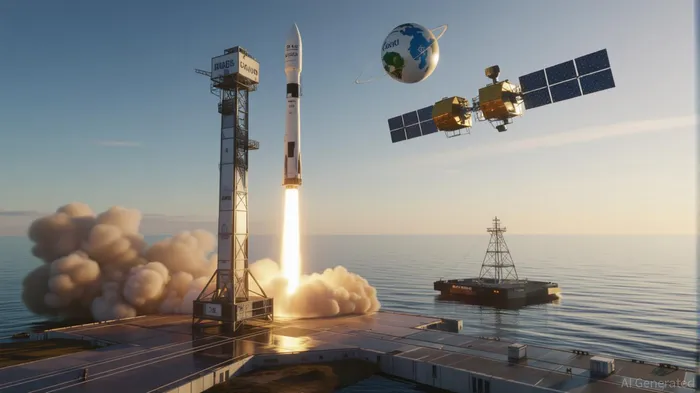
Blue Origin's New Glenn rocket, a 322-foot-tall, two-stage vehicle designed for reusability, has emerged as a game-changer in the race to make Mars exploration economically viable. The rocket's second mission, launched on November 12, 2025, carried NASA's twin ESCAPADE (Escape and Plasma Acceleration Dynamics Explorers) satellites to study Mars' atmospheric loss. This mission cost NASA approximately $55 million, a fraction of the $107.4 million total budget, with Blue Origin receiving $18 million for the launch. By comparison, traditional planetary missions often exceed hundreds of millions of dollars.
The New Glenn's reusable first stage, capable of at least 25 flights, further amplifies its cost advantages. The recent successful landing of the booster on a drone ship-a first for Blue Origin-demonstrates the company's progress in reducing launch costs, a critical factor for scaling commercial and scientific missions. According to a report by , the rocket's ability to deploy small satellites for missions like ESCAPADE while maintaining reusability positions Blue Origin to compete directly with SpaceX in the commercial launch market.
Reshaping Aerospace Valuation Models
Private-sector advancements in space technology are forcing a reevaluation of aerospace valuation metrics. Historically, aerospace companies were valued based on traditional metrics like revenue growth and R&D spending. Today, investors are increasingly prioritizing cost-per-launch efficiency, reusability potential, and the scalability of space logistics networks.
For instance, the global space logistics market, valued at $780 million in 2024, is projected to grow to $1.8 billion by 2032, driven by lunar and Martian missions. This growth is underpinned by reusable launch vehicles, which have reduced the cost of transporting cargo to orbit from $10,000 per kilogram to under $2,000 per kilogram. Such advancements are not only making space logistics economically viable but also creating new revenue streams for companies like Blue Origin and SpaceX.
The satellite sector is another area of rapid transformation. The satellite data services market, valued at $10.57 billion in 2024, is expected to grow at a 21.46% compound annual growth rate (CAGR) through 2029, fueled by demand in smart cities, agriculture, and climate monitoring. Investors are now scrutinizing companies that can leverage these trends, such as those specializing in high-thrust electric propulsion systems or AI-driven logistics automation.
Investment Opportunities in the New Space Economy
The commercialization of space is generating long-term opportunities across three key sectors:
Satellite Technology: With the global satellite data services market expanding rapidly, companies involved in precision agriculture, 5G infrastructure, and climate monitoring are prime candidates for growth. For example, firms developing AI-powered analytics for satellite data could benefit from the 22.78% CAGR projected for the agriculture segment.
Launch Systems: Reusable rocket technology is the cornerstone of the new space economy. Blue Origin's New Glenn, SpaceX's Starship, and emerging players like Relativity Space are poised to dominate this sector. Investors should also consider companies supplying components for reusable systems, such as advanced materials or avionics.
Interplanetary Logistics: As missions like NASA's Artemis program and private lunar ventures gain traction, demand for specialized logistics solutions is surging. The ability to transport raw materials for in-space manufacturing or extract water ice for propellant production could reduce Earth-launched mass requirements by up to 65% for certain missions.
The Road Ahead
The democratization of Mars exploration, enabled by cost-effective launch systems like New Glenn, is just the beginning. As private-sector players continue to drive down costs and expand capabilities, the aerospace industry will likely see a shift toward more agile, mission-specific platforms. For investors, this means prioritizing companies that can adapt to a rapidly evolving landscape while leveraging scalable technologies.
The commercial space sector is no longer a speculative frontier-it is a maturing industry with clear financial metrics and growth trajectories. By aligning with the innovations of companies like Blue Origin and the broader trends in satellite and logistics markets, investors can position themselves to capitalize on the next era of space exploration.







Comentarios
Aún no hay comentarios