
The Rise of CeDeFi: OKX's DEX Integration as a Strategic Move in the Evolving Crypto Landscape
A New Era of Unified Access
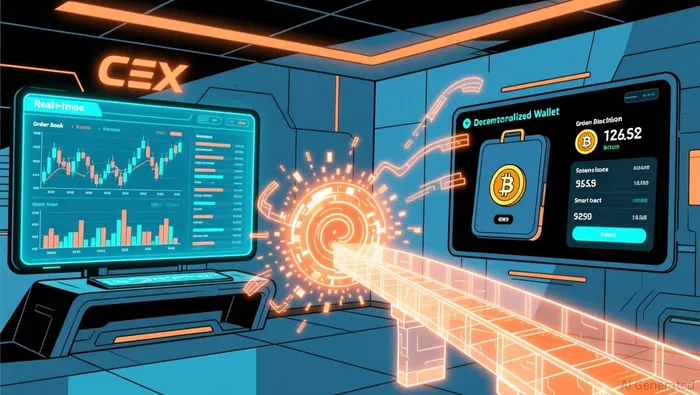
OKX's DEX integration, launched in 2025, allows users to trade millions of tokens across SolanaSOL--, Base, and its proprietary X Layer-all within the same app used for centralized trading. This eliminates the need to juggle multiple wallets, cross-chain transfers, and hidden fees, streamlining the user experience according to CoinCodex. The platform's smart routing feature scans over 100 liquidity pools to optimize trade execution, while a flat 0.85% fee structure ensures transparency. Crucially, the integration automatically generates self-custody wallets with passkey protection, giving users full control of private keys without sacrificing the ease of a CEX interface.
This move aligns with broader industry trends. On-chain trading volumes surged to $613 billion in October 2025, driven by demand for user-friendly DEX solutions. Meanwhile, tokenized real-world assets (RWAs)-such as real estate and corporate bonds-are gaining traction, with their market value quintupling from $5 billion in 2022 to $24 billion by mid-2025. OKX's DEX integration positions it to capitalize on these trends by offering investors seamless access to both emerging DeFi tokens and traditional RWAs.
Investment Implications: ROI, Risk, and Diversification
For investors, OKX's DEX integration introduces three key implications:
Enhanced ROI Through Liquidity Aggregation
By routing trades across 100+ liquidity pools, OKX's DEX ensures users access the best prices, reducing slippage and maximizing returns. This is particularly valuable for tokens with low buy-side depth, a common issue in early-stage DeFi projects according to The Block. For example, a trader executing a large order on a niche token via OKX's DEX would likely achieve better execution than on a standalone DEX, where liquidity is fragmented.Risk Mitigation via Self-Custody and Transparency
The integration of self-custody wallets addresses a critical risk in DeFi: fund exposure to third-party custodians. By retaining control of private keys, users avoid the vulnerabilities of centralized hacks or mismanagement. Additionally, OKX's transparent fee structure (0.85% with no hidden costs) reduces the risk of unexpected expenses, a common criticism of traditional DEXs.Portfolio Diversification Across Chains and Asset Classes
OKX's multi-chain support (Solana, Base, X Layer) enables investors to diversify across ecosystems with varying risk profiles. Solana's high throughput and low fees attract retail traders, while Base's EthereumETH-- compatibility appeals to institutional investors. Meanwhile, X Layer's incubation of new projects offers exposure to innovation with higher growth potential. This diversification is further amplified by RWAs, which introduce real-world collateral to crypto portfolios according to Louis TechVC.
Strategic Risks and Competitive Dynamics
Despite its advantages, OKX's DEX integration is not without challenges. Regulatory scrutiny, particularly in the U.S., remains a wildcard. The SEC's ongoing battles with Ethereum-based DEXs (e.g., Uniswap) highlight the risks of compliance overreach. OKX's push to re-enter the U.S. market in 2025 could face hurdles if regulators classify its DEX as a securities platform.
Competition is another factor. Platforms like Binance and Coinbase have also integrated DEX capabilities, while Solana-based aggregators like JupiterJUP-- are gaining traction according to The Block. OKX's differentiation lies in its hybrid model: the ability to switch between centralized and decentralized markets within a single app. However, sustaining this edge will require continuous innovation, such as expanding X Layer's TVL and DAU metrics.
The Road Ahead
OKX's DEX integration is more than a feature-it's a strategic repositioning in the CeDeFi arms race. For investors, the platform's ability to unify access to CEX and DEX markets, while addressing liquidity, custody, and fee transparency, offers a unique value proposition. As RWAs and Layer 2 solutions mature, OKX's ecosystem- bolstered by a $100 million grant fund for X Layer developers-could become a cornerstone of the next crypto bull run.
Yet, the path forward demands vigilance. Regulatory shifts, competitive pressures, and the inherent volatility of DeFi projects will test OKX's resilience. For now, the integration underscores a broader truth: the future of finance lies in hybrid models that balance innovation with accessibility. Investors who recognize this shift early may find themselves well-positioned to capitalize on the CeDeFi revolution.






Comentarios
Aún no hay comentarios