
The Rise of BNB and the Emergence of DeFi Innovation in Ethereum Ecosystem
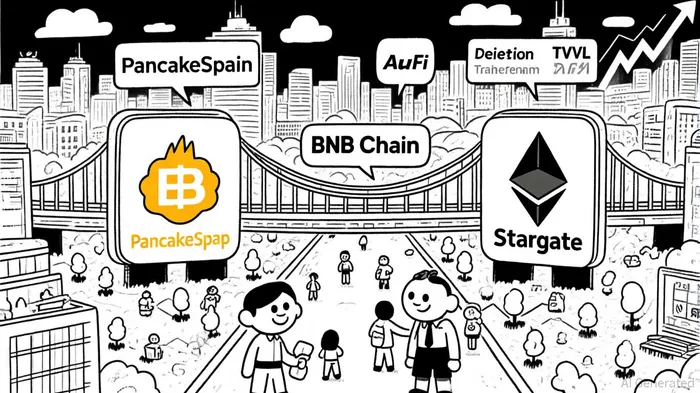
In Q3 2025, the blockchain landscape is defined by two dominant forces: BNBBNB-- Chain's explosive growth and Ethereum's enduring innovation in decentralized finance (DeFi). While BNB Chain has surged in market capitalization and user adoption, EthereumETH-- continues to solidify its position as the bedrock of DeFi, driven by institutional engagement and Layer-2 (L2) advancements. The real story, however, lies in the synergies between these ecosystems, where cross-chain interoperability and collaborative projects are creating a more interconnected and efficient financial infrastructure.
BNB Chain: Scaling for Mass Adoption
BNB Chain's market capitalization reached $92 billion in early 2025, maintaining its position among the top five cryptocurrencies despite a 10% dip from its 2024 peak of $101.1 billion[1]. This resilience is underpinned by infrastructure upgrades that reduced block times to 0.75 seconds and finality to 1.875 seconds[6], making it one of the fastest Layer-1 (L1) networks. These improvements have fueled a surge in decentralized exchange (DEX) activity, with BNB Chain's DEX volume hitting $319.4 billion in Q3 2025—surpassing all other chains[4].
The chain's DeFi ecosystem is equally robust. PancakeSwapCAKE--, the largest DEX on BNB Chain, holds $4 billion in TVL and processes over 55 million trades monthly[1]. Venus Protocol, a leading lending and borrowing platform, offers high annual percentage yields (APYs) and integrates seamlessly with PancakeSwap[1]. Meanwhile, Lista DAO's liquid staking services and cross-chain bridges like Stargate and Symbiosis Finance are expanding BNB Chain's reach[3].
Ethereum's DeFi Renaissance
Ethereum's DeFi ecosystem saw a 41% surge in total value locked (TVL) in Q3 2025, reaching $160 billion—a three-year high[1]. This growth was driven by protocols like AaveAAVE-- (TVL: $41 billion), Lido (TVL: $39 billion), and EigenLayerEIGEN-- (TVL: $20 billion), which benefited from rising crypto prices and regulatory clarity[1]. Ethereum's L2 solutions, including ArbitrumARB-- and OptimismOP--, further amplified this growth by handling fast-paced DeFi activities like arbitrage trading while reducing gasGAS-- fees[5].
The Ethereum Community Conference (EthCC) 2025 in Cannes underscored the ecosystem's momentum, with institutional investors and developers converging to discuss scalability and product innovation[1]. Notably, Ethereum's L1 remains critical for high-value settlements, while L2s handle day-to-day transactions—a division of labor that enhances efficiency[5].
Synergies: Bridging Chains, Building Ecosystems
The most compelling narrative of 2025 is the collaboration between BNB Chain and Ethereum. Cross-chain bridges like Stargate, Symbiosis Finance, and Across have enabled seamless asset transfers between the two ecosystems, leveraging BNB Chain's low fees and Ethereum's robust smart contracts[3]. For example, Stargate's LayerZero-based infrastructure allows near-instant transfers of native assets (e.g., ETH, USDC) across 40+ chains, including BNB Chain, with a flat 0.06% fee[1].
Key projects are capitalizing on this interoperability. PancakeSwap, while native to BNB Chain, now supports Ethereum and other chains, enabling cross-chain yield farming and liquidity provision[1]. Similarly, Ondo Finance's integration with BNB Chain allows fractional trading of traditional assets like TeslaTSLA-- and AppleAAPL--, bridging DeFi with traditional finance[5]. These projects highlight a broader trend: DeFi is no longer siloed.
Strategic Implications for Investors
For investors, the synergy between BNB Chain and Ethereum represents a dual opportunity:
1. BNB Chain's Scalability: Its sub-second block times and gasless transactions position it as a hub for high-frequency DeFi activity, particularly in DEX trading and cross-chain liquidity[6].
2. Ethereum's Institutionalization: The chain's L2 ecosystem and regulatory clarity make it a safe haven for institutional capital, while its TVL growth validates its role as the “base layer” of DeFi[5].
Projects like Symbiosis Finance and Stargate, which facilitate cross-chain interactions, are particularly compelling. These bridges notNOT-- only enhance liquidity but also reduce the friction between ecosystems, enabling users to access the best protocols regardless of chain[3].
Conclusion
The rise of BNB Chain and Ethereum's DeFi innovation are not mutually exclusive but complementary. By leveraging cross-chain interoperability, these ecosystems are creating a more efficient, accessible, and scalable financial infrastructure. For investors, this means opportunities to capitalize on both the speed and cost advantages of BNB Chain and the institutional-grade security of Ethereum. As the lines between chains blur, the future of DeFi will be defined by collaboration—not competition.






Comentarios
Aún no hay comentarios