
The Rise of Bitcoin ETFs and BlackRock's IBIT: A New Institutional Benchmark
The institutional investment landscape has undergone a seismic shift in 2025, with BitcoinBTC-- ETFs emerging as a cornerstone of mainstream portfolio diversification. At the heart of this transformation is BlackRock's iShares Bitcoin TrustIBIT-- (IBIT), which has redefined institutional access to digital assets through regulatory innovation, operational efficiency, and market leadership. As the U.S. solidifies its position as the global epicenter of crypto adoption, the interplay between regulatory clarity, product design, and investor behavior is reshaping the asset class's trajectory.
Regulatory Tailwinds: The Catalyst for Institutional Adoption
The SEC's January 2024 approval of spot Bitcoin ETFs marked a watershed moment, unlocking a flood of institutional capital. According to a report by CFRAResearch, this regulatory clarity catalyzed a 400% surge in institutional investment flows, with $75 billion pouring into the sector post-launch. The approval not only validated Bitcoin's legitimacy but also addressed prior concerns about market manipulation and custody risks.
Complementing this was the passage of the GENIUS Act in 2025, which established a federal stablecoin framework, and the SEC's endorsement of in-kind creation/redemption mechanisms for ETFs, enhancing liquidity and reducing arbitrage risks according to CFRAResearch. These developments created a robust infrastructure, enabling institutions to deploy capital with confidence. The U.S. now hosts 76 spot and futures crypto ETPs, managing $156 billion in assets under management-a testament to the sector's exponential growth.
BlackRock's IBIT: The Institutional Gold Standard
BlackRock's IBITIBIT-- has emerged as the de facto benchmark for institutional Bitcoin exposure. With $50 billion in assets under management and a commanding 48.5% share of the Bitcoin ETF market, the fund's dominance is underpinned by three pillars: regulatory alignment, cost efficiency, and operational scale according to PowerDrill AI.
The fund's 0.25% expense ratio, one of the lowest in the industry, appeals to cost-conscious institutions, while its early SEC approval granted it a first-mover advantage. As stated by PowerDrill AI, IBIT's institutional-grade infrastructure-including custodial solutions and transparent reporting-has made it the primary gateway for pension funds, endowments, and sovereign wealth funds seeking Bitcoin exposure.
However, the fund's performance underscores a critical nuance: timing matters. Despite a 28.1% year-to-date return as of November 2025, the average investor earned only 11% annualized between January 2024 and November 2025. Yahoo Finance attributes this gap to delayed inflows, with many investors entering after significant gains had already been realized. 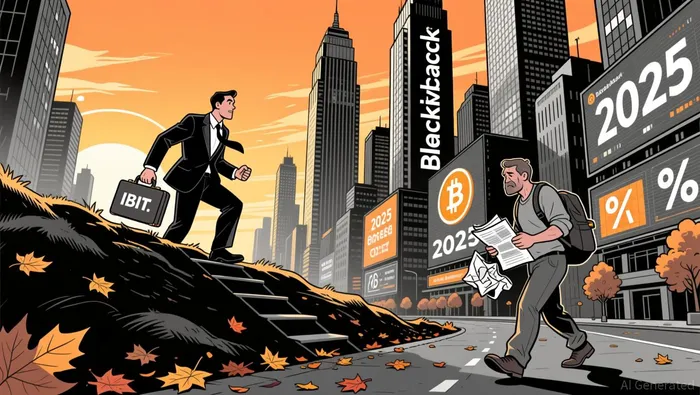 This highlights the challenges of managing expectations in a high-volatility asset class, even for sophisticated institutions.
Corporate Adoption: A Legitimacy Signal
Beyond institutional investors, corporate treasuries are increasingly allocating to Bitcoin. MicroStrategy's acquisition of 257,000 Bitcoin in 2024 alone exemplifies a broader trend of corporations treating digital assets as strategic reserves. This shift reflects a growing recognition of Bitcoin's role as a hedge against inflation and a store of value in an era of monetary uncertainty.
Such moves are not merely speculative; they signal a redefinition of corporate balance sheets. As traditional assets face yield compression and geopolitical risks, Bitcoin's scarcity and decentralized nature offer a compelling alternative. This corporate adoption further reinforces Bitcoin's status as a legitimate asset class, attracting institutional capital in a self-reinforcing cycle.
The Road Ahead: Challenges and Opportunities
While the current momentum is undeniable, challenges remain. Regulatory scrutiny in other jurisdictions, such as the EU's cautious approach to stablecoins, could create friction. Additionally, the disparity between fund performance and investor returns underscores the need for better education and tools to manage Bitcoin's volatility.
Yet, the long-term outlook remains bullish. With the U.S. pro-crypto administration advancing initiatives like the Strategic Bitcoin Reserve and expanding crypto access in retirement plans, the institutional infrastructure will only strengthen. For investors, the key takeaway is clear: Bitcoin ETFs, led by IBIT, are no longer niche-they are a foundational asset in the modern portfolio.





Comentarios
Aún no hay comentarios