
The Rise of AI-Enabled Robotics: How Google DeepMind's Gemini is Reshaping Industrial Automation
The industrial automation landscape is undergoing a seismic shift, driven by the convergence of artificial intelligence (AI) and robotics. At the forefront of this transformation is Google DeepMind's Gemini, a suite of AI models that is redefining the capabilities of industrial robots. By enabling machines to perceive, reason, and act in dynamic environments, Gemini is not merely enhancing automation—it is catalyzing a new era of productivity, adaptability, and scalability. For investors, this represents a pivotal opportunity to capitalize on a market poised for exponential growth.
The Gemini Advantage: Multimodal Intelligence Meets Physical Action
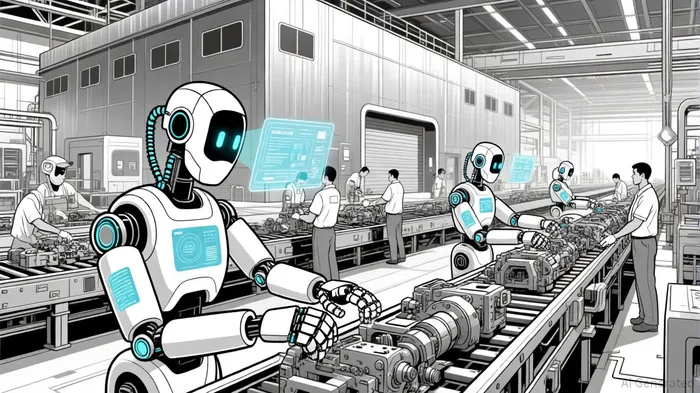
Google DeepMind's Gemini Robotics 1.5 and Gemini Robotics-ER 1.5 models exemplify the next generation of AI-driven robotics. These systems integrate vision, language, and action into a unified framework, allowing robots to execute complex, multi-step tasks such as folding origami, packing fragile items, or assembling machinery[1]. Unlike traditional robotics, which rely on rigid, task-specific programming, Gemini-powered robots leverage embodied reasoning to adapt to novel scenarios. For instance, Gemini Robotics-ER can determine the optimal grasping point for a coffee mug, mimicking human-like intuition[2]. This adaptability is critical in industries like manufacturing, where dynamic environments demand real-time decision-making.
The competitive edge of Gemini lies in its multimodal architecture. By processing visual, textual, and contextual inputs simultaneously, it outperforms monomodal systems in tasks requiring spatial awareness and semantic understanding[3]. A collaboration with Intrinsic and Boston Dynamics has further demonstrated Gemini's potential: a system using graph neural networks and reinforcement learning reduced collisions among multiple robots by 60% when scaling from four to eight units[4]. Such advancements address a longstanding bottleneck in industrial automation—coordinating heterogeneous robotic systems in shared spaces.
Market Dynamics: A $52.72 Billion Opportunity by 2031
The AI-driven robotics market is expanding at an unprecedented pace. According to a report by Statista, the global AI industrial robotics market is projected to grow from $12.67 billion in 2025 to $52.72 billion by 2031, with a compound annual growth rate (CAGR) of 26.82%[5]. North America, particularly the United States, is a key growth driver, fueled by demand in logistics, healthcare, and advanced manufacturing. Startups leveraging Gemini and similar platforms are attracting significant capital—$2.26 billion was raised in Q1 2025 alone, with AI-native robotics firms commanding high valuations[6].
Investors are increasingly prioritizing platforms that combine hardware, software, and AI. For example, Apptronik's Apollo humanoid robot, powered by Gemini, is being tested in logistics and elder care, demonstrating the technology's versatility[7]. Similarly, Agility Robotics and Enchanted Tools are deploying Gemini-enabled systems to handle delicate objects in agriculture and healthcare, reducing product damage and improving efficiency[8]. These case studies underscore the commercial viability of AI-driven robotics, with quantifiable outcomes such as a 75% reduction in diagnostic time in healthcare and an 81% boost in retail conversion rates[9].
Competitive Landscape: Gemini vs. GPT-4, Claude, and LLaMA
While competitors like OpenAI's GPT-4 and Anthropic's Claude excel in text generation and coding benchmarks, Gemini distinguishes itself through its seamless integration of multimodal processing and physical action[10]. For instance, Gemini's 1 million-token context window allows it to analyze entire codebases or regulatory filings in a single session, a feature critical for industrial automation workflows[11]. Meanwhile, Anthropic's Claude 4 leads in coding tasks, but Gemini's embodied reasoning capabilities—such as spatial planning and collision avoidance—make it uniquely suited for robotics[12].
Microsoft's Azure AI and Meta's LLaMA also compete in the AI space, but their lack of a comprehensive robotics ecosystem limits their appeal. Google's integration of Gemini with its broader AI and cloud infrastructure provides a significant advantage, particularly for enterprises already invested in Google Workspace[13]. However, OpenAI's GPT-4.5 remains dominant in creative and conversational tasks, handling 2.5 billion prompts daily[14]. This highlights the importance of niche specialization for investors: while Gemini excels in industrial automation, alternatives may be better suited for enterprise software or customer service.
Strategic Investment Insights: Where to Allocate Capital
The robotics investment boom of 2025 is characterized by three key trends: specialization, AI-native platforms, and Robotics-as-a-Service (RaaS) models. Startups like Scythe Robotics (agricultural automation) and 1X Technologies (humanoid robotics) have raised over $100 million collectively, backed by major players like NVIDIA and OpenAI[15]. Investors are also favoring companies with proprietary datasets and integrated hardware-software solutions, as these reduce development costs and accelerate commercialization[16].
Corporate VCs and strategic investors are playing an increasingly active role. Intel Capital and Toyota AI Ventures are targeting robotics startups with semiconductor-adjacent technologies and mobility automation, while Sequoia Capital and DCVC are backing AI-native platforms like Field AI[17]. For institutional investors, the focus should be on firms with clear ROI metrics and scalable applications. For example, AnthroTek's $1 million seed round for advanced materials manufacturing and Voliro's $14 million in aerial robotics funding demonstrate the sector's maturation[18].
Conclusion: The Next Industrial Revolution
Google DeepMind's Gemini is not just a technological breakthrough—it is a catalyst for a new industrial revolution. By enabling robots to think, adapt, and collaborate, it is unlocking productivity gains across sectors. For investors, the imperative is clear: prioritize platforms that combine AI's cognitive power with physical dexterity. As the market evolves, those who align with Gemini's ecosystem—or its most compelling alternatives—will be well-positioned to reap the rewards of this transformative wave.







Comentarios
Aún no hay comentarios