
The Rise of AI-Driven Enterprises and the End of Static Career Models
The global workforce is undergoing a seismic shift as artificial intelligence (AI) reshapes industries, redefines job roles, and accelerates the obsolescence of static career models. According to a report by McKinsey, nearly 44 percent of employed Americans are willing to change occupations for better pay or hours but lack the skills to do so. This skills gap, exacerbated by rapid technological advancements, has forced enterprises to rethink traditional reskilling strategies. Leading consulting firms and venture capital firms like McKinsey and General Catalyst are now advocating for a paradigm shift: treating AI upskilling as a continuous, dynamic process rather than a one-time training initiative. For investors, this signals a golden opportunity to capitalize on education technology, AI training tools, and workforce reskilling platforms that align with this transformation.
The Shift from Static to Dynamic Skill Development
McKinsey's 2025 research underscores that AI integration is not merely a technical challenge but a cultural and organizational one. Companies must embed AI literacy, adoption, and domain-specific transformation into daily workflows. This approach requires a departure from rigid, siloed training programs to fluid, adaptive learning ecosystems. General Catalyst's AI Action Plan further reinforces this trend, emphasizing the need for enterprises to align with national priorities such as AI education and skilled trades training. The Trump administration's executive orders on AI workforce development, for instance, create a regulatory and funding environment that incentivizes companies to innovate in reskilling.
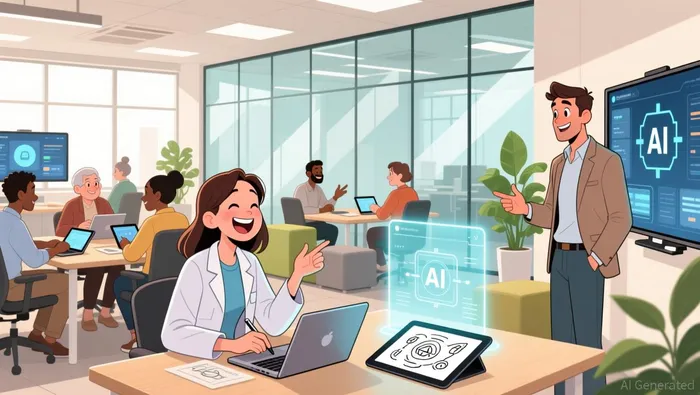 A critical insight from both McKinsey and General Catalyst is the urgency of addressing the "AI maturity" gap. While AI has the potential to be as transformative as the steam engine, only 1% of companies consider themselves mature in AI deployment. Meanwhile, employees are often more ready to adopt AI than their leaders assume, using AI tools regularly in their workflows. This disconnect highlights a growing demand for platforms that bridge technical and cultural gaps, enabling organizations to scale AI adoption while fostering employee confidence.
Investment Opportunities in AI-Adaptive Talent Platforms
The convergence of AI-driven enterprises and dynamic skill development opens doors for investors in three key areas:
Education Technology (EdTech) Platforms: Startups and established players that offer modular, AI-powered learning systems are well-positioned to meet the demand for continuous upskilling. These platforms must prioritize scalability, personalization, and integration with enterprise workflows. For example, General Catalyst's HATCo initiative in healthcare demonstrates how partnerships with health systems can drive tailored reskilling programs for complex, regulated industries.
AI Training Tools: Tools that democratize AI literacy-such as low-code/no-code AI builders, simulation environments, and real-time feedback systems-are critical for embedding AI into daily operations. McKinsey emphasizes that successful AI adoption hinges on redesigning roles to include AI collaboration, a process that requires intuitive training tools.
Workforce Reskilling Platforms: Platforms that leverage data analytics to identify skill gaps and align reskilling with business objectives are gaining traction. General Catalyst's focus on metrics like "people lifetime value" (PLTV) reflects a shift toward quantifying the ROI of employee investment. Investors should prioritize platforms that integrate AI with human-centric metrics, such as psychological safety and innovation readiness.
The Role of Leadership and Cultural Alignment
McKinsey's analysis highlights that AI upskilling is a "change imperative" requiring leadership to model AI adoption and foster psychological safety for experimentation. This cultural shift is particularly relevant in sectors like healthcare, where startups like Hippocratic AI are targeting low-risk, high-ROI use cases within regulatory sandboxes. For enterprises, aligning incentives, systems, and leadership behaviors with AI-enabled workflows is non-negotiable. Investors should look for companies that prioritize leadership training alongside technical upskilling, ensuring that AI integration is both sustainable and scalable.
Conclusion: A New Era for Workforce Investment
The end of static career models is not a threat but an opportunity. As McKinsey and General Catalyst executives have shown, the future belongs to organizations that treat AI as a foundational amplifier of innovation, not just a cost-saving tool. For investors, this means backing platforms that enable lifelong learning, dynamic skill development, and AI-driven cultural transformation. The winners in this space will be those that align with national priorities, address sector-specific challenges, and prioritize human-centric metrics. In an AI-driven economy, the most valuable asset is not capital or technology-it is the ability to adapt.







Comentarios
Aún no hay comentarios