
Ripple's XRP Market Dynamics and Whale Activity: Decoding Early Signals of Capital Flight and Sentiment Shifts
In the volatile world of cryptocurrency, identifying early signals of capital flight and sentiment shifts is critical for investors. Ripple's XRPXRP--, a digital asset with a unique position in cross-border payments, has recently exhibited a mix of bullish and bearish indicators. By analyzing on-chain activity, whale behavior, and regulatory developments, we can decode whether XRP is entering a phase of institutional-driven growth or facing a liquidity crunch.
Price Trends and Technical Patterns: A Precarious Balance
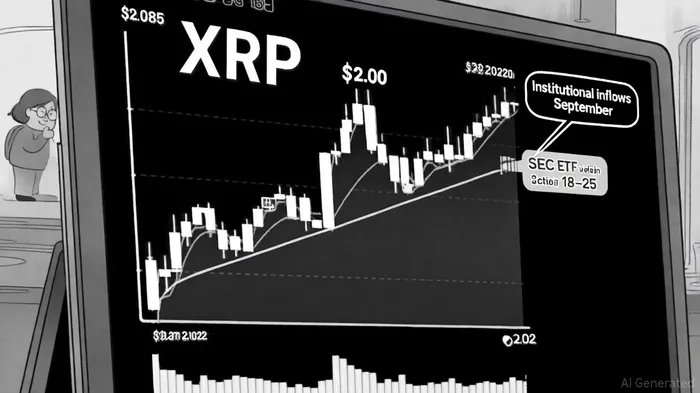
XRP's price action in late 2025 has been a rollercoaster. After reaching an all-time high of $3.66 in July 2025[1], the asset entered a descending wedge pattern, consolidating between $2.80 and $3.02[3]. This technical setup, often seen as a precursor to a bullish breakout, has drawn attention as the price tests key resistance levels. However, recent volatility-marked by a 78% crash in early October 2025[4]-has raised concerns about capital flight. The sharp drop, which erased $19.6 billion in positions within hours, mirrors historical corrections like the 2017 and 2021 bear markets[4].
Historical data reveals that XRP's price-breaks above its 30-day resistance level have yielded positive returns in the short term. Since 2022, such breakouts have occurred approximately 50 times, with an average 5-day excess return of +6.6% and a 10-day return of +10%[1]. The win rate peaks at 58% on day 5, remaining above 50% until day 15, after which momentum fades. This suggests that while resistance-level breakouts historically offer a short-term edge, their effectiveness diminishes beyond two weeks, with returns flattening and win rates dropping below 50% after day 20[1].
On-Chain Activity: Undervaluation or Liquidity Risk?
On-chain metrics paint a nuanced picture. The Network Value to Transaction (NVT) ratio for XRP has plummeted to 108.56[1], suggesting the asset is undervalued relative to its growing transaction volume. This divergence often precedes price recoveries, as seen in Bitcoin's 2019 rebound. However, a low NVT can also signal weak demand if transaction activity fails to translate into price appreciation. Meanwhile, over 439 million XRP ($1.2 billion) was withdrawn from exchanges in late September 2025[1], a move typically associated with long-term holding strategies. This "whale accumulation" phase, combined with institutional inflows of $210 million in September[1], indicates confidence in XRP's utility, particularly in cross-border payments.
Whale Behavior and Institutional Inflows: A Double-Edged Sword
Ripple's XRP is dominated by institutional players, with 43.4% of the circulating supply held in large wallets[3]. These entities, including Ripple itself (which controls ~42% through escrow[3]), act as both stabilizers and potential triggers for volatility. The recent $210 million inflow into XRP, despite market turbulence, underscores institutional conviction[1]. However, the same concentration of holdings poses risks: a single large sell order could exacerbate price swings. This dynamic is amplified by the SEC's pending XRP ETF decisions (October 18–25, 2025[2]), which could unlock billions in capital if approved. Analysts project price targets of $3.66–$5[2], but such optimism hinges on regulatory clarity.
Regulatory Uncertainty and Market Sentiment
The SEC's role in XRP's trajectory cannot be overstated. While seven ETF applications are under review[2], the agency's historical stance on crypto assets has created a climate of uncertainty. For example, the 2021 lawsuit against Ripple caused a 77% price drop[4], illustrating how regulatory actions can override technical and on-chain signals. In 2025, however, XRP's institutional adoption-bolstered by partnerships with asset managers and the launch of Ripple's RLUSD stablecoin[4]-suggests a maturing ecosystem. This shift may insulate XRP from past regulatory shocks, but the October ETF decision remains a binary event that could redefine market sentiment.
Conclusion: Navigating the Crossroads of Opportunity and Risk
XRP's market dynamics reflect a crossroads. On one hand, on-chain metrics and institutional inflows signal undervaluation and long-term utility. On the other, the asset's susceptibility to regulatory decisions and whale-driven volatility highlights inherent risks. For investors, the key lies in monitoring three factors:
1. ETF approvals (October 18–25): A green light could trigger a $3.66–$5 rally[2].
2. NVT ratio trends: A sustained drop below 100 may confirm undervaluation[1].
3. Whale activity: Large withdrawals or deposits could foreshadow capital flight or accumulation[3].
As XRP approaches its October 2025 inflection point, the interplay between technical strength, institutional demand, and regulatory outcomes will determine whether this is a prelude to a new bull market or a cautionary tale of crypto's fragility.






Comentarios
Aún no hay comentarios