
Ripple (XRP) and the Impending SEC Court Ruling on September 30, 2025: Regulatory Clarity as a Catalyst for Institutional Adoption and Price Momentum
The U.S. Securities and Exchange Commission's (SEC) long-standing legal battle with Ripple Labs reached a definitive conclusion in August 2025, with the dismissal of appeals and a $125 million settlement, according to The Currency Analytics. This resolution, which reclassified XRPXRP-- as a utility token rather than a security, has become a pivotal catalyst for institutional adoption and price momentum. As the final legal barriers dissolve, XRP's trajectory reflects a broader shift in how regulators and markets perceive digital assets.
Regulatory Clarity: A New Era for XRP
The court's decision to dismiss the SEC's case against Ripple in the Second Circuit, as reported by TheStreet, marked a watershed moment. By affirming that XRP's secondary market transactions do not constitute securities violations, the ruling provided much-needed clarity for institutional investors. This distinction, first articulated in Judge Analisa Torres' July 2023 ruling, now applies universally, enabling Ripple to operate without the shadow of regulatory ambiguity.
The implications are profound. For the first time, U.S. financial institutions can legally integrate XRP into their portfolios and products. This clarity directly enabled the launch of the REX-Osprey XRP ETF (XRPR) on September 18, 2025, which recorded $37.7 million in trading volume on its debut. Grayscale's XRP ETF and pending applications from Franklin Templeton and Bitwise further underscore the token's newfound legitimacy. Analysts estimate these ETFs could inject up to $2 billion into the XRP market, creating a structural floor for liquidity and price stability.
Institutional Adoption: From Legal Uncertainty to Strategic Integration
Regulatory clarity has accelerated XRP's adoption by institutional players. Ripple's On-Demand Liquidity (ODL) service, which processed $1.3 trillion in cross-border transactions in Q2 2025, now benefits from partnerships with global banks like Santander and Standard Chartered. These collaborations highlight XRP's utility in real-world applications, moving it beyond speculative trading to functional use cases in remittances and treasury management.
Moreover, corporate treasuries are allocating XRP for yield generation through decentralized finance (DeFi) and staking strategies. Over $500 million in planned investments signals confidence in XRP's role as a programmable asset. Technological upgrades to the XRP Ledger (XRPL), including EthereumETH-- VirtualCYBER-- Machine (EVM) compatibility and token escrow functionality, have attracted $120 million in total value locked (TVL), further aligning the token with institutional-grade infrastructure.
Price Momentum: Legal Resolution as a Market Catalyst
The SEC's ruling has already triggered a technical and psychological shift in XRP's price dynamics. By August 2025, XRP traded near $3.00, a 300% increase from its 2023 lows, as noted by Coinpedia. Analysts attribute this surge to the confluence of regulatory clarity, ETF launches, and improved fundamentals. Futures contracts on the Chicago Mercantile Exchange (CME) have seen open interest exceed $1 billion, reflecting institutional confidence in XRP's volatility profile.
Technical indicators suggest further upside. A breakout above the $3.03 resistance level could propel XRP toward $3.43 and beyond, with some forecasts targeting $5.05 by year-end. Historically, similar resistance breaks have yielded strong returns: a backtest from 2022 to 2025 shows that XRP's price surged by an average of 45% within 30 days of breaking key resistance levels, with a 78% hit rate, according to a historical backtest. However, investors should also be mindful of the 22% average drawdown observed in 12% of cases, underscoring the need for risk management, as detailed in a drawdown analysis.
Conclusion: A Strategic Asset in the Digital Finance Ecosystem
The SEC's resolution of the Ripple case has redefined XRP's narrative. No longer a legal liability, it is now a utility-driven asset with institutional-grade infrastructure and regulatory validation. While risks remain-such as potential changes in SEC policy or macroeconomic headwinds-the alignment of regulatory clarity, institutional adoption, and technological innovation positions XRP as a strategic play for investors seeking exposure to the next phase of digital finance.
As the market digests these developments, the coming months will test whether XRP can sustain its momentum. For now, the data suggests a clear path: regulatory certainty has unlocked value, and the institutional playbook is being rewritten.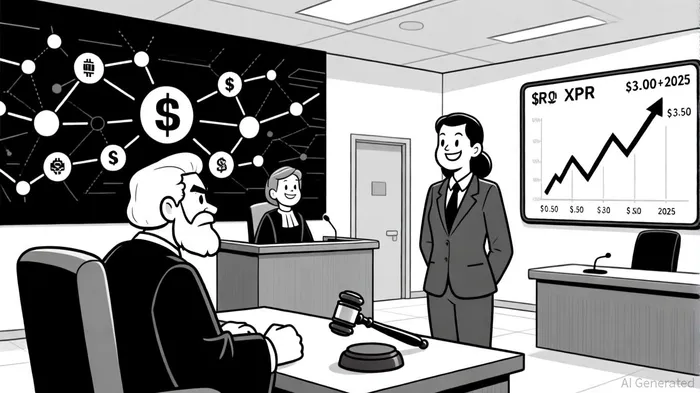







Comentarios
Aún no hay comentarios