
Ripple's XRP Escrow Strategy and Its Implications for Institutional Investors
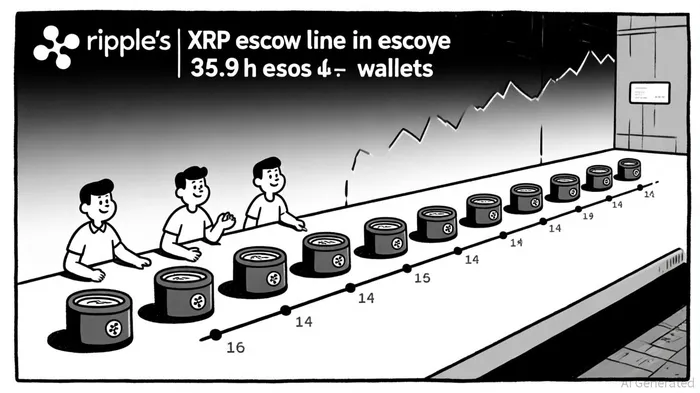
Ripple's XRPXRP-- escrow strategy has long been a focal point for investors and regulators alike. As of July 2025, the company holds 35.9 billion XRP in escrow across 14 wallets, with a structured release mechanism unlocking 1 billion XRP monthly via time-based smart contracts on the XRP Ledger, according to E D Buesing. This system, designed to prevent market flooding and ensure transparency, has evolved into a critical tool for managing regulatory risk and institutional adoption. For institutional investors, the interplay between ownership clarity and regulatory compliance now presents a compelling case for XRP as a utility-driven asset.
Ownership Clarity Through Controlled Supply Management
Ripple's escrow strategy is rooted in a predictable, algorithmic release of tokens. Each month, 1 billion XRP is unlocked, but only 10–300 million is typically used for operational expenses, partnerships, and the On-Demand Liquidity (ODL) network, as The Currency Analytics reports. The remaining 700–900 million is re-locked into new escrow contracts, extending the timeline for the escrow to deplete. This creates a dynamic where the total supply in escrow decreases at a controlled rate, with estimates suggesting a 10-year timeline if 300 million XRP is used monthly, or as short as six years if usage increases annually, as E D Buesing estimates.
This structured approach provides institutional investors with ownership clarity, as the supply dynamics are transparent and governed by deterministic rules enforced by the XRP Ledger's consensus mechanisms, as Ripple's explanation notes. Unlike traditional assets where supply manipulation risks persist, Ripple's escrow system ensures that XRP's circulating supply grows at a predictable pace, reducing uncertainty for long-term investors. According to a report by The Currency Analytics, this predictability has been instrumental in attracting institutional interest, as it aligns with risk management frameworks that prioritize transparency and auditability.
Regulatory Risk Mitigation Post-SEC Settlement
The August 2025 settlement with the U.S. Securities and Exchange Commission (SEC) marked a turning point for XRP. By clarifying that XRP is a non-security in secondary market transactions, the ruling removed prior compliance barriers and enabled Ripple to resume institutional sales of the token, per a CoinPulseHQ analysis. This regulatory clarity has been a game-changer for institutional investors, who previously hesitated to engage with XRP due to litigation risks.
Data from Elevenews indicates that Ripple's treasury began monetizing its accumulated 35.3 billion XRP backlog post-settlement, with sales often timed to coincide with price rallies to minimize volatility, a pattern E D Buesing also documents. These strategic sales, which account for less than 1% of XRP's average daily trading volume, have been designed to avoid market disruption while optimizing liquidity, as The Currency Analytics describes. For institutional investors, this signals a shift from speculative trading dynamics to a more stable, utility-driven model. As noted by Ripple's CTO David Schwartz, the post-settlement environment has fostered a "new era of institutional confidence" in XRP's role in cross-border payments, a point highlighted in the CoinPulseHQ analysis.
Implications for Institutional Investors
The combination of ownership clarity and regulatory risk mitigation positions XRP as a unique asset class for institutional portfolios. Key implications include:
- Reduced Counterparty Risk: The escrow system's transparency ensures that Ripple's ownership of XRP is clearly defined, with no hidden reserves or unregulated distributions. This aligns with institutional requirements for asset traceability.
- Utility-Driven Demand: XRP's use in Ripple's ODL network-facilitating fiat-to-XRP conversions for cross-border transactions-creates a recurring demand that is less susceptible to speculative cycles, as Elevenews reports. Partnerships with institutions like BNY Mellon further validate its utility.
- Regulatory Tailwinds: The SEC settlement has normalized XRP's status in secondary markets, reducing the likelihood of future legal challenges. This stability is critical for institutions navigating compliance-heavy environments.
Conclusion
Ripple's XRP escrow strategy exemplifies how blockchain-based governance can align with institutional investor needs. By combining algorithmic supply control with regulatory compliance, the company has transformed XRP from a contested asset into a stable, utility-driven tool for global payments. For institutional investors, the post-2025 landscape offers a compelling opportunity to engage with a token that balances innovation with risk mitigation-a rare combination in the volatile crypto market.






Comentarios
Aún no hay comentarios