
Ripple's Strategic Shift: Can Reduced XRP Sales Catalyze a New Bull Case?
Ripple's evolving revenue model has sparked renewed interest in XRPXRP-- as an investment thesis, particularly for institutional players seeking de-risked exposure to crypto. By shifting away from XRP sales and embracing diversified income streams-such as enterprise services and the RLUSD stablecoin-the company is addressing long-standing concerns about token sell pressure and regulatory uncertainty. This strategic pivot, combined with favorable market dynamics and legal clarity, could position XRP as a more institutional-grade asset.
1. Diversifying Revenue: A Structural Shift
Ripple's traditional reliance on XRP sales to fund operations has been a double-edged sword. While the token provided liquidity, it also created volatility and regulatory scrutiny. In 2023, the company began pivoting toward enterprise services and stablecoin infrastructure to reduce this dependency. According to Ripple's CTO David Schwartz, these new revenue streams "ease the pressure to sell XRP, especially during market downturns."
Key developments include:
- Enterprise Services: Ripple expanded its cross-border payment solutions, targeting financial institutions with its RippleNet infrastructure. This generates recurring revenue through software licensing and transaction fees according to Ripple's Q4 2024 report.
- RLUSD Stablecoin: Launched in late 2024, RLUSD-a U.S. dollar-backed stablecoin-has grown to a $1.26 billion market cap, becoming the third-largest U.S.-regulated stablecoin as reported by Yahoo Finance. Its dual-chain architecture (XRP Ledger and Ethereum) enables fast cross-border payments and DeFi integration according to the same report.
This diversification is critical. By reducing XRP sales, Ripple minimizes the perception of market manipulation, a concern that historically deterred institutional adoption. As of Q4 2023, XRP trading volume surged 75-100% quarter-on-quarter, reaching $600 million daily, signaling renewed confidence.
2. Legal Clarity and Regulatory Compliance
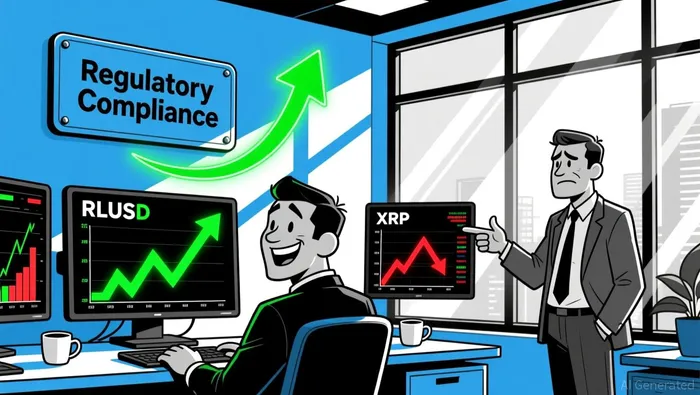
The July 2023 SEC ruling, which deemed most XRP sales non-securities, was a watershed moment. This legal victory removed a major overhang, allowing institutions to engage with XRP without regulatory risk according to Ripple's analysis. Additionally, Ripple's compliance-focused approach-such as its transparent escrow mechanism (releasing 1 billion XRP monthly while relocking most of it)-has enhanced predictability for investors as noted by financial analysts.
Regulatory progress extended beyond the U.S. Ripple secured a Major Payments Institution license in Singapore and a virtual asset service provider registration in Ireland according to Ripple's Q4 2023 report, further solidifying its global footprint. These milestones align with the company's goal to operate within a "compliant, institutional-grade framework" as reported by PMin Insights.
3. Institutional Adoption via RLUSD
RLUSD has emerged as a linchpin for Ripple's institutional strategy. By partnering with entities like Mastercard, WebBank, and Gemini, Ripple is integrating RLUSD into real-world financial applications, such as credit card settlements as reported by Yahoo Finance. This use case demonstrates the stablecoin's utility beyond speculative trading, appealing to risk-averse investors.
Moreover, RLUSD's transactions on the XRP Ledger burn XRP as network fees, creating a deflationary effect. This mechanism ties stablecoin growth to XRP's supply dynamics, potentially enhancing its value proposition according to the same source. For institutions, this means XRP is no longer just a speculative asset but a utility token embedded in a growing financial infrastructure.
4. Market Dynamics and Price Implications
While XRP's price remains volatile, the fundamentals are improving. In Q4 2023, the token traded above $0.60, though it dipped to $0.52 by early 2024 according to Cryptorank. However, the surge in trading volume-driven by legal clarity and institutional interest-suggests a shift in sentiment. Analysts note historical patterns where XRP's price surges follow regulatory milestones.
The XRP Ledger's transaction volume also grew by 22.7% quarter-on-quarter in Q4 2023, partly due to inscriptions-related activity according to Ambcrypto analysis. This indicates broader adoption beyond Ripple's core use cases, further de-risking the asset.
5. Risks and Considerations
Despite these positives, challenges remain. XRP's price is still correlated with broader crypto market cycles, and regulatory scrutiny in other jurisdictions could resurface. Additionally, while RLUSD's growth is impressive, it lags behind Circle's USDCUSDC-- ($61.7 billion market cap) according to Connecting the Dots, limiting its immediate impact.
Conclusion: A Bull Case for XRP?
Ripple's strategic shift-from XRP-centric sales to diversified revenue and institutional-grade infrastructure-addresses key risks for investors. By reducing token sell pressure, enhancing regulatory clarity, and building utility through RLUSD, the company is laying the groundwork for XRP to be viewed as a more stable, institutional-friendly asset.
For investors, the question is no longer whether XRP can survive regulatory scrutiny but whether it can capitalize on its unique position in the cross-border payments and stablecoin ecosystems. If Ripple continues to execute its vision, XRP may yet see a parabolic move, driven by institutional adoption and a maturing market.





Comentarios
Aún no hay comentarios