
Ripple's Strategic Shift to Luxembourg and Its Implications for RLUSD and XRP
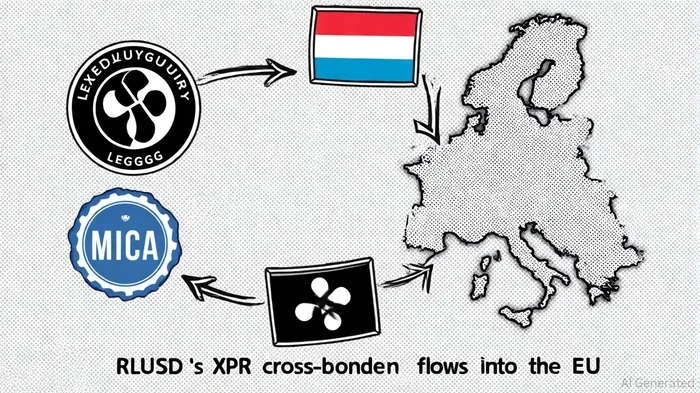
In the ever-evolving landscape of digital finance, regulatory alignment has become a critical determinant of institutional adoption and asset growth. Ripple's recent strategic relocation to Luxembourg underscores this reality, positioning the company to leverage the European Union's Markets in Crypto-Assets (MiCA) framework as a catalyst for expanding its stablecoin (RLUSD) and native token (XRP) into institutional markets. By securing a regulatory foothold in Luxembourg-a jurisdiction increasingly seen as the EU's crypto capital-Ripple is not only navigating compliance but actively shaping the future of cross-border payments and stablecoin infrastructure.
Luxembourg: A Regulatory Powerhouse for Crypto Innovation
Luxembourg's regulatory environment has emerged as a gold standard for crypto firms seeking EU-wide scalability. The country's Law of 6 February 2025 fully integrates MiCA, granting the Commission de Surveillance du Secteur Financier (CSSF) sweeping authority to license and supervise crypto-asset service providers (CASPs) and electronic money institutions (EMIs), as explained in Luxembourg's new law. This framework allows firms like Ripple to obtain a single EMI license and "passport" their services across all 30 European Economic Area (EEA) countries, bypassing the need for fragmented national approvals, according to CoinCentral.
Ripple's decision to register Ripple Payments Europe S.A. in Luxembourg in April 2025 was no accident. The country's robust anti-money laundering (AML) and counter-terrorist financing (CFT) measures, combined with its proactive fintech ecosystem, make it an ideal base for launching MiCA-compliant products, as Goodwin Law notes. Notably, Ripple is now competing with industry giants like Coinbase and Bitstamp, which have also secured EMI licenses in Luxembourg, to dominate the EU's $1.2 trillion stablecoin market, according to Coinotag.
Regulatory Compliance as a Catalyst for Institutional Adoption
The institutional-grade appeal of Ripple's RLUSD and XRPXRP-- hinges on its ability to meet MiCA's stringent requirements. By aligning with the EU's harmonized regulatory standards, Ripple has positioned RLUSD to fill a critical void left by Tether's (USDT) delisting in Europe due to non-compliance. Since its launch in December 2024, RLUSD has already processed over 33,953 transactions on the XRP Ledger and 1,690 on EthereumETH--, with daily trading volumes nearing $94 million, according to CryptoPotato. This growth is further amplified by partnerships with exchanges like Uphold, Bitstamp, and Bullish, which now list XRP/RLUSD trading pairs, as reported by CoinMarketCal.
For XRP, the June 2025 U.S. SEC ruling affirming that XRP is not a security in open-market transactions has been a game-changer. This legal clarity, combined with MiCA compliance in the EU, has enabled major U.S. banks to explore XRP for treasury operations, as described in Apex 2025. Ripple's recent integration of an Ethereum Virtual Machine (EVM) sidechain and protocol-native oracles has also enhanced the XRP Ledger's utility for institutional DeFi applications, including tokenized loans and automated market makers (AMMs), as explained in Institutional DeFi.
Strategic Partnerships and Cross-Border Utility
Ripple's institutional momentum is further fueled by strategic alliances. The company's collaboration with Ondo Finance allows tokenized U.S. Treasuries (OUSG) to be minted and redeemed via RLUSD, while its partnership with Guggenheim Treasury Services introduced digital commercial paper (DCP) rated Prime-1 by Moody's, as reported by Bitget. These innovations highlight the XRP Ledger's role as a scalable infrastructure for real-world assets (RWAs), a sector projected to grow to $16 trillion by 2030.
Geographically, Ripple's cross-border corridors-such as its pilot with Bahrain Fintech Bay-are expanding RLUSD's utility in the Gulf, where demand for stablecoins is surging due to regulatory sandboxes and dollarization trends, according to Ledger Insights. Meanwhile, the acquisition of Rail has bolstered Ripple's stablecoin issuance and settlement capabilities, reinforcing its position as a global payments infrastructure provider.
The Road Ahead: Regulatory Advantage as a Competitive Edge
Ripple's Luxembourg strategy is a masterclass in regulatory arbitrage. By securing an EMI license, the company gains not only passporting rights but also credibility with institutional investors who prioritize compliance. This is particularly relevant as the EU's MiCA framework phases out legacy Virtual Asset Service Provider (VASP) regimes by July 2026, creating a window for compliant players to dominate the market, as Deloitte anticipates.
For XRP, the convergence of U.S. and EU regulatory clarity-coupled with its role in facilitating RLUSD's cross-border utility-positions it as a hybrid asset bridging traditional finance and decentralized infrastructure. As institutional demand for tokenized assets and stablecoin-backed settlements grows, Ripple's dual focus on compliance and innovation could drive both RLUSD's market share and XRP's utility to new heights.
Conclusion
Ripple's relocation to Luxembourg is more than a regulatory checkbox-it's a strategic pivot to capture the EU's $1.2 trillion stablecoin market and institutionalize XRP as a cross-border settlement asset. By aligning with MiCA's rigorous standards, Ripple is not only mitigating legal risks but also building a moat around its financial infrastructure. For investors, this represents a compelling case study in how regulatory foresight can catalyze asset growth in an increasingly fragmented crypto landscape.






Comentarios
Aún no hay comentarios