
Ripple's Strategic Resilience and XRP's Market Potential Post-CTO Exit: Navigating Leadership Transitions in Crypto
Leadership transitions in crypto firms often send shockwaves through markets, testing the resilience of projects and their communities. Ripple's recent CTO exit-David Schwartz stepping down after 13 years to become CTO Emeritus-has sparked both skepticism and optimism. This analysis unpacks how Ripple's strategic continuity, institutional adoption, and regulatory clarity are shaping XRP's trajectory, while dissecting the broader implications of leadership shifts in the crypto sector.
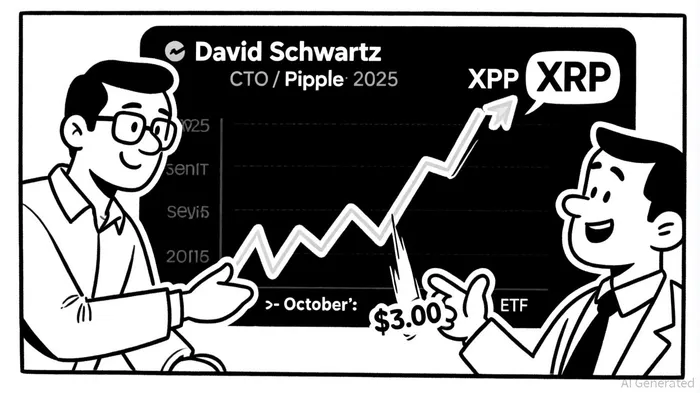
Leadership Transition: Continuity Amid Change
David Schwartz's departure from day-to-day operations marks the end of an era for Ripple. As CTO, he was instrumental in developing the XRPXRP-- Ledger (XRPL) and its applications in cross-border payments. His transition to a strategic advisory role and board membership ensures his technical expertise remains embedded in Ripple's DNA, according to CoinDesk. Dennis Jarosch, the new leader of technical operations, inherits a matured infrastructure, including SWIFT integration via the Interledger Protocol (ILP), which positions XRP as a bridge between blockchain and traditional finance, per Yahoo Finance.
Critics initially feared a leadership vacuum, but Ripple CEO Brad Garlinghouse swiftly quelled concerns by emphasizing Schwartz's ongoing influence through weekly check-ins and board participation, as reported by CoinEdition. This calculated handover reflects Ripple's commitment to maintaining institutional trust-a critical asset in a sector where governance stability often trumps individual charisma.
Market Reactions: Volatility and Catalysts
XRP's price initially dipped post-announcement but rebounded sharply, surpassing $3.00 in October 2025. This rally was fueled by three key catalysts:
1. Institutional Adoption: Companies like VivoPower shifted treasuries to XRP, leveraging its low-cost, high-speed settlement capabilities, according to XRPRightNow.
2. ETF Optimism: Seven U.S. spot XRP ETF applications loom, with the REX-Osprey ETF already recording $37.7 million in first-day trading volume, per Markets.
3. Regulatory Clarity: The SEC's no-action letter permitting custodians to hold XRP for institutional clients removed a major legal barrier.
Analysts like Kenny Nguyen argue that these factors create a "perfect storm" for XRP, with price targets ranging from $22 to $50 by 2026, according to CoinGape. However, bearish voices caution against overreliance on ETF approvals, noting that SWIFT's blockchain initiatives and stablecoin competition could dilute XRP's market share, warns Coin-Views.
Ripple's Roadmap: Beyond the CTO Exit
Ripple's 2025-2026 roadmap underscores its pivot toward institutional DeFi and global financial infrastructure. Key initiatives include:
- RLUSD Expansion: The XRP-backed stablecoin now boasts a $789 million market cap, with partnerships in African remittances and U.S. institutional lending, per AMBCrypto.
- Quantum-Resistant Cryptography: Long-term research into securing the XRPL against future threats is outlined in the NextSprints guide.
- CBDC Sandboxes: Collaborations with central banks to testTST-- XRP-based solutions for digital currencies are underway, notes Currency Analytics.
These moves align with broader industry trends. As Grayscale Research notes, crypto firms prioritizing real-world utility-rather than speculative hype-are outperforming peers in 2025's maturing market. Ripple's focus on interoperability (e.g., ISO 20022 compliance) further cements its role as a bridge between legacy systems and blockchain innovation.
Long-Term Outlook: Risks and Rewards
While XRP's fundamentals are robust, risks persist. A breakdown below $2.75 could trigger a sell-off if ETF approvals falter, while macroeconomic headwinds (e.g., interest rate hikes) may dampen risk-on sentiment, according to CoinPedia. Conversely, a successful ETF rollout could unlock billions in institutional capital, propelling XRP toward $10+ by 2026 - a scenario some commentators at Coin-Views have explored.
The XRP community's reaction to Schwartz's exit also highlights a broader truth: crypto markets value vision as much as execution. Ripple's ability to innovate beyond XRP-such as its EVM Sidechain attracting 1,400 smart contracts in its first week-demonstrates a diversified ecosystem less reliant on any single leader, per analysis from FXEmpire.
Conclusion
Ripple's CTO transition is a case study in strategic resilience. By retaining Schwartz's strategic input while empowering new leadership, the company has mitigated short-term volatility and reinforced long-term credibility. For XRP, the path forward hinges on regulatory milestones, institutional adoption, and the execution of its cross-border payment vision. As the crypto sector matures, Ripple's blend of technical rigor and institutional pragmatism positions it as a formidable player in the race to redefine global finance.






Comentarios
Aún no hay comentarios