
Ripple's Strategic Regulatory Wins Position XRP for Long-Term Institutional Growth
In the ever-evolving landscape of digital assets, regulatory clarity has emerged as a critical catalyst for institutional adoption. Ripple, the blockchain payment solutions provider, has positioned itself at the forefront of this shift through a series of strategic regulatory victories in 2025. From securing approval from the UK's Financial Conduct Authority (FCA) to expanding its stablecoin infrastructure in the Middle East, Ripple's moves are not only reshaping the narrative around XRPXRP-- but also laying the groundwork for XRP to become a foundational asset in regulated digital payments infrastructure.
FCA Approval and EMI License: A UK Powerhouse for Institutional Adoption
Ripple's UK subsidiary, Ripple Markets UK Ltd, recently secured a landmark regulatory approval from the FCA, including a Cryptoasset Registration and an Electronic Money Institution (EMI) license according to reports. This dual authorization allows Ripple to offer cross-border payment services and e-money solutions to institutional clients in the UK, a market known for its stringent compliance standards. The approval is particularly significant given that nearly 90% of crypto firms attempting to register with the FCA have failed, underscoring the rigor of the process and Ripple's commitment to compliance.
The UK's planned 2027 digital asset framework further amplifies the importance of this win. Ripple's proactive alignment with regulatory expectations-such as adhering to Money Laundering Regulations-positions it to navigate the upcoming transition to a more robust licensing regime under the Financial Services and Markets Act. By operating within a regulated framework, Ripple is not only mitigating risks for institutional clients but also signaling to the market that XRP can coexist with traditional financial systems.
BNY Mellon Partnership and RLUSD: Bridging Traditional and Digital Finance
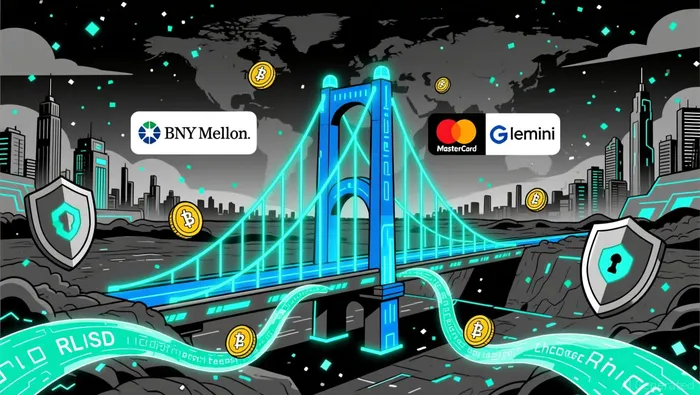
Ripple's collaboration with BNY Mellon, one of the world's oldest and most trusted financial institutions, has been a game-changer. The partnership led to the launch of Ripple USD (RLUSD), a U.S. dollar-backed stablecoin operating under New York's Trust license. RLUSD is now being integrated into high-profile initiatives, including the Evernorth-Doppler liquidity partnership and potential credit card settlement pilots with Mastercard and Gemini as reported. These developments highlight RLUSD's role as a compliant, liquid asset for institutional use cases, from collateral management to cross-border settlements.
Moreover, RLUSD's deployment on both blockchains underscores Ripple's cross-chain utility and its ability to cater to diverse institutional needs. By anchoring stablecoin issuance to XRP's infrastructure, Ripple is effectively expanding the token's utility beyond its native use case, creating a flywheel effect that could drive demand for XRP in the long term.
Abu Dhabi Expansion: A Strategic Move in the Middle East
Ripple's regulatory breakthroughs in the Middle East, particularly in Abu Dhabi, further solidify its institutional appeal. In 2025, the Abu Dhabi Global Market (ADGM) recognized RLUSD as an "Accepted Fiat-Referenced Token," enabling its use in collateral management, lending, and international transactions by licensed firms according to Ripple's announcement. This endorsement by the Abu Dhabi Financial Services Regulatory Authority (FSRA) aligns with the UAE's broader push to become a global hub for digital finance.
The UAE's regulatory environment, characterized by progressive frameworks like ADGM's, has attracted institutional players seeking innovation within compliance. Ripple's RLUSD, with a market capitalization exceeding $1.2 billion, is now a key player in this ecosystem. Additionally, the approval of an XRP ETF in May 2025 marks a milestone in institutional confidence, as it provides a regulated vehicle for institutional investors to gain exposure to XRP without navigating the complexities of direct custody.
The Long-Term Implications for XRP
While XRP's price reaction to these developments has been muted- rising just 0.7% following the FCA announcement-the long-term implications are far more profound. Ripple's regulatory momentum is creating a flywheel effect: compliance-driven partnerships, stablecoin adoption, and cross-border utility are converging to position XRP as a backbone for institutional-grade blockchain finance.
For forward-looking investors, the key takeaway is clear: Ripple is not merely a crypto project but a regulated infrastructure provider with a roadmap to integrate digital assets into the traditional financial system. As the UK, UAE, and other markets continue to refine their digital asset frameworks, XRP's role in cross-border payments, stablecoin settlements, and tokenized treasuries will likely become increasingly indispensable.
Conclusion
Ripple's strategic regulatory wins in 2025-spanning the UK, New York, and the Middle East-demonstrate a deliberate, multi-jurisdictional approach to institutional adoption. By securing FCA approval, partnering with BNY Mellon, and expanding RLUSD's utility in the UAE, Ripple is transforming XRP from a speculative asset into a foundational component of regulated digital payments infrastructure. For investors, this represents a compelling opportunity to bet on a token that is not only surviving the regulatory scrutiny of 2025 but thriving within it.






Comentarios
Aún no hay comentarios